
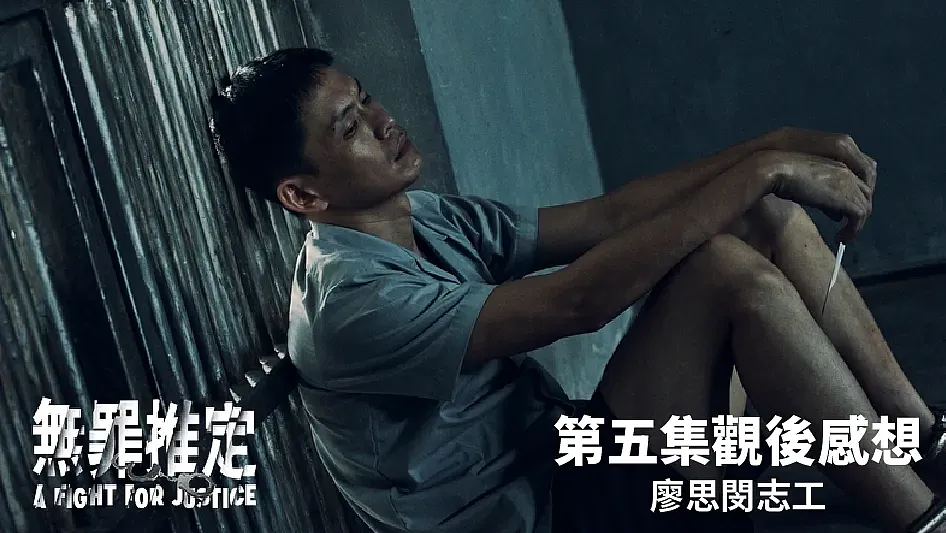
Review | "Innocence" Episode 5
Last edited: 2026-07-27
Although I promised the JRF to write a review, I must honestly admit I hadn't watched the first three episodes until tonight, when I binged two episodes in a row on PTS Taigi. Even though I missed the earlier episodes, as soon as I started watching, I could roughly tell which trial stage it was adapted from and who the character prototypes were, allowing me to guess what plots would unfold—which slightly robbed me of the joy of being a regular viewer XD
Episode 5 is mainly adapted from the trial proceedings and case developments of the Hsu Tzu-chiang (徐自強) case, transitioning from the sixth retrial to the seventh retrial. Although the case had already reached the ninth retrial when I served as a volunteer at the JRF, I had heard about classic scenes that appeared in earlier trial stages, such as the prosecutor's closing argument involving tearing up paper bridges, which was quite faithfully portrayed in the drama. I still remember how surprised I was when lawyers and JRF executive secretaries talked about this incident back then. It is hard to imagine that in a Taiwanese courtroom, a prosecutor would pick up a piece of paper with the character for "greed" (貪) written on it, say that the case was entirely due to the defendant's greed, and then tear the paper into pieces and scatter them toward the public gallery. Although I was a law student who hadn't witnessed many court sessions back then, in my limited courtroom experience, public prosecutors usually stated during closing arguments that the facts were as stated in the indictment, and prosecutors who said a bit more would usually just summarize the indictment's contents. In Taiwanese courtrooms, it was unheard of for a prosecutor to perform such a paper-tearing stunt and scatter the fragments into the public gallery. After all, back then the citizen judge system had not yet been implemented, and the only person the prosecutor had to convince was a judge who had already reviewed the case files. Intense back-and-forth clashes and relatively passionate expressions usually only occurred during the witness cross-examination stage. This became one of my most memorable fragments of the trials in the Hsu case.
Another deeply moving segment was the court case assignment. Seeing the reactions of the three lawyers in the drama upon seeing the judge for the seventh retrial reminded me of a remark made by Yen Hsin-yin (嚴心吟), who served as Hsu Tzu-chiang's lawyer, in a speech. She said, "I hope that one day, when people step into the judiciary, it will no longer be like gambling, and a lawyer's very first task upon taking a case will no longer be asking who the judge is." When I was assisting with the March 318 Movement cases at the JRF back then, the thing lawyers cared about most was which panel division the case was assigned to and who the assigned judge was. At first, I didn't quite understand why lawyers would ask this question first thing, but after observing court a few times and experiencing trials before several different judges, I finally understood why lawyers cared so much about who the judge was. Although judges all go through rigorous screening to sit in that position, every forest has dead branches, and due to everyone's different personalities and life experiences, the judgments they render also differ. A lucky defendant will encounter a serious, open-minded judge and get a chance at a fair trial; a less fortunate defendant may have a judge who couldn't care less about their statement, operates on the presumption of guilt, gives lawyers a hard time, and makes sarcastic remarks. The gap between good and bad is so vast, yet it is all part of the daily routine of the courtroom, and a judge's whim marks the turning point between life and death for a defendant.
Another segment that was faithfully presented yet made me feel slightly disengaged was that the rooftop of the JRF is not nearly that exquisite, though it perfectly restored the fact that everyone goes up there to catch their breath whenever they are in a bad mood. I don't know why, but whenever volunteers had some difficult problems or the staff felt a bit frustrated and discouraged, everyone would always walk up to the rooftop in twos and threes, breathe, chat, gaze into the distance, or zone out, and then walk back downstairs to keep worrying and keep moving forward.
Although I only watched 2 episodes, I can tell that this drama is meticulously researched and faithfully presents many courtroom daily routines. I am very glad that Taiwan has such a legal drama that reflects the current reality of Taiwanese courtrooms and is adapted from real cases. What is even more astonishing is that it is entirely in Taiwanese Hokkien. I am super impressed that the production crew could present such esoteric legal terminology in Taiwanese Hokkien. I highly recommend everyone to follow this drama. After all, Taiwan has now implemented the citizen judge system. Aside from legal practitioners or those who have studied law, everyone has the opportunity to serve as a citizen judge and become a key figure in determining whether a defendant is guilty or not. Through this drama, perhaps people can slightly feel the weight and impact of a case, and when they see news of major criminal cases in the future, they can recall the reflections brought by this show.
This article is an AI-generated translation of the original Chinese text. In the event of any discrepancy, the Chinese version shall prevail.