
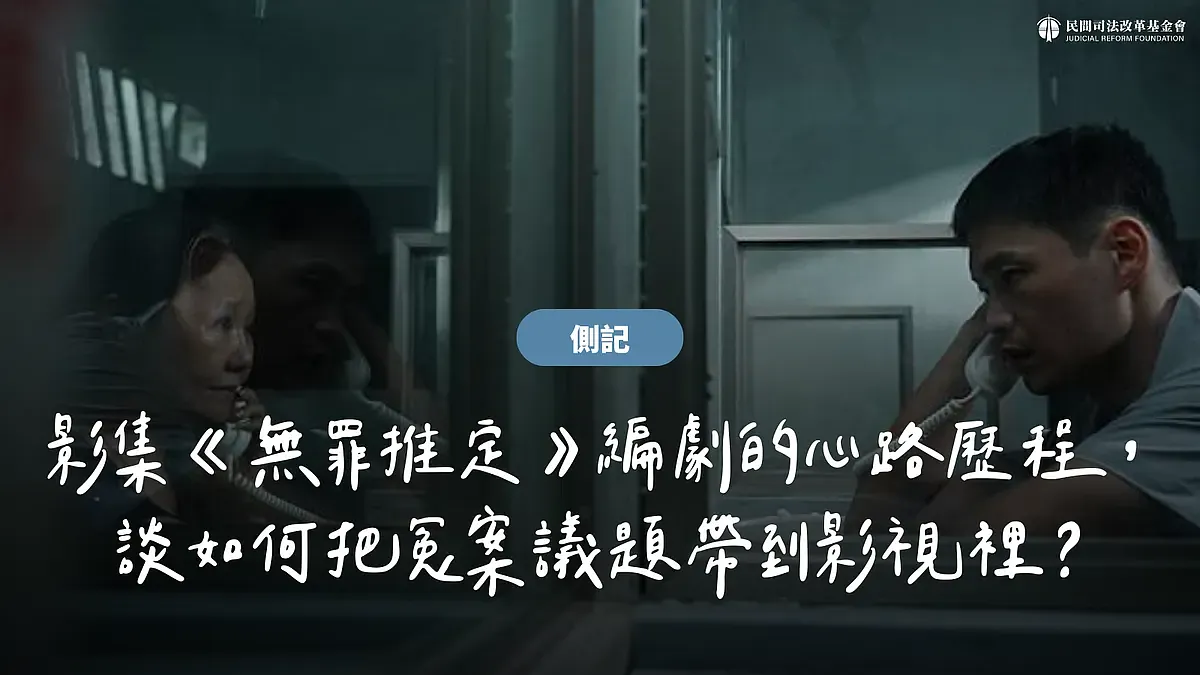
Sidelights | The Screenwriter's Journey for the TV Series *Innocence*: Bringing Wrongful Conviction Issues to the Screen
Last edited: 2026-11-04
Can you imagine being forced to stay in prison for 16 consecutive years, with 4 of those years confined to a room measuring just 1.368 pings? Can you imagine having to drag 2-kilogram leg irons every day for 10 years, solely for a crime you never committed? These absurd and human rights-defying descriptions actually played out in Taiwanese society during the 1980s and 1990s, and they reflect the life of Hsu Tzu-chiang, the archetype for the drama's protagonist, Yang Ming-te.
Sixteen Years Brought to a Standstill
In 1995, Hsu Tzu-chiang took over his mother-in-law's small betel nut stand to prepare for his child entering elementary school. Everything seemed ordinary, but two months later, he was unexpectedly embroiled in a kidnapping and murder case. From that moment on, his life was turned upside down.
The entire case relied solely on the testimony of two co-defendants to implicate Hsu Tzu-chiang. Later, because both perpetrators were sentenced to death, Hsu feared that once they were executed, there would be no way to prove his innocence, believing that since he had done nothing wrong, he should not be wronged. Driven by these factors, Hsu chose to turn himself in accompanied by a lawyer. However, what greeted him was not judicial justice and clarity, but endless court hearings, death sentences, waiting, and much more helplessness.
Creative Philosophy
Today, many people still believe that whatever subject one studies, one should pursue a corresponding career. For the three speakers, however, this is not necessarily the case; instead, they emphasized that applying what one learns in practice is what truly matters. At the very beginning of the seminar, the two screenwriters and the moderator all mentioned that they came from a legal background. Screenwriter Pei-yu further noted that she was actually a dabbler in the law.正是因為她的特殊身分 (It is precisely because of her unique background that she could empathize with the feelings of those unfamiliar with the law and better appreciate the importance of being well-versed in legal knowledge. Thus, she decided to use drama as a medium because drama strives to be accessible to everyone while maintaining entertainment value, which can not only advance judicial reform but also disseminate ideas and concepts to the general public, ultimately leading to the creation of this show.)
However, during the creative process, it was discovered that producing a great work makes it difficult to balance entertainment value and accuracy. For example, there are many court trial and litigation procedures in the series, with judges and defense counsel engaging in sharp verbal sparring. In reality, however, court hearings rarely feature lawyers pacing around the scene. Therefore, to spark public interest and willingness to watch, the creators chose a more dramatic presentation to capture the public eye, rather than the tediousness of the real world.
The series embodies the ideas and reflections that the screenwriters wished to convey to the public. Some say that social progress requires some people to make sacrifices, but why must it be those who are wrongfully imprisoned? Perhaps, like everyone else, they simply wanted to live ordinary and stable lives; should they really have to become the pioneers of revolution? I think the answer is no. Another idea the screenwriters wished to convey is the hope that everyone will take the initiative to explore the law, and that if they encounter difficulties, they will understand how to seek relief, clearly realizing that "the law is not something to be feared, but something to bring stability to society and protect the people of this land."
Presumption of Innocence
"Presumption of innocence" may sound like a very unfamiliar and distant concept to those of us unfamiliar with legal codes, understood only through its literal definition. Yet, the presumption of innocence is fundamentally a spirit, calling upon the court to conduct investigations and preparations across multiple pieces of evidence before rendering judgment. Even if a party involved appears to have conclusive evidence against them, not every case is like this. The presumption of innocence is essentially used to protect everyone on this land, because all wrongful convictions are manufactured. Only by upholding this spirit can tragedies be minimized.
"Most justice is waited for." This is a line from the drama, but it truly depicts the phenomenon of contemporary society. Many defendants in wrongful cases are still trapped in the abyss, waiting for the day their justice arrives. Until then, it is hoped that the general public will pay more attention to this issue, continuing to care, advocate, or promote reform so that these defendants can emerge from the abyss. Leaving the abyss is also the greatest blessing we can offer them.
This article is an AI-generated translation of the original Chinese text. In the event of any discrepancy, the Chinese version shall prevail.