
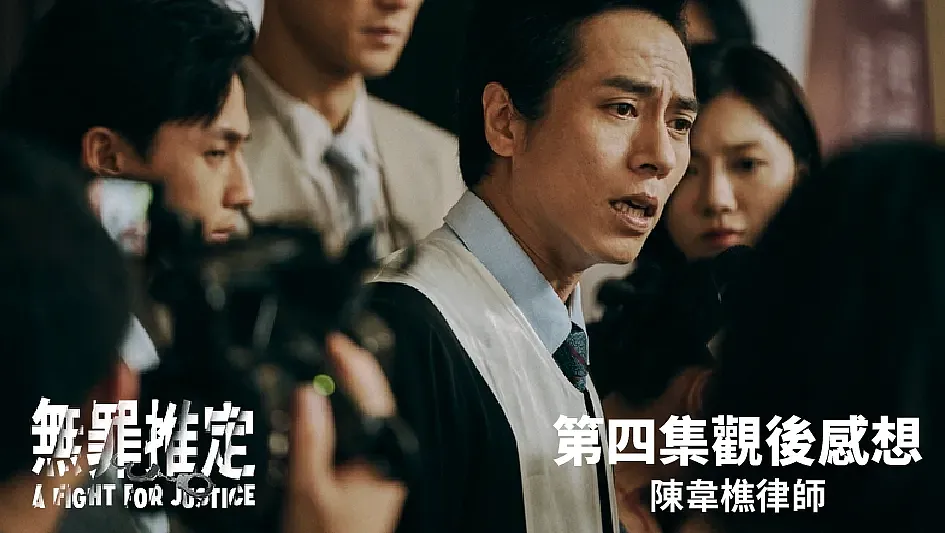
Review | "Innocence" Episode 4
Last edited: 2026-07-27
I. Episode 4 Plot Summary
The plot of Episode 4 primarily focuses on the retrial proceedings of the sixth remand (The Taiwan High Court's 94th Year Re-Shang-Geng-(Liu) No. 90 Criminal Judgment, in which the Taiwan High Court still sentenced Hsu Tzu-chiang to death on December 8, 2009) of the archetype figure Hsu Tzu-chiang.
In the drama, the male lead, attorney Li Cheng-shuo, considering the financial issues of the JRF, suddenly prevents the female lead, attorney Hsu Yen-ching, from continuing to participate in the sixth remand trial proceedings of the wrongful conviction character Yang Ming-de in the drama. Instead, he replaces her with attorney Chang Pin-chia—whose conversation is filled with sexism toward female attorney Hsu Yen-ching, and who, in Episode 3 of "Innocence," during the fifth remand trial of the Yang Ming-de case, gave up halfway and defended Yang perfunctorily just because she found the case troublesome and wanted to take on conglomerate tax cases to gain fame, resulting in the fifth remand also ending in a death sentence. Later, attorney Chang Pin-chia pursues the so-called "human rights lawyer" reputation, intends to run for chairperson of the Taipei Bar Association, and offers a sponsorship to the JRF. Because of this, attorney Li Cheng-shuo lets attorney Chang Pin-chia lead the defense team for the sixth remand of the Yang Ming-de case to continue the defense.
The drama deliberately highlights the displeasure of Presiding Judge Lan I-sen of the Taiwan High Court's sixth remand when he discovers that Yang Ming-de might have the opportunity to present an alibi to prove his innocence. For instance, Presiding Judge Lan I-sen seems displeased when he notices that expert opinions in the Yang Ming-de case regarding whether the victim was actually splashed with sulfuric acid by Yang Ming-de are questioned on suspicious points by Yang's defense counsel, attorney Li Cheng-shuo; Presiding Judge Lan feels relieved when a co-defendant makes testimony unfavorable to Yang Ming-de; and when attorney Li Cheng-shuo cross-examines a Taipei Prison warden trying to ascertain whether the co-defendant had confessed to the Yang Ming-de's mother during a prison visit that he framed Yang Ming-de, Presiding Judge Lan actively strips attorney Li Cheng-shuo of his right to continue cross-examining the witness. Furthermore, while attorney Hsu Yen-ching is burning the midnight oil reviewing case files at the JRF, she discovers that Presiding Judge Lan held a secret, private trial session behind closed doors, contacted the victim's family, and unprecedentedly told them: "I suggest you hire an experienced lawyer instead of relying on the agent of the private prosecutor, otherwise the defendant might be acquitted." This evidently violates Article 15 of the Code of Judicial Ethics, which stipulates that judges must remain neutral and shall not communicate or meet with only one party or their related persons unless there is a special reason. At the end of Episode 4, since attorney Chang Pin-chia does not want to file a motion for recusal of the judge so as not to offend the second-instance judges, attorney Hsu Yen-ching is brought back into the sixth remand defense team for the Yang Ming-de case, and the three of them intend to file a motion for recusal against Presiding Judge Lan, concluding the episode.
II. Misunderstandings and Inaccuracies in Episode 4 That Need Clarification:
Moreover, regarding the legal misunderstandings in the plot, there is a real need for clarification. Given that the "Citizen Judges Act" has been in effect since January 1, 2023, for nearly two years, well over a thousand citizens have entered courts to be screened as citizen judges, and nearly a hundred citizens have actually served as citizen judges, participating with real judges, prosecutors, and attorneys in the joint trial of major homicide cases. Therefore, domestic legal dramas should be closer to reality and pay attention to legal accuracy. If there are too many legal misunderstandings, it becomes difficult for legal professionals to resonate with legal dramas, let alone convince audiences who already have experience with the "Citizen Judges Act."
As someone who has been a special member of the Taipei Bar Association for over five years and has witnessed multiple elections for the chairperson of the Taipei Bar Association, one does not get the impression—as attorney Chang Pin-chia is obsessed with—that one must have the reputation of a so-called "human rights lawyer" to be elected chairperson of the Taipei Bar Association. On the contrary, if someone wants to serve as the chairperson of the Taipei Bar Association, they should be well-versed and show a high level of interest in various active and static clubs within the bar association, exchanges with other professional associations, the Judicial Yuan, the Ministry of Justice, domestic university law schools, domestic judicial reform NGOs, foreign bar associations, foreign university law schools, the implementation of the Citizen Judges Act, legal education, legal popularization, and other judicial reform issues, thereby demonstrating a high degree of interest before they are qualified to be elected chairperson of the Taipei Bar Association. Therefore, the drama's portrayal of attorney Chang Pin-chia—whose concepts of gender equality are severely backward, who violated Article 27 of the Attorney Ethics Norms during the fifth remand of the Yang Ming-de case ("A lawyer handling legal affairs for a client shall strive to enrich the legal knowledge necessary for handling the case and make proper preparations. (Paragraph 1) A lawyer shall, in accordance with laws, regulations, and due process, strive to protect the legitimate rights and interests of the client, shall not delay the handling of entrusted cases without justifiable cause, and shall promptly inform the client of important matters regarding the progress of the case. (Paragraph 2)"), perfunctorily and sloppily defended the case in court, and even blindly dismissed intern lawyers, yet still delusionally thought she could be elected chairperson of the Taipei Bar Association—is a script presentation that easily misleads audiences into thinking that the position of chairperson of the Taipei Bar Association is merely a post for lawyers to fish for fame and pursue reputation. There is a major misunderstanding here and it must be clarified.
Furthermore, regarding the plot where attorney Chang Pin-chia donates money to the JRF and can thereby demand that attorney Li Cheng-shuo replace Hsu Yen-ching as the defense counsel for the sixth remand of the Yang Ming-de case, this part of the plot also greatly misunderstands the JRF's stance of fairness and independence in rescuing judicial cases. This is because the JRF has repeatedly stated upon receiving donations: "To ensure fairness and impartiality in undertaking individual case actions and relief, and to uphold professional ethics, for any party who files a grievance regarding a judicial case with our foundation, or whose administrative procedures or judicial relief are assisted by our foundation, until the conclusion of the case procedures assisted by our foundation, our foundation will not accept their donations." Therefore, attorney Li Cheng-shuo, as a member of the JRF in the drama, should absolutely not accept attorney Chang Pin-chia's demand to replace the original sixth remand defense counsel Hsu Yen-ching simply because of a donation. This part of the dramatic performance fails to account for the fact that attorney Li Cheng-shuo's behavior severely violates the JRF's donation policy, easily misleading the audience into thinking that the JRF can accept donations regarding individual cases to influence the fairness and impartiality of conducting case actions and relief. There is also a major misunderstanding here, which must be clarified.
The drama stages a scene where Presiding Judge Lan I-sen in the sixth remand of the Yang Ming-de case holds a private court session without notifying Yang's sixth remand defense counsel, summons the victim's family, and directly states: "I suggest you hire an experienced lawyer instead of relying on resins of the private prosecutor, otherwise the defendant might be acquitted." This part is also a plot that may be inconsistent with facts and involves severe misunderstandings. First of all, judges cannot privately contact parties, nor can they prematurely reveal their mental determination of guilt or innocence. If a judge desperately wants to reveal their mental determination of guilt and contacts the victim's family, the judge could simply render a guilty verdict directly—just like the sixth remand judgment in the drama which also sentenced the defendant to death. Why would Presiding Judge Lan I-sen in the drama bother to privately hold a court session to contact the victim, hint that the victim should chat in the judge's office, record it himself, and allow Yang Ming-de's sixth remand defense counsel to discover through case file review that Presiding Judge Lan privately contacted the victim, leading to a motion for judicial recusal? Moreover, if Yang Ming-de's sixth remand defense counsel indeed grasped such outrageous recordings of Presiding Judge Lan saying: "I suggest you hire an experienced lawyer instead of relying on the agent of the private prosecutor, otherwise the defendant might be acquitted," why didn't they resort to the media to accuse Presiding Judge Lan of severely violating the judicial principle of the "presumption of innocence"? Why didn't the JRF in the drama file for a judicial evaluation of Presiding Judge Lan? And why was there no follow-up after filing the motion for judicial recusal, but instead, as the plot describes, a year later facing Presiding Judge Lan only to be told on the spot by the new collegiate bench presiding judge Cheng Yuan-shan that Presiding Judge Lan had been transferred to the Kinmen Court (this part is the opening plot of Episode 5 of "Innocence"), without explaining the result of the recusal motion? All of the above questions show that the plot—in which Presiding Judge Lan I-sen directly tells the victim's family during the sixth remand case, "I suggest you hire an experienced lawyer instead of relying on the agent of the private prosecutor, otherwise the defendant might be acquitted," which was captured on a recording and grasped by Yang Ming-de's sixth remand defense counsel upon file review, while the JRF did not vigorously seize upon this to appeal to the media or petition for a judicial evaluation of Presiding Judge Lan—is quite unreasonable.
Moreover, the drama depicts a courtroom scene where, when attorney Li Cheng-shuo summons a Taipei Prison warden trying to prove whether the co-defendant had confessed during a Taipei Prison visit to Yang Ming-de's mother that he had framed Yang Ming-de, Presiding Judge Lan I-sen actively halts attorney Li Cheng-shuo's right to continue cross-examining the witness, and directly tells the court clerk that the lawyer's questions do not need to be recorded in the minutes anymore. Although attorney Li Cheng-shuo objects on the spot, Presiding Judge Lan ignores it and dismisses the witness. This courtroom activity by the judge clearly violates Article 41 of the Code of Criminal Procedure: "If the person interrogated and the defense counsel present request additions, deletions, or changes to the record, their statements shall be appended to the record. However, the appending of the defense counsel's statements shall be done after letting the defendant understand them." Yet this violation was not addressed in the plot. Yang Ming-de's mother, who was present in the drama, felt quite displeased, but none of the lawyers present expressed dissatisfaction, nor did they subsequently resort to the media or use this as grounds to petition for a judicial evaluation of Presiding Judge Lan. This portrayal in the plot is also likely to mislead the audience.
Regarding the sixth remand of the Yang Ming-de case, the most important legal significance is that this case went through Judicial Yuan Interpretation No. 582, which established that co-defendants' testimony cannot directly replace a defendant's statements, and further mandated the protection of the defendant's right to cross-examine co-defendants. Following this, the case came back to life when the Prosecutor General of the Supreme Prosecutor's Office successfully petitioned for extraordinary appeal, and the Supreme Court revoked the original judgment and remanded the case for retrial. Therefore, from a legal perspective, the dramatic performance of the sixth remand should focus on how Judicial Yuan Interpretation No. 582 was utilized by Yang Ming-de's sixth remand defense counsel during the sixth remand, and how the sixth remand judges faced the new perspective of Interpretation No. 582. Unfortunately, the audience was unable to understand through the plot's setup what the content and impact of Judicial Yuan Interpretation No. 582 actually were, nor whether the defendant Yang Ming-de's right to cross-examination was protected during the sixth remand proceedings. The audience could only gather that Interpretation No. 582 seemed to suggest Yang Ming-de was innocent, and so on. Conversely, the assertion that Interpretation No. 582 deemed Yang Ming-de innocent constitutes a major misunderstanding.
The final misunderstanding to clarify is that the trial locations for the sixth, seventh, eighth, and ninth remands of the Yang Ming-de case were all at the Taiwan High Court Criminal Division Building (located directly behind the same building as the Judicial Yuan). However, the building presented in the drama is the Taipei District Court. Meanwhile, the hit Taiwanese legal drama of July 2023, "Port of Lies"—which recently won 16 nominations at the 59th Golden Bell Awards—mistakenly placed the building of the Taiwan High Court Criminal Division at the Taoyuan District Court... And "The World Between Us," which won Best Television Program, Best Director (Lin Chun-yang), Best Screenplay, Best Leading Actress (Hsu Ting-wei), and Best Supporting Actor (Wu Kang-jen) at the 54th Golden Bell Awards, placed the building of the Taiwan High Court Criminal Division at the Taiwan High Court Civil Division Building... Not a single one of these three dramas wanted to use the authentic building of the Taiwan High Court Criminal Division as their filming subject, unlike Korean legal dramas which do not deliberately mislead viewers about the true appearance of real courts. One can only say that the architecture of the Taiwan High Court Criminal Division Building might truly be unappealing, which is why it has never made it on camera...
Furthermore, inside the courtroom, the desks of the judges, prosecutors, and lawyers had no computers on them, which is actually quite unreasonable. Without computers, one cannot even see what the court clerk is typing. Therefore, it is hard to understand why the plot chose to omit computers from the desks of judges, prosecutors, and lawyers...
As for the appearance of the JRF Taipei Office, it is not particularly shabby, but it is a bit of a pity that it did not appear on camera at all. We can just assume that the crew of "Innocence" created an imagined alternative office decor and dream for the JRF. Perhaps in the future, when the JRF raises funds and holds events, it can use the styling and the handsome and beautiful JRF lawyer personas from "Innocence" to fundraise—that would be very effective~~
III. Interim Conclusion
Although the plot of "Innocence" contains some legal misunderstandings—showing that the legal knowledge aspect of this first Taiwanese-language legal drama still needs strengthening—it is hoped that through the above clarifications, future Taiwanese-language legal dramas can be better appreciated by legal professionals and loved by audiences.
This article is an AI-generated translation of the original Chinese text. In the event of any discrepancy, the Chinese version shall prevail.