
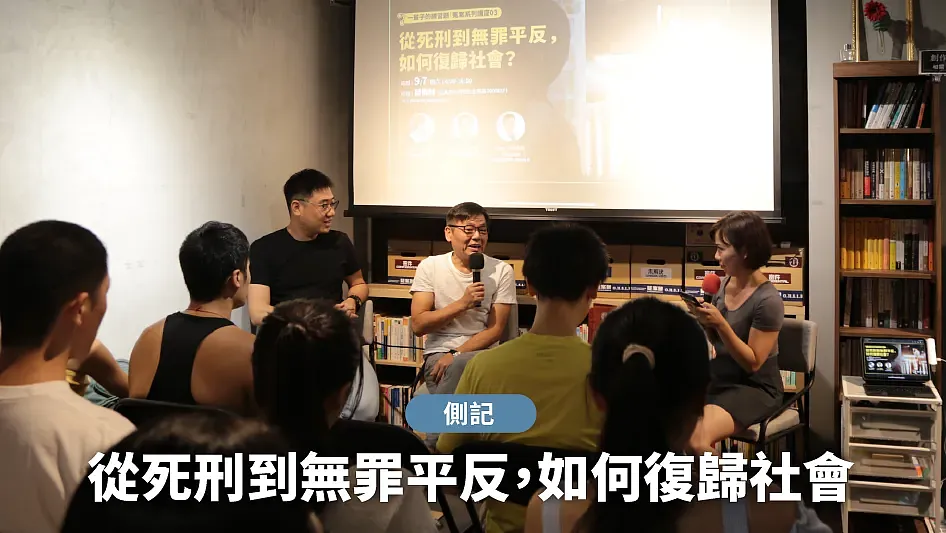
Sidelights | From Death Row to Acquittal and Exoneration: Reintegrating into Society
Last edited: 2026-11-04
A Lifelong Practice | The third lecture in the Wrongful Conviction Series was held at the Taiwan Innocent Prisoners' Aid Office. Focusing on the two key themes of death row wrongful convictions and social reintegration, the session featured wrongfully convicted exoneree "A-Chiang" Hsu Tzu-chiang and counseling psychologist Hao Po-wei, moderated by Lin Pei-ying, who volunteered on the Hsu Tzu-chiang case.
At the start of the lecture, moderator Lin Pei-ying gauged the audience's familiarity with the issue by asking who had heard of the Hsu Tzu-chiang case, who had attended lectures about it, and who had a background in psychological counseling. Through a quick Q&A session, she helped the audience quickly become acquainted with the speakers, Hsu Tzu-chiang and Hao Po-wei.
Hsu Tzu-chiang mentioned that the currently airing Taiwanese-language drama *Innocent Witness* is based on his story, albeit with slight dramatizations. He has not watched the entire series, however, because watching it remains a painful reminder of a heavy past for the protagonist—especially the scenes depicting family members running around exhaustively to rescue the defendant of the wrongful conviction, which cause him immense distress. Yet, talking about his family and the campaign to rescue him is inextricably linked to his survival. Brother Chiang shared that his family exhausted every possible means to save him, even kneeling in exchange for the freedom that Hsu Tzu-chiang should have rightfully possessed. At a time when Hsu was nearly broken by the immense torment in prison and wanted to give up, asking his family to stop trying to save him, his mother told him: "Don't stop me, I don't want to wait until the death penalty is carried out to find out there was something more I could have done!" Perhaps it was this formidable strength from his family that allowed the "luck" A-Chiang repeatedly mentioned during the lecture to befall him.
Aside from the legal complexities of the rescue process, Hsu Tzu-chiang specifically spoke about his own negative emotions and lack of trust—from being falsely implicated by his cousin and a friend when the case first broke out, to discovering through the news that he was inexplicably involved, to enduring 16 years of imprisonment and 21 years of litigation simply for going in to explain the circumstances of a case. Furthermore, during the four years when his numerous extraordinary appeals were repeatedly dismissed, he also suffered through four years of immense pressure, facing the constant threat of execution at any moment. Hsu Tzu-chiang recalled that every evening before roll call, he would change into a fresh set of clothes, waiting for a firing squad that could come at any time. Every day could be his last, with no guarantee of tomorrow; each family visit and reluctant farewell before departure was charged with the agonizing knowledge that it might be their final meeting. The negative emotions generated by these mounting pressures caused Hsu Tzu-chiang to harbor zero trust in the rescue advocacy efforts by the JRF or the intervention of the Control Yuan at the time. It was not until current Taiwan Association for Executive Director Lin Hsin-yi visited Hsu Tzu-chiang in person, looked into his eyes with a steady gaze, and told him, "I believe you! We will help you," that Hsu finally regained his trust in people and even came to realize how "lucky" he was compared to many others in similar situations because he had so many people helping him.
Reflecting on his social reintegration, Hsu Tzu-chiang shared that after his detention was lifted and freedom restored thanks to the passage of the Criminal Speedy Trial Act, he stayed at home for four months before choosing to volunteer at the Judicial Reform Foundation. However, because of the prolonged institutionalized lifestyle in correctional facilities, Hsu Tzu-chiang had grown somewhat passive, unaccustomed to planning for the future, and would often sit in the office waiting for other partners to assign him tasks. When asked whether he had successfully reintegrated, A-Chiang said he did not know. Because he has spent a long time within NGOs, which provide a strong container of tolerance, he is uncertain whether he can adapt to the world outside his echo chamber. Still, after reintegrating, A-Chiang went from initially being afraid to sleep—terrified that he would wake up back in prison—to gradually learning to cherish the present moment. For instance, A-Chiang mentioned how deeply he yearns for something as simple as walking in the rain, an experience that is virtually impossible inside a correctional facility. A-Chiang also noted whether he has truly let go of the past: "After all, it may only take a few seconds to walk out of the detention center, but walking out of the hurdle in one's heart may take a lifetime."
Speaker Hao Po-wei also noted that, synthesizing interview records with death row inmates, the social reintegration of individuals who have undergone long-term imprisonment presents distinct difficulties. First, imprisoned individuals are isolated from society; all information, technology, emotional bonds, social trust, and trust in the law are severed, producing the so-called "death row phenomenon." This includes the anxiety Hsu mentioned about changing into clothes every evening while awaiting potential death, the inability to plan for tomorrow, grievances and frustrations with no outlet, and even contradictory, fragmented imaginations. For instance, Hao Po-wei pointed out that during interviews, death row inmates acknowledged they might never regain freedom, yet still maintained imaginations or plans regarding their own reintegration—a psychological reaction to cope with harsh reality while preserving self-actualization.
Hao Po-wei mentioned that while the function of correctional institutions is reform, his professional experience has also revealed that many returning individuals grow accustomed to a regimented lifestyle and even develop a habit of hyper-vigilance, living lives devoid of a sense of security. Upon release, they may need to be reminded that such measures are seemingly no longer necessary. This calls into question the institutional design of social isolation as a correctional method and highlights the need to reflect on its efficacy. Furthermore, there are the frequently overlooked "prisoners outside the prison walls"—the family members of every wrongful conviction defendant, whose finances may be tied up in litigation, who must run around exhaustively, and who may even have to sacrifice their own dignity. Relatively speaking, they are also subjected to immense violations.
This article is an AI-generated translation of the original Chinese text. In the event of any discrepancy, the Chinese version shall prevail.