
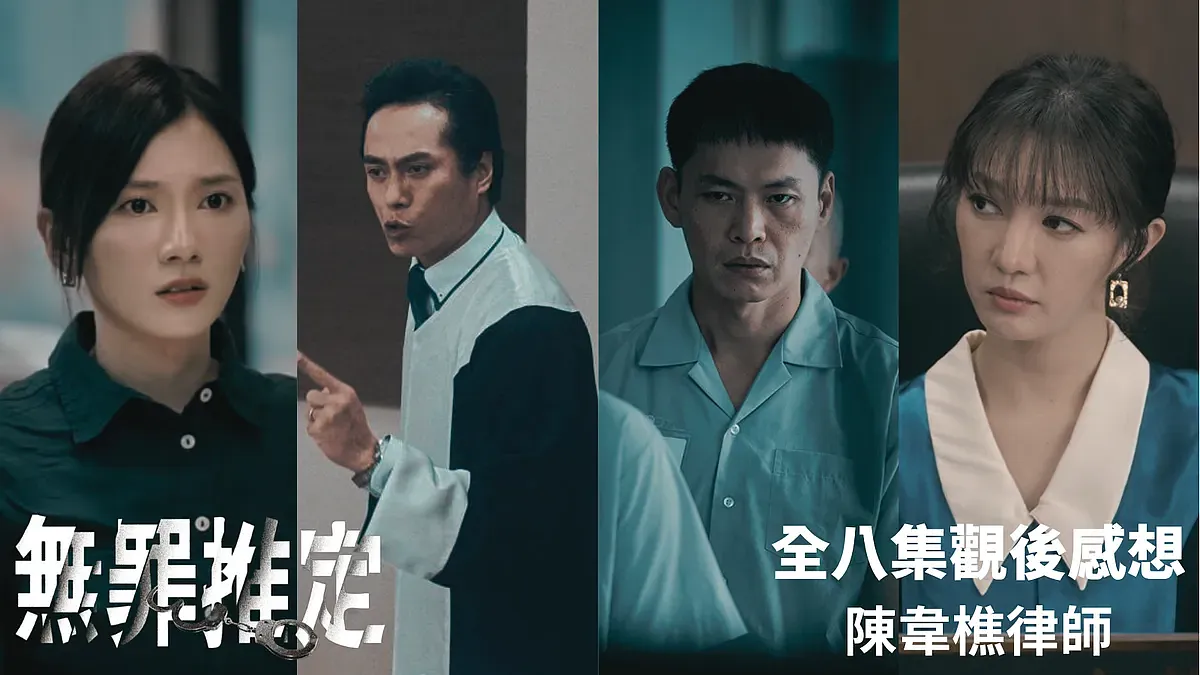
Review | "Not Guilty" - All Eight Episodes
Last edited: 2026-07-27
I. Synopsis of All Eight Episodes
"Not Guilty" is Taiwan's first Taiwanese-language legal drama. It is based on the harrowing wrongful conviction of the real-life figure Hsu Tzu-chiang, who was implicated in the September 1, 1995 kidnapping, extortion, and subsequent brutal murder of real estate broker Huang Chun-shu—a crime that at the time carried the mandatory death penalty for robbery-murder under Article 348, Paragraph 1 of the Criminal Code.
Why is it described as a brush with death? Following the incident on September 1, 1995, Hsu Tzu-chiang went into hiding out of fear of "judicial injustice." He later voluntarily faced the judicial system and was detained on June 24, 1996. He was subsequently sentenced to death at every single stage: the first instance at the Shilin District Court, the second instance at the Taiwan High Court, and through remands by the Supreme Court for retrials ranging from the first through the fifth retrials (Geng-Yi to Geng-Wu). The Supreme Court's 2000 Tai-Shang No. 2196 Judgment dismissed the appeal on April 27, 2000, finalizing the death sentence.
After the Supreme Court finalized the death sentence, Hsu Tzu-chiang's mother sought help from the JRF. Following research by the JRF volunteer legal team, they decided to use news media and public opinion to urge the Minister of Justice to temporarily halt Hsu's execution. The JRF volunteer legal team researched and assisted Hsu in filing a total of four extraordinary appeals, as well as petitioning the Grand Justices of the Judicial Yuan. All four extraordinary appeals assisted by the Supreme Prosecutor's Office were ultimately dismissed by the Supreme Court and failed.
However, on July 23, 2004, Judicial Yuan Interpretation No. 582 (referred to in the drama as Interpretation No. 582) concluded that the original trial proceedings had failed to grant Hsu Tzu-chiang the right to confront and cross-examine his co-defendants, Huang Chun-ch'i and Ch'en I-lung, who had falsely implicated him in the robbery-murder. This violated the right to confrontation protected under Interpretation No. 582 (namely, the right to summon co-defendants as witnesses for confrontation and cross-examination). Subsequently, with the Supreme Prosecutor's Office filing a fifth extraordinary appeal, the Supreme Court's 2005 Tai-Fei No. 124 Judgment finally rescinded the Supreme Court's 2000 final judgment and the fifth retrial judgment.
Nevertheless, the sixth retrial (Geng-Liu) still resulted in a death sentence. It was not until May 18, 2012, during the seventh retrial (Geng-Qi), that the court took a different view of the facts and commuted the sentence to life imprisonment. The day after the seventh retrial verdict was announced, the Taipei Detention Center released Hsu Tzu-chiang ahead of time pursuant to Article 5, Paragraph 3 of the "Provisional Penal Code" (effective May 19, 2012), which stipulates: "The total duration of detention during trial shall not exceed eight years." He became the first criminal defendant in Taiwan's judicial history to be released by applying the "Provisional Penal Code." He was again sentenced to life imprisonment in the eighth retrial (Geng-Ba); and finally, on September 1, 2015, the ninth retrial (Geng-Jiu) acquitted him. On October 13, 2016, the Supreme Court dismissed the prosecutor's appeal, finalizing his acquittal. Considering the first instance at the Shilin District Court, the second instance at the Taiwan High Court, the death sentences from the first through fifth retrials, the finalized Supreme Court judgment, and the death sentence from the sixth retrial, Hsu Tzu-chiang was indeed sentenced to death 9 times. Compared to his eventual final acquittal, it can truly be called a narrow escape from death.
"Not Guilty" portrays these events through the case of Yang Ming-te, a character modeled after Hsu Tzu-chiang. In this story, real estate broker Chou Shao-hsiung is robbed and murdered in 2003, and suspects K'o Hsing-lung and P'an Te-li are apprehended. While another suspect, P'an Te-sheng, remains at large, K'o Hsing-lung and P'an Te-li accuse Yang Ming-te of being an accomplice. Following sensationalized media reports, prosecutors and police constantly questioned Yang Ming-te with a "presumption of guilt" mindset, demanding to know why he "refused to confess." The drama follows the arduous 16-year journey through eight retrials (the first through sixth retrials all resulting in death sentences; the seventh retrial changing to life imprisonment, and the eighth retrial resulting in acquittal) to fight for his innocence.
II. Brief Overview of Key Plots by Episode
Episode 1: The Occurrence of the Yang Ming-te Case
Yang Ming-te attempts to flee when stopped by police for questioning, but is apprehended. The female protagonist, Hsu Yen-ch'ing, has a mother who is a long-term victim of domestic violence and holds a deep personal interest in criminal cases. She enters a university law school and successfully passes the bar exam. Although she encounters a fiercely sexist employer, attorney Chang P'in-chia, during her traineeship, she serendipitously takes on the Yang Ming-te case—which is already at the fifth retrial stage—and discovers that Yang has an alibi, having gone to a farmers' association far from the crime scene to deposit money for his mother during the time of the incident.
Episode 2: The JRF Legal Team Begins Involvement in the Yang Ming-te Case
Attorney Hsu Yen-ch'ing is summarily fired on the spot by her traineeship boss, Chang P'in-chia, in violation of the "Labor Standards Act" simply because she talked back, forcing Hsu to restart her five-month traineeship. However, Hsu brings Yang Ming-te's parents to the JRF office to meet with attorney Li Cheng-shuo. Although Li initially declines to help after reviewing the case files because he finds it too difficult, upon reviewing them a second time, he recognizes potential suspicious circumstances and decides to step in. Together, they make their first visit to the Taipei Detention Center to meet with Yang Ming-te. Later, the fifth retrial still sentences Yang to death, and the Supreme Court dismisses his appeal. Facing the risk of imminent execution, attorney Li Cheng-shuo hastily drives attorney Hsu Yen-ch'ing to the Ministry of Justice in hopes of securing a stay of execution.
Episode 3: Interpretation No. 582 and a Glimmer of Hope for Overturning the Case
When attorney Li Cheng-shuo and attorney Hsu Yen-ch'ing visit the Minister of Justice, they happen to encounter a Control Yuan member reviewing Ministry of Justice documents, thereby leveraging the situation to seal and retrieve the documents, which halts the execution. After Yang Ming-te's fourth extraordinary appeal fails, the JRF legal team, assisted by attorney Li, helps Yang petition for a constitutional interpretation. They successfully secure Judicial Yuan Interpretation No. 582, safeguarding Yang's right to confront suspects K'o Hsing-lung and P'an Te-li. Subsequently, they secure an extraordinary appeal filed by the Supreme Prosecutor's Office and have the Supreme Court overturn the original finalized death sentence and the fifth retrial judgment, opening the door to a sixth retrial. Yang Ming-te's inhumane prison conditions—having to wear heavy leg irons every day—attract the attention of international human rights organizations, eventually leading to the removal of the daily leg irons. Because the JRF is short on funds, attorney Li allows boss Chang P'in-chia to join the JRF legal team for the Yang Ming-te case through a donation that violates JRF's donation policies, abruptly replacing attorney Hsu Yen-ch'ing, who had been handling the case for a long time.
Episode 4: Encountering a Judge Lacking Impartiality in the Sixth Retrial
The plot focuses on the proceedings of the sixth retrial of the Yang Ming-te case. Yang's mother visits the Taipei Detention Center to meet with K'o Hsing-lung, pleading with him to find his conscience and admit that he falsely accused Yang Ming-te. However, K'o still refuses to confess in court. During the trial, attorney Hsu Yen-ch'ing, while pulling all-nighters reviewing files at the JRF, discovers that Presiding Judge Lan I-sen has been holding secret private trial sessions, contacting the victims' family members, and unprecedentedly advising them: "You should hire an experienced lawyer instead of relying on the private prosecutor, otherwise the defendant might be acquitted." This clearly violates Article 15 of the "Code of Judicial Ethics," which stipulates that judges must remain neutral and, barring special circumstances, shall not communicate or meet with only one party or their related persons. Toward the end of Episode 4, the JRF legal team intends to apply for the recusal of Presiding Judge Lan due to his repeated manifestation of a "presumption of guilt" mental stance. However, the fame- and profit-seeking Chang P'in-chia refuses to file for recusal to avoid offending the second-instance judges and abruptly withdraws from the team, allowing attorney Hsu Yen-ch'ing to rejoin the sixth retrial defense team.
Episode 5: The Agony of Another Failed Rescue in the Sixth Retrial
The application for the recusal of Presiding Judge Lan in the sixth retrial is unsuccessful; instead, due to the regular judicial rotation system, Lan is transferred to a court in Kinmen, and the case is reassigned to a panel of three new judges. Regrettably, the plot does not explain how the new panel views Yang Ming-te's alibi, nor whether they granted Yang his right to confront K'o Hsing-lung and P'an Te-li pursuant to Interpretation No. 582. The drama simply presents the result of the sixth retrial: another death sentence. Episode 5 also depicts the helplessness and heavy grief felt by attorney Hsu Yen-ch-ing upon receiving yet another death sentence despite the existence of Interpretation No. 582 and the Supreme Court accepting the extraordinary appeal for retrial. The show displays the "Not Guilty" banner created by the JRF back then to support the prototype figure Hsu Tzu-chiang, signed by many lawyers, human rights groups, and JRF volunteers to offer spiritual encouragement for Hsu's acquittal. Later, the seventh retrial commences, and the JRF rescue team continues its arduous defense. Near the end of Episode 5, JRF volunteer Lin Hsiao-ling confides privately to attorney Hsu Yen-ch'ing that she was sexually assaulted by a Control Yuan member while in a car when she was overcome by alcohol!
Episode 6: Sacrifices and Compromises in the Fight for Acquittal in the Seventh Retrial?
Attorney Hsu Yen-ch'ing seemingly intends to help JRF volunteer Lin Hsiao-ling file a sexual assault lawsuit against the Control Yuan member. However, attorney Li Cheng-shuo is reluctant to face the awkward situation of exposing a Control Yuan member who has long assisted the JRF. This draws dissatisfaction from Hsu Yen-ch'ing and another member of the JRF rescue team, attorney Ch'en Chih-ch'ien from the same law firm as Li. Failing to assist in a sexual assault case clearly runs counter to their inner sense of justice. Attorney Li agonizingly gazes at the JRF's spiritual motto (which the real-life JRF indeed possesses!):
"We have a dream for judicial reform.
We look forward to the day when those who abide by the law are not lonely, those who break the law harbor fear, and everyone can attain the justice in their hearts.
We look forward to the day when the judiciary becomes our common promise—a promise of a fair trial, an egalitarian culture, and a society that embodies justice."
The NGO "Life Protection Alliance," which is dedicated to helping overturn the Yang Ming-te case, holds a candlelight vigil, arranging candles to spell out "Not Guilty" to support Yang. Yang Ming-te's son actively participates and cares about his father's case. However, the alliance's event is disrupted by opponents who question Yang's guilt in the robbery-murder, leading to clashes. The head of the Life Protection Alliance is harassed, and their office is vandalized with feces. The Control Yuan member provides secret documents to attorney Li Cheng-shuo, leading Li and Hsu Yen-ch'ing to discover that JRF volunteer Lin Hsiao-ling's sexual assault allegations may be fabricated.
Episode 7: The Difficult Path to Fighting for Acquittal
During the proceedings of the seventh retrial, Yang Ming-te is approached in the Taipei Detention Center by a public defender sent by the High Court, who persuades Yang that if he confesses, he will have the opportunity to apply for the "Provisional Penal Code" and have his sentence commuted to a lighter fixed-term imprisonment, urging Yang to compromise with the judiciary in exchange for early release. After contemplating his insistence on innocence versus pragmatic compromise, Yang ultimately decides to fight for his innocence without compromising with reality.
Attorney Li Cheng-shuo publicly questions the judge during the seventh retrial as to whether the public defender was intentionally sent to urge a confession, but the judge does not admit to it in court.
However, during the seventh retrial, Yang Ming-te's father suddenly passes away due to illness. Yang is deeply saddened that he could not clear his name in time before his father died of grief, even bowing and apologizing to his father's portrait in prison, vividly illustrating the immense difficulty of the path to seeking justice.
During the closing arguments of the seventh retrial, attorney Hsu Yen-ch'ing emotionally addresses the judges:
"The people are not afraid of the judiciary making mistakes; what they fear most is refusing to correct mistakes once made. The most precious thing about the judiciary is not that it never makes mistakes. After all, the one who never makes mistakes is not the judiciary—it is God. Please, stop making mistakes."
Meanwhile, in her office, Presiding Judge Shen Fang-i expresses her inner thoughts through a conversation with her judicial assistant:
"Even as a judge, one cannot see 100% of the truth from evidence and the people involved in a case; we can only get as close to the facts as possible. Every time I write a judgment, I wonder: Is this defendant truly innocent? Or were we negligent in our investigation and failed to find the key evidence? If I acquit him, but he really is the culprit, what should I do? If I convict him, but he is actually innocent, what then? The pen weighs a thousand catties; every judge feels the same way."
Ultimately, the death sentence is overturned, and Yang Ming-te is reclassified as a secondary accomplice rather than the mastermind of the robbery-murder, resulting in a commuted sentence of life imprisonment.
Episode 8: Yang Ming-te's Return to Society After Release and Final Acquittal in the Eighth Retrial
The episode opens with Yang Ming-te finally leaving the Taipei Detention Center ahead of schedule pursuant to the "Provisional Penal Code" provision limiting pretrial detention to no more than eight years. The moment Yang embraces his mother is deeply touching and inspiring. Although Yang initially struggles to adjust to daily life—such as sleeping on a bed or conversing with people—and is initially reluctant to go to the JRF office when his mother suggests he help out due to his maladjustment to social life, he gradually breaks through his mental barriers. He learns to communicate with others, gives lectures on wrongful convictions in middle schools, high schools, and universities, and even learns to enjoy the sensation of rain.
In the end, attorney Li Cheng-shuo secretly colludes with the police officer handling the Yang Ming-te case to fabricate call logs showing that Yang did not communicate with co-defendants K'o Hsing-lung and P'an Te-sheng during the incident. The drama depicts attorney Li using this evidence in his closing arguments to successfully win Yang's acquittal.
However, attorney Hsu Yen-ch'ing subsequently discovers that it was attorney Li who used unscrupulous means to manipulate the police into fabricating the call logs, and enabled the police to continue supporting JRF volunteer Lin Hsiao-ling's sexual assault accusation against the Control Yuan member to prevent him from running for city council... Consequently, Hsu submits her resignation to Li. Several months later, for reasons unspecified, Hsu returns to the JRF office to find Li Cheng-shuo and Ch'en Chih-ch'ien, proposing they work together on a 15-year-old case involving Liu Wen-hsiung, a soldier wrongfully convicted of sexually assaulting a young girl, sentenced to death, and executed. The three JRF lawyers continue fighting against miscarriages of justice.
III. Overall Review of All Eight Episodes
"Not Guilty" can basically be divided into four main axes: female protagonist attorney Hsu Yen-ch'ing's unwavering persistence in justice; male protagonist attorney Li Cheng-shuo's persistence and compromises; Yang Ming-te's grief, anger, and rebirth; and the judicial system's persistence and changes in facing the Yang Ming-te case.
Regarding the female protagonist, attorney Hsu Yen-ch'ing: because her mother suffered years of domestic violence, she possesses an innate sense of justice centered on "refusing to be bullied." Thus, even before officially becoming a lawyer, she holds firmly to the concept of the "presumption of innocence." The "presumption of innocence principle," as stipulated in Article 154, Paragraph 1 of the Code of Criminal Procedure, states: "A defendant shall be presumed innocent until proven guilty by a final judgment." Therefore, even though a prosecutor has instituted a public prosecution, if there is insufficient legally investigated evidence, the defendant cannot be declared criminal prior to a court conviction and trial; they must first be presumed innocent.
Thus, while still in university, attorney Hsu Yen-ch'ing reads news about the Shilin District Court's first-instance death sentence in the Yang Ming-te case with great care. She is deeply troubled by reports that Yang was sentenced to death simply because co-defendants K'o Hsing-lung and P'an Te-li accused him of being an accomplice. Later, when her first traineeship boss, Chang P'in-chia, handles Yang's fifth retrial, Hsu encounters the case again. She takes the audience along to meet Yang's mother and son, leading viewers through the despair of the sixth retrial's death sentence, the frustration of drinking away sorrows on the JRF balcony, the helplessness of co-hosting a candlelight vigil for acquittal with the "Life Protection Alliance" during the seventh retrial amidst disruptions from opponents, and finally to the achievement and joy of the eighth retrial's acquittal.
Attorney Hsu Yen-ch'ing strongly resembles attorney Ch'en Yü-fan, then Deputy Executive Director of the JRF, who worked hard to rescue the prototype figure Hsu Tzu-chiang, always exuding warm companionship and unyielding persistence in justice. Though angered by judicial injustice, she never acts rashly.

(Figure 1, Left: Attorney Ch'en Yü-fan, then Deputy Executive Director of the Taiwan Judicial Reform Foundation; Figure 1, Right: Hsu Tzu-chiang)
As for attorney Li Cheng-shuo, he is a firebrand lawyer who vociferously denounces issues of judicial injustice, directly confronting judges in court during the sixth, seventh, and eighth retrials of the Yang Ming-te case. In this regard, he closely resembles attorney Lin Yung-sung, then Chairperson of the JRF, who worked diligently to rescue the prototype figure Hsu Tzu-chiang. Lin served as the spokesperson for the Hsu Tzu-chiang case, actively facing the media during the sixth, seventh, eighth, and ninth retrials and using forceful language such as: "Judges are merely maintaining the surface dignity of the judiciary, ignoring evidence and disregarding human lives," "hasty judgments," and "disregarding human lives." Viewers who followed the Hsu Tzu-chiang case back then will undoubtedly remember attorney Lin Yung-sung's firebrand personality, making it unsurprising that the production crew of "Not Guilty" specifically designed the character of attorney Li Cheng-shuo.

(Figure 2, Left: Attorney Lin Yung-sung, then Chairperson of the Taiwan Judicial Reform Foundation; Figure 2, Third from Left: Hsu Tzu-chiang; Figure 2, Fourth from Left: Hsu Tzu-chiang's mother)
However, another theme that "Not Guilty" attempts to highlight—though without deep exploration—is whether one should make certain compromises when pursuing justice. For instance, the drama deliberately portrays a scenario where JRF's donations are insufficient to support the legal team in continuing to assist with the Yang Ming-te case. Consequently, during the sixth retrial, the JRF has to accept a donation that violates its donation policy in exchange for adding a donor to the legal team, abruptly replacing the long-time handler, attorney Hsu Yen-ch'ing. It also portrays a Control Yuan member allegedly sexually assaulting JRF volunteer Lin Hsiao-ling, while attorney Li Cheng-shuo initially refuses to face Hsu Yen-ch'ing's push to assist Lin in filing the sexual assault allegation. The camera deliberately focuses on Li looking troubled as he gazes at the JRF's spiritual motto (which the real-life JRF indeed possesses!):
"We have a dream for judicial reform. We look forward to the day when those who abide by the law are not lonely, those who break the law harbor fear, and everyone can attain the justice in their hearts. We look forward to the day when the judiciary becomes our common promise—a promise of a fair trial, an egalitarian culture, and a society that embodies justice."
Perhaps the most controversial plot point is when attorney Li Cheng-shuo secretly colludes with the police officer handling the Yang Ming-te case to fabricate call logs, enabling the police to continue supporting JRF volunteer Lin Hsiao-ling's sexual assault accusation against the Control Yuan member to prevent him from running for city council... Li then uses these call logs in his closing arguments to show that Yang did not communicate with co-defendants K'o Hsing-lung and P'an Te-li during the incident, securing Yang's acquittal.
However, attorney Hsu Yen-ch'ing later discovers that attorney Li used unscrupulous means to manipulate the police into fabricating the call logs. Hsu consequently tenders her resignation to Li. Several months later, for reasons unexplained, Hsu returns to the JRF office to find Li Cheng-shuo and Ch'en Chih-ch'ien, proposing they work together on the 15-year-old case of Liu Wen-hsiung, a soldier wrongfully convicted of sexually assaulting a young girl, sentenced to death, and executed. The three JRF lawyers continue fighting against miscarriages of justice.
The prototype figure Hsu Tzu-chiang and his legal team certainly never fabricated call logs to fight for an acquittal. If the call logs had obvious discrepancies from earlier versions that lawyers could spot at a glance, judges and prosecutors would have seen them too; thus, real-world lawyers had no need to collude with the police to fabricate call logs or other evidence to win an acquittal.
Unfortunately, because this subplot is underexplored, it seems merely intended to highlight that judicial justice in pursuing acquittals invariably demands a price. Yet the drama ultimately fails to show whether the Control Yuan member was ever convicted of sexual assault. If attorney Li Cheng-shuo is permitted to collaborate with the police to wrongfully frame a Control Yuan member, wouldn't that run completely counter to the central theme of "Not Guilty"? Furthermore, if Li can resort to unscrupulous methods to secure an acquittal, how can attorney Hsu Yen-ch'ing ensure Li will not repeat such actions in the future? These are regrettable narrative shortcomings.
As for the third axis of the plot, it centers on Yang Ming-te and his mother. The drama brilliantly captures the initial grief and anger of the prototype figure Hsu Tzu-chiang in prison when falsely accused by co-defendants Ch'en I-lung (his former friend) and Huang Chun-ch'i (his cousin) of participating in the robbery-murder. It portrays his despair over the death sentence, the daily terror of awaiting execution, and the agony of wearing heavy leg irons—realities often omitted from news coverage of the Hsu Tzu-chiang case, rendered here in vivid, three-dimensional detail for viewers. Later, it portrays his gradual recovery of confidence, his refusal to confess under the "Provisional Penal Code" in exchange for a lighter fixed-term sentence, his insistence on a trial, and his reintegration into society after release under the "Provisional Penal Code," complete with the intellectual look of wearing glasses—all portrayed exceptionally well.
Similarly, regarding the prototype of Hsu Tzu-chiang's mother, the drama touchingly captures her speechless grief toward the heavens, the maternal love that led her to frequently visit the JRF to care for the legal team, her nervous tension while observing court trials, and her process of helping Hsu adjust to social life after his release, deepening the audience's appreciation of her maternal love and resilience.
The final axis is the judicial system's performance in self-reflection. The drama illustrates this through the media's growing focus on whether the Yang Ming-te case is a wrongful conviction starting from the sixth retrial. Presiding Judge Lan I-sen of the sixth retrial is disgruntled that the case remains unfinalized after five retrials and refuses to listen to any evidence pointing toward Yang's innocence, sentencing him to death. In contrast, Presiding Judge Shen Fang-i of the seventh retrial agonizes while talking to her judicial assistant: "Even as a judge, one cannot see 100% of the truth from evidence and the people involved in a case; we can only get as close to the facts as possible. Every time I write a judgment, I wonder: Is this defendant truly innocent? Or were we negligent in our investigation and failed to find the key evidence? If I acquit him, but he really is the culprit, what should I do? If I convict him, but he is actually innocent, what then? The pen weighs a thousand catties; every judge feels the same way." Ultimately, she overturns the death sentence, reclassifying Yang as a secondary accomplice rather than the mastermind, and sentences him to life imprisonment.
This segment is a crucial dramatic portrayal, touching upon the difficulty of adhering to "letting neither the guilty escape nor the innocent suffer" and upholding the "presumption of innocence," as well as the judicial psychology every judge faces. Unfortunately, the drama chooses not to delve deeper into the mental journey that prevented Presiding Judge Shen Fang-i from firmly acquitting Yang Ming-te. Such an exploration of a judge's inner psyche, combined with glimpses of the judges' family lives and resulting values, would have made for a brilliant theme.
Another regrettable omission is the failure to portray how the pivotal eighth retrial led to an acquittal—specifically mirroring the ninth retrial acquittal of the prototype figure Hsu Tzu-chiang in Taiwan High Court 2012 Shang-Chung-Geng-Jiu No. 5 Judgment. In that case, the judges decisively ruled that because co-defendants Ch'en I-lung and Huang Chun-ch'i refused to testify again pursuant to Interpretation No. 582 to safeguard Hsu's right to confrontation (which would have exposed the unreasonableness of their prior testimonies), and because their previous police and prosecutorial testimonies could not rule out suspicions of police torture and contained numerous inconsistencies in personal statements, their past statements could not be used as evidence to convict Hsu. Consequently, based on insufficient evidence and the presumption of innocence, Hsu was acquitted.
Furthermore, the fact that the Supreme Court repeatedly remanded the sixth and seventh retrials for retrial should have been deeply encouraging news for the JRF legal team. The Supreme Court's reasoning for remands is well worth presenting to viewers unfamiliar with the case so they can understand the Supreme Court's perspective, yet the drama omits this.
Additionally, throughout the series, explanations of esoteric legal terminology are insufficient. The production crew could have drawn inspiration from the 2022 breakout South Korean legal drama "Extraordinary Attorney Woo," which uses visual effects to help characters understand abstract legal concepts, character dialogues referencing other cases, or even direct voice-overs to briefly explain difficult legal terms.
Another shortcoming is that the character portrayals and growth feel somewhat thin. The Yang Ming-te case spanned 16 years, and the time from the post-fifth-retrial JRF rescue to the eighth retrial acquittal covered roughly 10 years. Over this decade, Yang Ming-te himself underwent significant transformation, yet characters like attorney Li Cheng-shuo and attorney Hsu Yen-ch'ing show no shifts in values due to aging, no changes in perspective on legal life, nor any other life realizations. Likewise, the drama fails to touch upon the JRF's own impact on judicial culture over this decade, nor its relationship with the media and public opinion. These important aspects of character growth and the JRF's broader impact on judicial culture are regrettably missing.
Finally, to clear up a misconception: the sixth, seventh, eighth, and ninth retrials of the Yang Ming-te case should have taken place in the Taiwan High Court Criminal Court Building (located behind the Judicial Yuan building). However, the drama portrays the building as the Taipei District Court. Meanwhile, the 2023 hit Taiwanese legal drama "Port of Lies" (which recently garnered 16 nominations at the 59th Golden Bell Awards) mistakenly placed the Taiwan High Court Criminal Court Building architecture in the Taoyuan District Court... And "The World Between Us"—which won Best Television Series, Best Director (Lin Chun-yang), Best Screenplay (Lü Shih-yuan), Best Leading Actress (Alyssa Chia), and Best Supporting Actor (Wen Sheng-hao) at the 54th Golden Bell Awards—placed the Taiwan High Court Criminal Court Building architecture in the Taiwan High Court Civil Court Building... None of these three dramas chose to use the authentic Taiwan High Court Criminal Court Building as a filming location, unlike South Korean legal dramas which do not deliberately mislead viewers about the true appearance of real courts. One can only surmise that the architecture of the Taiwan High Court Criminal Court Building must be quite unappealing, which is why it has never graced the screen...
Moreover, the absence of computers on the desks of judges, prosecutors, and lawyers inside the courtroom is quite unrealistic. Without computers, one cannot see what the court clerk is typing, making the omission of computers from their desks rather puzzling.
As for the real appearance of the JRF Taipei Office, it is slightly regrettable that the production crew did not replicate a similar interior design. However, the sets designed by the crew are full of ingenuity, successfully capturing the posters of various NGO issues and the small-yet-exquisite spatial design associated with the JRF. Perhaps these depictions can be viewed as the production crew's imagined alternative office decor and beautiful dream for the JRF. In the future, when the JRF fundraises or holds events, using the styling and the handsome and beautiful JRF legal team from "Not Guilty" for fundraising might prove extremely effective~~
In summary, while the drama has its flaws, as Taiwan's very first Taiwanese-language legal drama, the actors' spoken Taiwanese is remarkably articulate. Particularly when dealing with obscure legal terms, the crew selected the most fitting Taiwanese phrasing, making it a joy to listen to. I look forward to seeing a second and third Taiwanese-language legal drama in the future! Naturally, following the flourishing success of Hakka-language television series such as "Gold Leaf" (2021) and "Girls Win!" which won domestic acclaim, I also eagerly anticipate the release of the first Hakka-language legal drama!
Perhaps attorney Hsu Yen-ch'ing's sentiment during her closing arguments in the seventh retrial serves as the best annotation for the entire series:
The people are not afraid of the judiciary making mistakes; what they fear most is refusing to correct mistakes once made. The most precious thing about the judiciary is not that it never makes mistakes. After all, the one who never makes mistakes is not the judiciary—it is God. Please, stop making mistakes.
This article is an AI-generated translation of the original Chinese text. In the event of any discrepancy, the Chinese version shall prevail.