
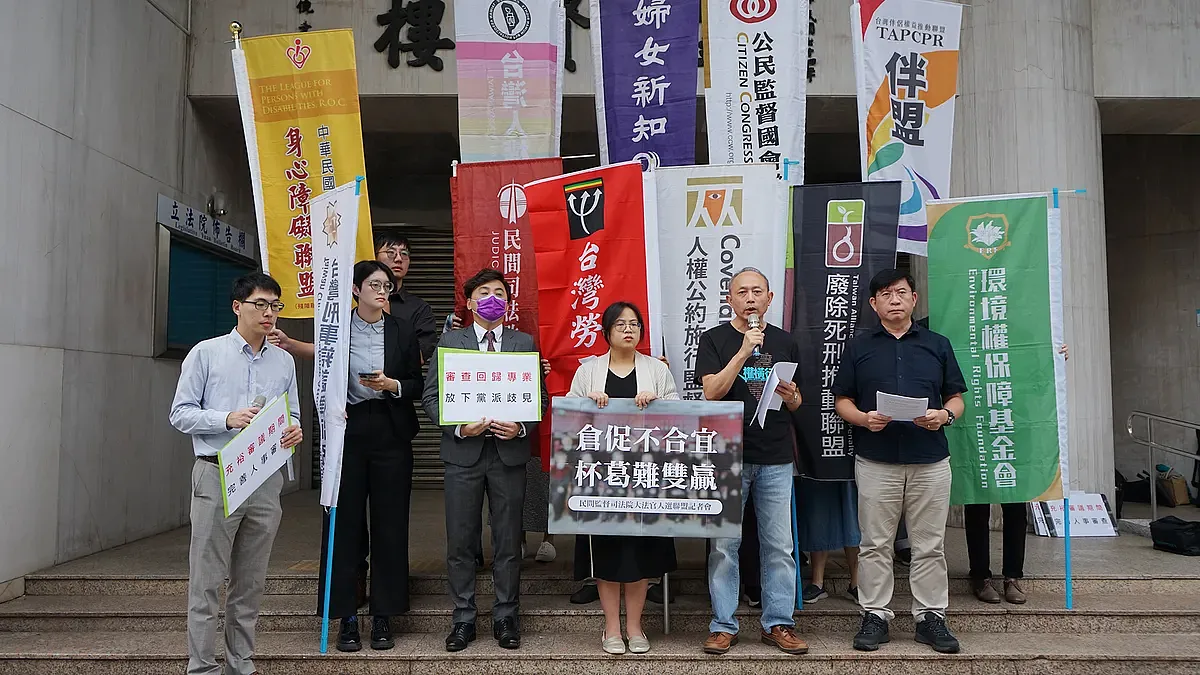
Press Conference|"Hasty and Inappropriate, Obstruction Undermines Win-Win" Press Release by the Alliance to Monitor Judicial Yuan Grand Justice Nominees
Last edited: 2026-07-27
On August 30, the Presidential Office announced seven nominees for Grand Justices: Chang Wen-chen, Yao Li-ming, Ho Lai-chieh, Chen Yun-tsai, Wang Pi-fang, Liao Fu-te, and Liu Ching-yi, to succeed the Grand Justices whose terms expire on October 31.
To examine the suitability of the nominees and the process of exercising the Legislative Yuan's consent power, 14 civil society organizations jointly formed the "Alliance to Monitor Judicial Yuan Grand Justice Nominees," urging the Legislative Yuan to conduct a rational review and posing questions to the nominees for the President and Vice President of the Judicial Yuan, as well as the Grand Justice nominees. In response, the Alliance has issued three statements as follows:
1. The consent power for Grand Justices and the judicial power are neither tools nor chips for partisan struggle; hasty exercise, malicious obstruction, or sloppy legislative amendments will all undermine judicial credibility and democratic politics. The Alliance calls on all political parties to actively uphold the democratic constitutional system and refrain from using the national system as a political gamble.
2. The review of personnel consent for Grand Justices must return to professionalism, and the Legislative Yuan must exercise its personnel consent power with prudence.
3. Grand Justice nominees are respectfully requested to respond to public inquiries to promote social dialogue on constitutional issues.
1. The Grand Justice Consent Power is Not Partisan Struggle; Hasty Exercise or Malicious Obstruction Will Undermine Judicial Credibility and Democratic Politics
Pursuant to Article 5 of the Additional Articles of the Constitution, the President nominates Grand Justices, who are then appointed with the consent of the Legislative Yuan. Judicial Yuan Interpretation No. 632 also explained that the Legislative Yuan's exercise of its personnel consent power concerns the substantive existence and normal operation of constitutional organs. The Legislative Yuan should exercise this power in accordance with its duty of loyalty to the Constitution to prevent the integrity of the national constitutional system from being damaged. However, following the announcement of this list of Grand Justice nominees, opposition parties have already threatened to demand the Presidential Office "withdraw and resubmit" the nominations. Moreover, given that past exercises of the consent power by the Legislative Yuan have frequently been inadequate and hasty, one cannot help but worry that the exercise of this personnel consent power will fall into the quagmire of partisan struggle rather than a substantive review of the nominees' suitability.
The Alliance emphasizes that regarding whether the nominees are suitable to serve as Grand Justices, the Legislative Yuan should return to a rigorous review of their "moral integrity," "constitutional and human rights ideology," and "knowledge and professional competence," and should not hastily grant consent or maliciously obstruct based on factors other than suitability. For example, some critics base their attacks solely on the conclusions of evaluation opinions previously rendered by nominees without conducting a substantive review and specific commentary on the quality of the legal reasoning in those evaluation opinions, denouncing the nomination as "political patronage." This risks devolving into partisan factionalism.
At the same time, regarding the draft amendments to the Constitutional Court Procedure Act proposed by legislators attempting to raise the "formation threshold" and "decision threshold" of the Constitutional Court, the Alliance believes that the current Constitutional Court Procedure Act lowered the decision threshold from two-thirds under the old law to the current one-half precisely to solve the problem of inefficient adjudication under the old system. This proposed amendment is a backward-stepping proposal that turns back the clock. In addition, the proposal to "define" the "statutory total number" of Grand Justices as the "total number of incumbent justices" may also paralyze the operation of the Constitutional Court, thereby disrupting the balance of power among the constitutional organs of our country. We must proceed with utmost caution.
2. Review Must Return to Professionalism; The Legislative Yuan Should Prudently Exercise Its Personnel Consent Power
Regarding the exercise of the Grand Justice personnel consent power, the Alliance puts forward the following specific recommendations:
- Upon receiving the nominees' materials, each caucus in the Legislative Yuan should form a task force to gather opinions and submit written questions or requests for supplementary materials to the nominees in advance.
- Each caucus should promptly and appropriately schedule the review and the exercise of the consent power to avoid undue delays.
- Before convening review meetings, the "Committee of the Whole House" should first hold a "public hearing" to broadly solicit opinions from all sectors of society. Task force members and legislators wishing to question nominees should participate throughout the entire process. Furthermore, to ensure that opinions from the public hearing are fully reviewed, synthesized, and utilized in subsequent review meetings, there should be an interval of at least one week between the public hearing and the review meeting.
- The "Committee of the Whole House" should hold at least two review meetings. If a nominee's responses at the first review meeting are insufficient, they should supplement them at the second review meeting. Meanwhile, committee review is not a "recitation test"; the Alliance calls on legislators, when questioning constitutional issues, not to meaninglessly quiz nominees on specific legal provisions or interpretation serial numbers, but rather to focus on clarifying the nominees' philosophies and perspectives.
- The spirit of exercising the consent power should be that individual legislators independently judge the suitability of nominees to achieve the goal of recruiting talent for the country. Therefore, the Alliance calls upon all parties, during the plenary session vote, to allow legislators to freely exercise their voting rights without restricting them through party discipline or other means.
In summary, the Alliance calls upon the Legislative Yuan to refer to the above recommendations to prudently exercise its consent power—neither acting hastily nor engaging in malicious obstruction. Through the personnel review process, public awareness of the functions of Grand Justices can be enhanced, and the suitability of each candidate can be widely subjected to public evaluation. Only thus can the Legislative Yuan be considered as properly fulfilling its constitutional duties. The Alliance also solemnly condemns any behavior that conducts reviews in a biased and arbitrary manner based on deliberate political confrontation. Such measures may not only lead to a constitutional crisis that substantially hollows out the judicial power but will also consequently damage public trust in the Grand Justices and the judiciary.
3. Nominees Are Respectfully Requested to Respond to Public Inquiries to Promote Social Dialogue on Constitutional Issues
Grand Justices, hailed as the "guardians of the Constitution," must engage in continuous communication with society to avoid the dangers of working behind closed doors and to lead judicial progress. To examine the nominees' constitutional human rights ideologies, knowledge, and professionalism, and to urge them to engage in dialogue with the general public, the Alliance will pose public questions to the nominees regarding major constitutional issues concerning the exercise of Grand Justices' powers, serving as a reference for the review.
We expect the seven nominees this time to respond to the public questions with an open attitude, making in-depth communication during the nomination process possible. Below, the Alliance poses 15 questions to the seven Grand Justice nominees; 7 questions to the nominees for the President and Vice President of the Judicial Yuan; and an additional 2 questions to nominee Yao Li-ming.
Joint Questions for Grand Justice Nominees (15 Questions)
-
Focus on Human Rights and Constitutional Issues
1. During your upcoming eight-year term, what do you consider to be the most indicative (or your most concerned) constitutional issue or basic human rights protection issue?
2. Regarding previously rendered Grand Justice interpretations or Constitutional Court judgments, please give an example illustrating how you would adopt a different conclusion or a different line of legal reasoning.
3. What constitutional or human rights issues are there upon which you already hold a firm constitutional conviction in your mind, yet which deviate to a certain extent from the current stable mainstream views or legal order, or on which diverse and divergent opinions still exist in society?
-
International Human Rights Covenants and Constitutional Review
4. Paragraph 16 of the Concluding Observations of the 2022 International Review Committee on International Human Rights Covenants states: "... In cases of conflict between existing or subsequently enacted laws and the two Covenants, the status of the two Covenants must be further clarified. The Review Committee emphasizes that the two Covenants, as the two most important human rights covenants of the United Nations, should be given priority." In your opinion, when domesticated international human rights covenants conflict with domestic laws, should they be applied with priority? Or, in the event of a conflict, should the standard of review for constitutional adjudication be raised? What is the relationship between the list of rights in international human rights covenants and the types and contents of basic rights in our country?
5. Paragraph 7 of Article 10 of the Additional Articles of the Constitution stipulates that employment assistance, livelihood maintenance, and relief for persons with disabilities shall be guaranteed, and their self-reliance and development shall be assisted. Paragraph 3 of General Comment No. 6 of the domesticated Convention on the Rights of Persons with Disabilities further points out: "... denial of reasonable accommodation constitutes discrimination." In your opinion, does the content of this General Comment possess legally binding force? In constitutional review, do you consider laws or judgments that violate the "principle of reasonable accommodation" to be a violation of the right to equality, and should they be subject to a strict scrutiny standard?
-
Referendums and Constitutional Review
6. Article 12 of the Additional Articles of the Constitution stipulates that amendments to our Constitution shall be subject to the procedure of proposal by the Legislative Yuan and citizen ratification. The constitutional amendment ratification bill for "Voting Rights at Age 18" held in 2022 failed to pass because it did not reach the passage threshold. In your view, looking at the current constitutional amendment procedures and the practice of the aforementioned constitutional amendment ratification bill, are the current constitutional amendment procedures and thresholds appropriate? How do you evaluate their impact on Taiwan's democratic operation? Does Article 12 of the Additional Articles of the Constitution raise constitutional doubts?
7. After the promulgation of Judicial Yuan Interpretation No. 748, several groups opposing same-sex marriage submitted a referendum proposal to the Central Election Commission (CEC) in January 2018 (concerning whether same-sex marriage should be defined and protected by the Civil Code), and the referendum was held on November 24 of the same year. Regarding the administrative disposition by the CEC announcing the establishment of the referendum proposal, a same-sex partner as an interested party filed a revocation lawsuit as the plaintiff before the voting at the Taipei High Administrative Court and applied for a stay of execution of the referendum procedure. The case was finalized on May 29, 2020, after the Supreme Administrative Court dismissed the plaintiff's appeal in Judgment No. 300 (2020), holding that the plaintiff was not an interested party, lacked subjective public rights, lacked standing to sue, and that the protective norm theory was not applicable. It additionally noted that even if a referendum proposal violates the Indigenous Peoples Basic Law, the CEC merely has the authority not to approve its proposal establishment, with prosecutors having the standing to sue according to law, whereas indigenous people themselves do not. What is your view on the aforementioned opinion that an interested party lacks standing to sue even if their rights are directly infringed? Regarding a referendum proposal with a high probability of unconstitutionality, how can and should the provisional disposition system prescribed in Article 43 of the Constitutional Court Procedure Act be applied?
-
State Duty of Protection and Constitutional Review
8. At present, de facto spousal relationships of opposite-sex or same-sex cohabiting partners still lack explicit legal protection. In your view, does the current status of lacking explicit legal protection for such relationships in our legal system constitute an unconstitutional "legislative omission"? Beyond this, what other states of "legislative omission" under the current situation do you think have the potential to be evaluated as unconstitutional?
9. Laws related to social assistance prioritize the prevention of abuses and set virtual income and total household income calculation regulations that do not reflect the economic reality of impoverished people, resulting in a serious underestimation of our country's poverty population. Although there are exception conditions (Article 539 clause), it still causes individuals who, for various reasons in practice, no longer contact their families of origin, or cannot or are unwilling to obtain support from their families of origin (such as domestic violence survivors or adult same-sex partners), to be unable to apply for social assistance when facing livelihood difficulties. From the perspective of our Constitution and constitutional adjudication practice in protecting the social rights of the people, how should constitutional review be conducted regarding the state's legislative or administrative omission in insufficiently protecting vulnerable groups? Regarding the aforementioned issue concerning the social assistance system, has it infringed upon people's right to survival and other fundamental rights?
10. In legal issues involving climate and environmental changes, the infringement upon people's rights and interests often stems not from active measures taken by public authorities, but from state omissions or insufficient actions (such as carbon emission policies). In your view, do vulnerable groups whose rights are about to be infringed or are being infringed upon under extreme climate scenarios possess standing to sue, thereby compelling the state to fulfill its duty of protection? If the system fails to provide appropriate relief channels, does this infringe upon the people's right of access to courts?
-
Gender Identity and Protection of Fundamental Rights
11. Judicial Yuan Interpretation No. 748 points out that differential treatment based on "sexual orientation" falls within the scope of the right to equality under Article 7 of the Constitution and should be subject to a stricter standard of review. In your opinion, does our Constitution protect people's "gender identity"? What is the basis and extent of such protection? Regarding differential treatment based on "gender identity" as a classification standard, what standard of review do you think should be adopted? Do you think that the constitutional protection of people's "sexual autonomy" includes the "right to gender self-determination"? What is your opinion on "gender-affirming recognition without surgery" (that changing gender registration does not necessarily require undergoing sex reassignment surgery)? If you support gender-affirming recognition without surgery, do you believe that changing gender registration still requires other conditions (such as a psychiatrist's diagnostic certificate), or do you support "free recognition"?
-
Land Expropriation and Protection of Fundamental Rights
12. In recent years, land development for major national construction projects has heavily adopted zone expropriation (e.g., Taoyuan Aerotropolis, Taipei Shezidao development projects, MRT development projects, railway developments), causing infringements upon people's right to housing and property rights. In your view, is citing solely "national economic development" as a reason sufficient to constitute the public interest objective for the state to initiate expropriation? Is the "zone expropriation" adopted in our legal system unconstitutional? When controversies involve evicting residents living on state-owned land, do you think the state can purely stand in the position of a private individual to assert its ownership without considering the infringement upon residents' fundamental rights, such as the right to housing, by public authority?
-
Protection of Rights in Correctional Institutions
13. Judicial Yuan Interpretation No. 755 holds that prohibiting inmates from filing remedies when prison management measures unlawfully infringe upon their rights and such infringement is not obviously minor is unconstitutional. Questions:
(1) An inmate petitioned a civil society organization, pointing out that prison personnel had inspected their correspondence. The correctional institution later penalized the inmate on the grounds that no such matter was found and that the inmate had "damaged the reputation of prison personnel." In this regard, do you consider the prison's punishment of the inmate appropriate? Does it violate the provisions of Article 91 of the Enforcement Act of the Imprisonment Act?
(2) What are your views on the current status in our country where inmates are unable to vote due to being factually incarcerated?
-
Equality and Non-Discrimination
14. Regarding a case where a public university expelled a student due to severe discrimination. Question: If such discriminatory conduct has already been determined by other competent authorities and "their opportunity to study should be restored," may the administrative court revoke the unlawful expulsion disposition rendered by the public university, regardless of whether it has become final? If revocation is not permitted, how should the court's judgment protect the rights and interests of the discriminated student?
15. To enact an "Anti-Discrimination Act," the government commissioned the research project "Whether Our Country Should Enact a Comprehensive Anti-Discrimination Act and Legislative Recommendations" in 2018, and its final report proposed a draft containing a total of 67 articles. However, the "Draft Anti-Discrimination Act" announced by the Executive Yuan in May 2024 differs considerably in content from the research project draft. What is your opinion on the enactment of an "Anti-Discrimination Act"? Besides clarifying the right to claim damages for discriminatory acts, what else should the "Anti-Discrimination Act" contain?
Joint Questions for Judicial Yuan President and Vice President Nominees (7 Questions)
1. In public satisfaction surveys regarding government administration in recent years, the item with the highest dissatisfaction is "judicial reform." In your view, what are the reasons for the public's low level of trust in the judiciary, and how should it be improved?
2. There has always been a phenomenon in the legal community where different organs and groups find it difficult to reach a consensus on controversies over specific issues. How do you plan to promote dialogue and exchange among various organs and groups (e.g., the public, judges, civic groups, the Ministry of Justice)?
3. During the National Judicial Reform Guiding Conference held in 2016, you served as a member of "Panel I: Justice Protecting Crime Victims and Vulnerable Groups." What are your opinions on the resolutions and implementation of this panel? Among the 326 resolutions of that conference, several important resolutions remain unimplemented; how do you think they should be promoted?
4. Do you think the resources currently invested by the government in judicial adjudication are sufficient? What are your views on the planning or increasing of the judicial budget?
5. When the Judicial Yuan currently proposes reforms in the form of bills, it publishes the draft and legislative explanations, but does not simultaneously publish detailed policy impact assessments, making it difficult for all sectors of society to evaluate their impact. For example, when the Judicial Yuan passed the draft concerning the "pyramid-shaped litigation system" in 2021, it did not detail how many people's rights and interests might be affected by the restriction of the right of appeal or how related supporting measures would mitigate the impact. In your view, how should the Judicial Yuan communicate judicial policy reforms with the public? When proposing major legislative amendment bills, should it simultaneously submit a "policy and human rights impact assessment"?
6. Regarding the current problem of overwork in the judicial system, what do you think is the crux of the problem? Under the premise of maintaining the protection of people's rights and interests, what measures do you think should be taken to reasonably reduce the judicial burden? What are your thoughts on rationalizing case burdens while simultaneously fulfilling the goals of on-the-job training and education for judges?
7. What are your views on the implementation of the "Lay Assessor System" (國民法官制度) up to the present? What are your thoughts on continuing to promote reforms in the criminal litigation system (such as the system of non-transfer of dossiers and evidence)?
Questions for Nominee Yao Li-ming (2 Questions)
1. According to the National Central Library Periodical Index System, you have published only one law-related paper since 2007. Since then, your focus has mainly been on political work. In contrast, Taiwan's judicial environment and legal scholarship have undergone significant changes and progress over the past 20 years. In this regard, how will you explain to the general public that you possess sufficient academic competence and professionalism to be competent for the power and responsibility of constitutional interpretation?
2. You served as the campaign headquarters director-general for the current President in 2023. In this regard, how will you explain to the general public that you can remain transcendent above partisan stances and impartially exercise your duties when holding the positions of Vice President of the Judicial Yuan and Grand Justice?
Press Conference Time
October 9, 2024 (Wednesday) 10:00 AM
Press Conference Location
Cunghsien Hall, Legislative Yuan (No. 1, Jinan Rd. Sec. 1, Zhongzheng Dist., Taipei City)
Attendees
Huang Sung-li | Convenor, Alliance to Monitor Judicial Yuan Grand Justice Nominees; Executive Committee Member, Citizens' Constitutional Reform Alliance
Yu Yi-chia | Secretary-General, Taiwan Association for Human Rights
Sun Yu-lien | Secretary-General, Taiwan Labor Front
T'an Yu-jung | Secretary-General, Awakening Foundation
Chien Chih-chieh | Secretary-General, Taiwan Alliance to Promote Civil Partnership Rights
Chang Hung-lin | Executive Director, Citizen Congress Watch
Sylvia Yi-ping Huang | Executive Director, Covenants Watch
Wu Chia-chen | Deputy Executive Director, Taiwan Association for Death Penalty Abolition
Lin Shih-hsun | Member, Judicial Reform Committee, Taipei Bar Association
Li Ming-ju | Deputy Executive Director, Judicial Reform Foundation
Chen Li-chen | Executive Secretary, Taiwan Criminal Defense Lawyers Association
Chang Che-cheng | R&D Specialist, National Union of the Mentally and Physically Disabled, R.O.C.
Lo Fang-chen | Lawyer, Environmental Jurists Association
Participating Organizations
Citizens' Constitutional Reform Alliance
Taiwan Association for Human Rights
Taiwan Labor Front
Awakening Foundation
Taiwan Alliance to Promote Civil Partnership Rights
Citizen Congress Watch
Covenants Watch
Taiwan Association for Death Penalty Abolition
Taipei Bar Association
Judicial Reform Foundation
Taiwan Criminal Defense Lawyers Association
National Union of the Mentally and Physically Disabled, R.O.C.
Environmental Jurists Association
Taiwan Association for Innocence
Press Contact
Lü Cheng-yen, Attorney-at-Law, Director of the Legal Policy Department, Judicial Reform Foundation
Phone: 02-2523-1178#37
Email: elvin@jrf.org.tw
This article is an AI-generated translation of the original Chinese text. In the event of any discrepancy, the Chinese version shall prevail.