
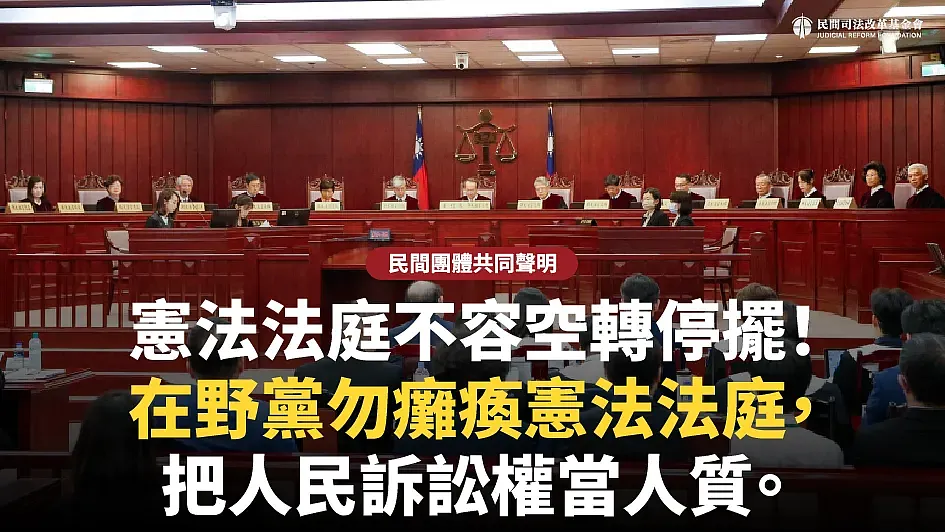
Joint Statement by Civil Society Organizations: The Constitutional Court Must Not Grind to a Halt! Opposition Parties Must Not Paralyze the Constitutional Court and Hold Citizens' Right of Access to Court Hostage
Last edited: 2026-11-03
Today (October 18), the Legislative Yuan moved KMT Legislator Weng Hsiao-ling's draft amendment to the Constitutional Court Procedure Act to a second reading (Full text of Proposal 1). Concurrently, KMT Convening Lawmaker Wu Tsung-heng issued a notice to alter the agenda to review another draft amendment to the Constitutional Court Procedure Act proposed by KMT Legislator Weng Hsiao-ling next Monday (October 21) (Full text of Proposal 2).
We hold that while opposing the president's nominated Grand Justices falls within the authority of the Legislative Yuan, and reasonable discussion regarding the rational operation of the Constitutional Court system is not out of the question. However, the opposition parties' hasty introduction of the aforementioned amendments at a sensitive time when the terms of nearly half of the Grand Justices are about to expire is an intentional attempt to use legislative power to unilaterally paralyze the operation of the judicial power. Furthermore, the KMT-led legislative amendments raise serious concerns of intimidation and attempts to influence the Constitutional Court's adjudication of the "Congressional Expansion of Powers / Reform Bills."
If the aforementioned drafts are passed and the vacancies of the Grand Justices are not filled, it could lead to the indefinite paralysis of the Constitutional Court due to an insufficient number of members. This would render the judicial power unable to check and balance illegal abuses of power by the president, executive power, and legislative power, potentially causing severe consequences that undermine the separation of powers and the rule of law. At the same time, this proposal completely fails to consider its severe impact on citizens' right of access to court.
Judicial Reform Foundation, Covenants Watch, Taiwan Labour Front, Citizen Congress Watch, Taiwan Association for Criminal Defense, Taiwan Alliance to End the Death Penalty, Environmental Rights Foundation, Taiwan Association for Human Rights, Amnesty International Taiwan, National Union of the Mentally and Physically Disabled, Taiwan Forever Association, Hong Kong-Taiwan Democracy Monitor, Taiwan Security Association, Koo Wide-Min Foundation, Environmental Jurists Association, Firefighters' Rights Promotion Association, Indigenous Youth Front, Taiwan Indigenous Youth Public Participation Association, and Hong Kong Outlanders—a total of 19 organizations—jointly call on legislators not to use the constitutional litigation system as a bargaining chip for political maneuvering, and strongly condemn the legislators who support the aforesaid proposals. We call on the general public to pay attention to this case, and urge all political parties and legislators not to pass the aforementioned proposals and to take concrete actions in response to these inappropriate legislative amendments.
1. The Constitutional Litigation System Should Not Become a Sacrificial Lamb of Political Maneuvering
We believe that amendments to the constitutional litigation system can certainly be made after rational debate based on the practical needs and merits of the system. However, the two draft amendments to the Constitutional Court Procedure Act by KMT Legislator Weng Hsiao-ling were precisely introduced at a time when the opposition parties intend to boycott the personnel appointments of the Grand Justices, and nearly half of the Grand Justices are set to step down on October 31. Meanwhile, the "Congressional Expansion of Powers / Reform Bills" passed under the leadership of the opposition coalition are also currently being adjudicated by the Constitutional Court.
During the legislative amendment process of the Constitutional Court Procedure Act in 2019 and after its passage, the KMT never formally proposed differing opinions regarding the composition and voting thresholds of the Constitutional Court. However, ever since the Grand Justices began reviewing the "Congressional Expansion of Powers / Reform Bills," KMT legislators have frequently "expressed concern" over the constitutional litigation system through legislative amendments. Objectively speaking, the KMT-led legislative amendments this time raise concerns of intimidation and attempts to influence the Constitutional Court's adjudication of the "Congressional Expansion of Powers / Reform Bills."
2. Defining the "Existing Total Number" as the "Statutory Total Number" is an Absurd Amendment that Calls a Stag a Horse
KMT Legislator Weng Hsiao-ling's draft amendment seeks to define the "existing total number" composing the Constitutional Court as the 15 members of the "statutory total number." Its approach is to add Paragraph 3 to Article 4 of the Constitutional Court Procedure Act: "The existing total number of Grand Justices referred to in this Act refers to the number of Grand Justices stipulated in Article 5 of the Additional Articles of the Constitution."
In terms of legislative text, the so-called "number of Grand Justices stipulated in Article 5 of the Additional Articles of the Constitution" (15 members) is the "statutory total number," whereas the "existing total number," according to its literal meaning, should refer to the "actual number of Grand Justices currently appointed in accordance with the law." From ordinary wording and interpretation, anyone can tell that the "existing total number" and the "statutory total number" are distinct concepts. Generally speaking, even if legislators intend to raise the statutory quorum for the operation of the Constitutional Court, they would not adopt an approach in legislation that confuses the aforementioned definitions and calls a stag a horse.
The shoddy quality of this legislation is also reflected in its conflict with the provisions themselves. Article 12 of the Constitutional Court Procedure Act stipulates: "Grand Justices who recuse themselves pursuant to this Act shall not be included in the count of the existing total number." Therefore, defining the existing total number in the draft amendment outside of the current Article 12 is likely to generate interpretive difficulties due to definitional contradictions.
The intention of this proposal is likely to prevent the Constitutional Court from operating normally after October 31. Because the terms of 7 Grand Justices will expire on October 31, only 8 Grand Justices will remain in office. In short, after the proposal passes, the Constitutional Court will be unable to adjudicate any cases until 2 members are added. This naturally includes constitutional litigation cases petitioned by citizens.
3. Raising the Voting Threshold is a Major Regression for Judicial Reform
Another proposal by KMT Legislator Weng Hsiao-ling attempts to change the voting threshold of the Constitutional Court Procedure Act from "attendance of two-thirds of the existing total number and consent of one-half of the existing total number" uniformly to "attendance of two-thirds of the existing total number and consent of two-thirds of the existing total number." This amendment is a regressive legislative move that returns to the old system.
Point 3 of the legislative reasoning for the 2019 amendments clearly points out: "Furthermore, the former provision of the first paragraph, first sentence of Article 14 stipulated that the voting threshold for reviewing whether a law violates the Constitution required the consent of two-thirds or more of the attending members in deliberation. As a result of practical operation, this frequently led to cases being difficult to conclude; this provision did not conform to the comparative law norm of adopting a majority vote for constitutional review cases, meaning that even if a majority of Grand Justices held the view of unconstitutionality, they still could not declare a law unconstitutional, causing cases to stall without reaching a conclusion and affecting the rendering of interpretations and the conclusion of cases. Therefore, there is a need to improve the current system. To protect the rights of petitioners and enhance the efficiency of Grand Justices in adjudicating cases, this article expressly stipulates that judgments shall, as a principle, require the consent of a majority of the existing total number of Grand Justices to facilitate the prompt conclusion of cases." In addition, Point 4 also explains: "For impeachment cases against the president and vice president in Chapter V and political party unconstitutional dissolution cases in Chapter VI, their passing numbers shall, according to the nature of the cases, be stipulated in Articles 75 and 80 respectively with a higher threshold requiring the consent of two-thirds or more of the existing total number of Grand Justices..."
In other words, the current voting threshold of the Constitutional Court Procedure Act is the conclusion derived from combining the past 73 years of constitutional interpretation experience of the Grand Justices. This current legislative proposal generalizes "extreme situations" rarely seen in past practice to drastically roll back reform, which will affect the efficiency of citizens in obtaining constitutional litigation results and is highly inappropriate.
If it is necessary to review the voting threshold, a more meaningful way of discussion would be to conduct more delicate discussions according to different adjudication procedures and the importance of the adjudication objects. However, taken together, KMT Legislator Weng Hsiao-ling's two proposals require at least 10 Grand Justices to be present, along with the unanimous consent of all attendees, in order to render a ruling. This greatly increases the difficulty for the Constitutional Court to render rulings, which is truly alarming.
4. The Constitutional Court is the Guardian of Citizens' Rights; Opposition Parties Must Not Disregard Citizens' Right of Access to Court
We want to emphasize once again that aside from potentially handling cases of high political controversy, the Constitutional Court is also the guardian of citizens' fundamental rights. Whether it is the recent Siraya Indigenous status case (111-憲判-17), the same-sex marriage freedom case (Interpretation No. 748), or earlier miscarriage of justice cases such as Hsu Tzu-chiang (Interpretation No. 582) and Teng Yuan-chen's bigamy case (Interpretation No. 242), the Grand Justices have played an important role in the judicial system as protectors of human rights.
When citizens find nowhere to turn for help in judicial cases, the Constitutional Court is also the last line of defense they pin their hopes on. If the Constitutional Court is paralyzed, what will be affected is the rights and interests of the vast masses of innocent citizens. We believe that KMT Legislator Weng Hsiao-ling's proposal completely fails to consider its impact on citizens' right of access to court.
We solemnly call on political parties not to disregard the rational operation of the Constitutional Court and impair citizens' right to effective judicial remedy merely for momentary political maneuvering or party interests.
5. Opposition Parties' Sabotage of the Constitutional Court Aims to Cause the Court to Idle and Paralyze, Which May Trigger a Constitutional Crisis
We emphasize once again that regarding the voting threshold of the Constitutional Court, there is naturally the possibility of rational discussion and debate within the system. However, at a time when the KMT is reviewing the "Congressional Expansion of Powers / Reform Bills" and intends to boycott the Grand Justice personnel consent power, the relevant legislative amendment proposals risk losing objectivity and rationality, potentially degenerating into tools to influence the Constitutional Court's adjudication of cases. Even if the opposition parties "allow" 3 people to pass so that the Constitutional Court has 10 Grand Justices and can "barely" operate, it cannot conceal the fact that they are arbitrarily trampling on the judiciary and disregarding citizens' rights and interests.
Moreover, when observing the opposition parties' boycott or refusal to review Grand Justice nominees in conjunction with their two amendments—"defining the 'existing total number' as the 'statutory total number'" and "raising the voting threshold from one-half to two-thirds of the existing total number"—the opposition parties' intention to cause the Constitutional Court to idle and paralyze is glaringly obvious!
Furthermore, as an important pillar of checks and balances of power, the Constitutional Court not only conducts unconstitutionality reviews on bills passed by the Legislative Yuan, but also prevents autocratic rule by the president and executive power. If the opposition parties wish to paralyze the court simply because they feel the legislative power is restrained by the judicial power, they fail to foresee that the president and executive power are subject to the same restrictions. If the Constitutional Court is paralyzed, it will simultaneously cause the president and executive power to lose their checks and balances, which is probably not what the public wishes to see. If the legislative power and other organs of power fail to respect the judicial power, causing unconstitutional and illegal actions to become commonplace, it will severely undermine Taiwan's hard-won foundations of democracy and the rule of law.
***
In fact, in the past, the legislative majority also deleted the professional allowance for Grand Justices due to dissatisfaction with the constitutional interpretation of the Truth Investigation Committee Act, which was later declared unconstitutional in Interpretation No. 601. Even earlier, because the Grand Justices determined that the National Assembly and the Control Yuan were also "parliaments" in nature (Interpretation No. 76), the Legislative Yuan raised the attendance and voting thresholds of the Grand Justices Meeting Law to an extremely high three-fourths in 1958, causing constitutional interpretation to fall into a protracted glacial period. Even so, that only increased the difficulty for Grand Justices to render interpretations. This legislative amendment, however, may paralyze the operation of the Constitutional Court in one fell swoop!
In summary, we call on legislators not to use the constitutional litigation system as a bargaining chip for political maneuvering and struggle, and strongly condemn the legislators who support the aforesaid proposals. We call on the general public to pay attention to this case, and urge all political parties and legislators not to pass the aforementioned proposals and to take concrete actions in response to these inappropriate legislative amendments.
Initiating Organizations of the Statement (Welcome to Join the Joint Statement)
Judicial Reform Foundation
Covenants Watch
Taiwan Labour Front
Citizen Congress Watch
Taiwan Association for Criminal Defense
Taiwan Alliance to End the Death Penalty
Environmental Rights Foundation
Taiwan Association for Human Rights
National Union of the Mentally and Physically Disabled
Taiwan Forever Association
Hong Kong-Taiwan Democracy Monitor
Taiwan Security Association
Koo Wide-Min Foundation
Environmental Jurists Association
Firefighters' Rights Promotion Association
Indigenous Youth Front
Taiwan Indigenous Youth Public Participation Association
Hong Kong Outlanders
Press Contacts
Lü Cheng-yen, Attorney at Law, Director of Legal Policy Department, Judicial Reform Foundation
Phone: 02-2523-1178#37
Email: elvin@jrf.org.tw
This article is an AI-generated translation of the original Chinese text. In the event of any discrepancy, the Chinese version shall prevail.