
Behind the Scenes of Judicial Reform | Crossing Mountains and Seas, Rooting the Rule of Law: A Record of Legal Education Outreach
Last edited: 2026-07-27
As we enter the final quarter of the year, looking back at 2024 as of late October, the JRF has completed or is scheduled to execute various "legal education outreach" activities in collaboration with schools and institutions. Through the "Taipei Office," which coordinates and matches "moot courts" and "special lectures," the Taipei Office expects to hold 34 moot court sessions (Jan–Dec), reaching over 1,100 participants, and at least 91 campus lectures (Jan–Dec), reaching approximately 10,070 participants. The statistical figure of over 11,000 participants does not even include grassroots educational rooting by the Taichung Office or various association-wide advocacy efforts (such as exhibitions, street stalls, forums, and workshops), etc.
The role and function of JRF's "lecturers" in "education" is to help teachers connect the "subject knowledge" published in textbooks to real-world practices and observations unfolding in real time. During moot courts, students frequently ask whether the prototype of the case resulted in a guilty or not guilty verdict, and if guilty, the length of the sentence. While sharing the source of the raw materials with the students, we always emphasize that due to curriculum time constraints, the conditions set for the case inevitably differ from the original document, and we remind students to pay attention to this difference.
Recalling the completed sessions now, my most vivid visual memories are likely of light and shadow passing through time. Once, while walking on the sidewalk toward a certain high school, surrounded by high school students moving in the same direction in a steady stream toward the school gate, I suddenly saw a familiar face coming the other way—it was the lecturer who would soon be leading the moot court. Why was he heading in the opposite direction? So I asked, "Hi! Good morning, Attorney W. Where are you headed? The school is just ahead." He smiled and replied that he wanted to head to a nearby convenience store to "grab a coffee!"—Ah, I get it, since it's an 8:00 AM class after all! But it's a bit far! Upon learning that the round trip would take ten minutes or so, Attorney W decided to turn back. Lacking the stimulating effects of caffeine, he was temporarily like a laptop in sleep mode; once the students filed into the classroom one by one, a lecturer passionate about teaching would automatically enter a high-performance mental state. "Arranging for outside guests to teach at 8:00 AM is not easy, please everyone pay attention"—the teacher's call to boost morning spirits. In fact, I think what's even less easy is the homeroom teacher themselves! In organizing the curriculum, the teachers truly put in extra thought and time for their students.
Under the experienced guidance of the lecturer, the students indeed performed exceptionally well. During the cross-examination phase, students (acting as lay judges) continuously raised their hands to ask questions, all springing from their own creative sparks. Guiding students to open up and express their own thoughts, seeing them engage in the curriculum and willing to offer feedback—witnessing students grow is definitely a natural pick-me-up far better than coffee for any lecturer.
Seeing students fully express themselves and just be who they are easily touches lecturers (even if their inner heart is shouting with excitement, facial expression management is still maintained). Recently, during the moot court group deliberations in mid-October, we discussed which weapons in the case were seized at the crime scene and how the police secured them. Were the tools the defendant's? While listening to students discuss, a lecturer shared with excitement that a group of students cited "Island Murder Chronicle" to discuss the perpetrator's handling of the "crime tool," which was content introduced three weeks prior in the "Wrongful Conviction Rescue" curriculum. The lecturer was thrilled to share this discovery with me. Therefore, even if in a certain class we might face students who haven't yet developed an interest in law, the case information provided in the curriculum introduces life experiences and prompts critical thinking, which students end up applying when the moment arises. For example, collaborating with a student club on a moot court, a student placed a Complete Works of Six Laws over ten centimeters thick on the desk. After class, he asked the lecturer how to look up original case judgments, and upon learning the ropes, immediately used his phone to search for and read the judgment.
Another lawyer told me that once, he wasn't able to finish the court drama and deliberations "because the students were extremely enthusiastic, asking endless questions to the witness-cum-expert witness. Do you know what happened later? The teacher later asked me to come back and finish the rest of the court drama and final deliberation." I felt the smile on the lawyer's face was one of gratification and a profound sense of accomplishment. Teachers and lecturers start the ball rolling and provide the scaffolding for learning, and then students draw inferences from one instance and ask questions incessantly—with students taking center stage as learners, they expand the boundaries of learning even further.
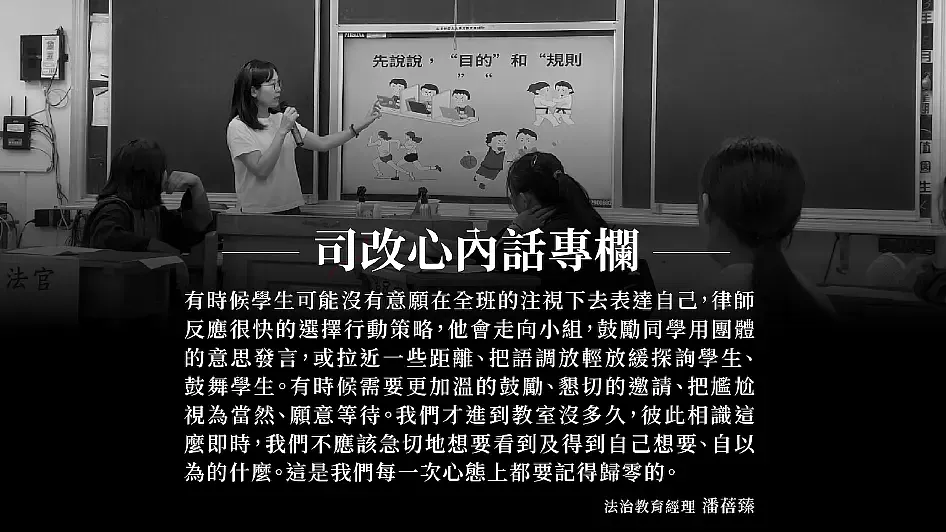
Among the high school students we partner with, some are from the same class, while others come from different classes. Sometimes students may be reluctant to express themselves under the gaze of the whole class; the lawyer would quickly choose a behavioral strategy, walking over to the groups, encouraging students to speak on behalf of the group, or moving a bit closer, softening and slowing their tone to probe and encourage the students. Yes, sometimes what is needed is warmer encouragement, a sincere invitation, treating awkwardness as a matter of course, and being willing to wait. Not long after stepping into the classroom, mutual understanding happens so instantly; we should not be impatient to see and get whatever we want or assume. This is the mindset to which we must remember to reset every single time.
Students recently fed back: "I don't care at all how many questions I was asked; I only care whether I answered clearly myself. This activity is only fun if played this way! Adding a bit of randomness keeps the moot court from being too rigid."
The moot court, affirmed by students, is 100% indebted to the teachers' arrangements and the students' willingness to participate. Moot court is an interactive curriculum that is very difficult to replicate online. In metropolitan areas, we have subway and bus networks, and the team enjoys an advantage in accessibility when executing missions. Once outside metropolitan areas, urban-rural gaps introduce factors such as transportation methods, geographical distances, and increased time costs.
In late May this year, the author once again set foot on the Southern Cross-Island Highway, heading to a remote school. I had already experienced the winding mountain roads and distant travels last time, but what made this time different was that the day before departure, the teacher emailed a reminder: "It's been raining constantly in the mountains recently, remember to turn on your headlights when driving, drive slowly~" and "Don't drive over small falling rocks on the road; shale easily causes flat tires."
This time I experienced firsthand the daily realities frequently encountered by remote indigenous schools. Only then did I realize that poor transportation is accompanied by even greater risks. When the class session ended, it was still raining, and the principal reminded us to be careful, saying, "There are fallen branches on the road, and staff members have reported they've been cleared." Turns out this is the daily routine for people living in mountainous areas; it isn't just a matter of whether we have time to visit remote schools, but more importantly, how to successfully complete our mission requires conditions far stricter than in other regions, which only highlights the significance of this journey all the more.
Our forms of campus collaboration include one-off courses as well as law-themed "flexible learning courses," such as Su Chien-ho and Hsu Tzu-chiang sharing "Taiwan's Judicial Human Rights (Part 1) & (Part 2): Walking Human Library Enters the Classroom," combined with role-playing activities like "Moot Court," thematic courses, and other curricular combinations. On the issue of "friendly campuses," we have also been invited to lead upper-lower elementary school students in understanding bullying and child sexual exploitation, and have engaged in professional dialogues with teachers on "New Regulations and Case Analysis for Campus Bullying Prevention." Regarding "community legal education outreach," we offer law courses with community colleges—the spring semester in the first half of the year, and the autumn semester in the second half are currently underway, and in October we began receiving invitations to plan the curriculum for next spring. To accommodate the learning interests of both returning and new community college students, the syllabus will be reorganized to a certain extent. The law classes begin at 7:00 PM. Every time I walk into a community college classroom, my vivid visual memory is of the white fluorescent lights in the dark night, the wooden desks and chairs, and students taking their seats one by one—including retired silver-haired students as well as office workers rushing over after work (this class time embodies a tight, fast-paced rhythm moving between the workplace and the classroom).
Regardless of compulsory education, senior learning, or continuing education, wherever there is a need for legal education, we seize the opportunity to move forward together with diverse cooperative partners to firmly anchor the rule of law.
This article is an AI-generated translation of the original Chinese text. In the event of any discrepancy, the Chinese version shall prevail.