
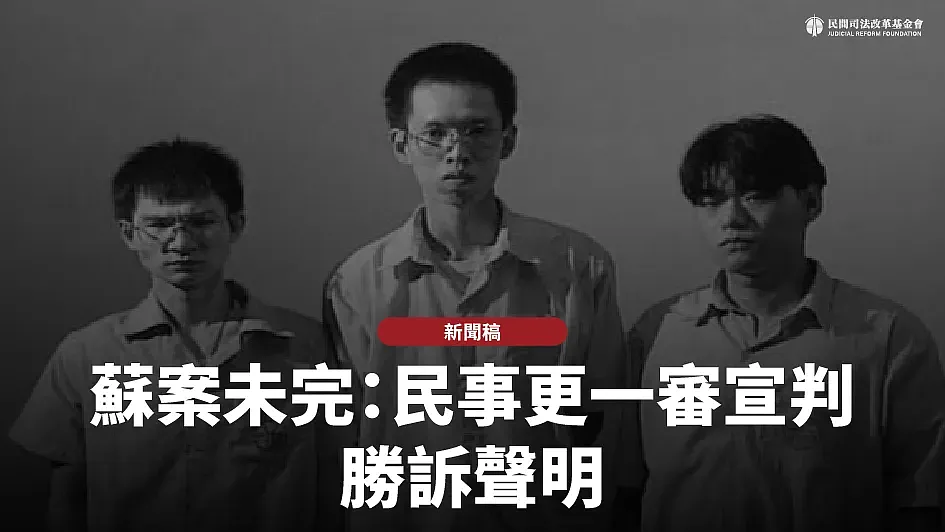
Statement on Winning the Verdict | The Su Case Is Not Over Yet: Civil Remand First Instance Judgment
Last edited: 2026-07-27
Today, the Civil Division of the Taiwan High Court delivered its judgment on the damages claim against Su Chien-ho, Liu Bing-lang, and Chuang Lin-xun, dismissing the victim's family's appeal and upholding the first-instance ruling that Su Chien-ho and the other two are not liable for damages. In response, the pro bono legal team earnestly hopes that this case will reach a final settlement soon, allowing Su Chien-ho and the other two, as victims of wrongful conviction and torture, to return to ordinary daily life.
This case is a well-known wrongful death penalty case. In 1991, a murder of the Wu couple occurred in Hsichih Township, Taipei County. However, without any objective evidence proving that Su Chien-ho and the other two were involved in the murder, and relying solely on confessions obtained through torture, the court finalized the criminal case in the third instance on February 4, 1995, wrongly determining that Su Chien-ho and the other two participated in the crime, sentencing each of them to two death penalties and deprivation of civil rights for life. Fortunately, on May 18, 2000, through the persevering efforts of the pro bono legal team, the High Court ruled to initiate a retrial. After the Supreme Court remanded the retrial case to the High Court for further proceedings three times, the retrial third-remand judgment on August 31, 2012, ultimately concluded that Su Chien-ho and the other two did not participate in the crime. The three finally cleared their names and were acquitted, and the case was finally finalized. From the moment Su Chien-ho and the other two were accused of the crime, from the age of 18 to 39, they spent 21 long years proving their innocence.
However, what many people do not know is that the criminal ancillary civil damages lawsuit filed by the victim's family in 1992 continued to be tried by the civil court after the criminal case was finalized. Both the first and second-instance courts held that Su Chien-ho and the other two were not liable for damages. Nevertheless, on August 26, 2020, the Civil Division of the Supreme Court vacated the judgment and remanded the case back to the High Court. The remand reasoning—stating that "the original court's reasoning—that the prosecutor failed to discharge the burden of proof regarding the absence of torture in the criminal proceedings—was insufficient to establish that Su Chien-ho was not subjected to torture, which particularly confuses the burden of proof between criminal parties and civil parties"—not only highlights a lack of sufficient awareness of the state's responsibility to prevent torture, but also ensures that this most famous and nation-shocking major wrongful conviction in Taiwan remains unresolved even today, more than 33 years after the incident occurred. Exactly 12 years since our courts confirmed through criminal judgments that Su Chien-ho and others were not involved in this crime, Su Chien-ho and the others are still wandering within the judicial system, unable to shake off the shadow of past wrongful convictions. Today's judgment result is merely a belated containment of damage; we fervently hope that this case can be finalized soon, bringing an end to the long and arduous litigation journey of Su Chien-ho and others.
Contact
Chang Hua-che, Deputy Director of the Case Action Department, JRF
02-2523-1178 ext. 22
ven@jrf.org.tw
This article is an AI-generated translation of the original Chinese text. In the event of any discrepancy, the Chinese version shall prevail.