
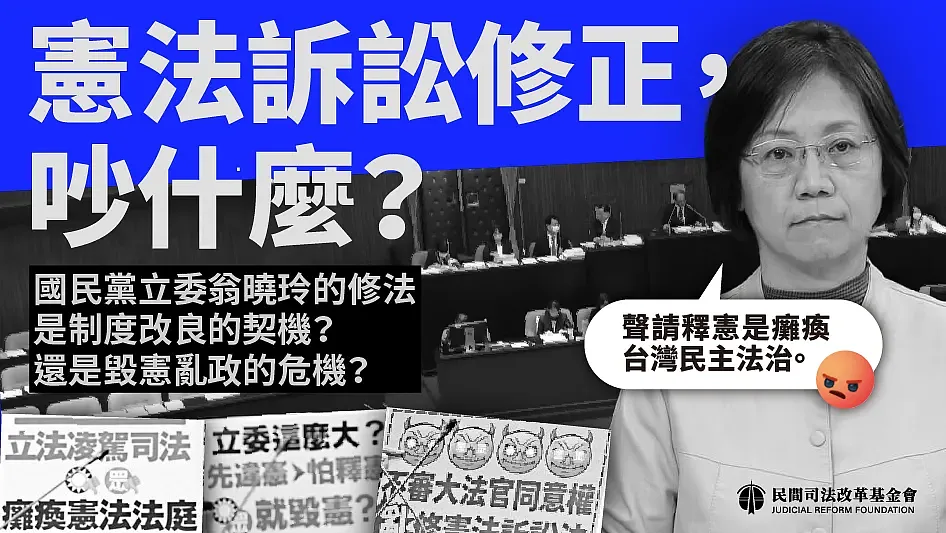
Pocket Guide | An Opportunity for Institutional Reform or a Crisis of Constitutional Destruction? The Controversy Over Amendments to the Constitutional Court Procedure Act
Last edited: 2026-11-03
Recently, Kuomintang (KMT) Legislator Weng Hsiao-ling proposed a bill to amend the Constitutional Court Procedure Act. First, she added a third paragraph to Article 4, stipulating that "the total number of incumbent Grand Justices referred to in this Act shall mean the number of Grand Justices specified in Article 5 of the Additional Articles of the Constitution." In other words, this defines "total incumbent members" as the "statutory total" of 15 members. Meanwhile, she changed the threshold of a "majority vote" under Articles 30 and 43 to a "vote of two-thirds or more." Following these amendments, meetings of the Grand Justices, the rendering of judgments, or temporary restraining orders would all require the attendance of at least 10 members and the consent of at least 10 members.
The aforementioned amendments have sparked intense debate from all sides. Proponents argue that the Constitutional Court Procedure Act's lack of a "quorum" requirement is a major loophole, and contend that the Constitutional Court naturally should have a high threshold for making rulings; opponents, on the other hand, worry that this wave of amendments will effectively make it difficult for Grand Justices to exercise their powers, impairing the operation of the constitutional litigation system.
During the Judiciary and Organic Laws and Statutes Committee meeting in the Legislative Yuan on October 21, extensive discussions were also held comparing the systems of other countries. However, is the matter truly as simple as discussed? Below, we introduce the systems of other countries and compare the controversies surrounding this amendment.
Our Opinion
On October 18, the Judicial Reform Foundation (JRF), uniting 18 civil society organizations, voiced opposition to this amendment, called upon legislators not to use the constitutional litigation system as a bargaining chip for political maneuvering, and strongly condemned the legislators who supported the aforementioned proposal.
How Do Other Countries Regulate This?
In her explanatory notes to the draft bill, Weng Hsiao-ling mentioned that she referenced Germany's system when setting the statutory attendance requirements. Furthermore, Huang Kuo-chang, during his questioning at the Legislative Yuan's Judiciary and Organic Laws and Statutes Committee, also cited examples from countries such as Japan, the United States, South Africa, and South Korea to illustrate that these nations require a certain level of attendance (threshold) for deliberations by constitutional review organs.
Let us take the United States, Germany, and Japan as examples to see if the situation is truly as the legislators claim.
Supreme Court of the United States
Constitutional review in the United States is "decentralized," meaning that judges at all levels of courts can refuse to apply laws they consider unconstitutional in individual cases. However, if a law is to be declared unconstitutional with general binding effect, a ruling must still be issued by the Supreme Court of the United States.
In addition, there are procedures for handling situations where the Supreme Court cannot hold sessions due to a lack of a quorum under specific circumstances: for instance, if a case originates from a district court, the Chief Justice may order the case to be remanded to the court of appeals for the federal judicial circuit embracing the district in which the case is situated, to be heard and determined by that court. Alternatively, if a majority of the Justices are of the opinion that the case cannot be heard and determined during the next ensuing term, the Supreme Court shall enter an order affirming the judgment of the court below with the same effect as if by an equally divided court.
Moreover, under the "rule of necessity," if multiple Justices have a conflict of interest regarding the case at issue, resulting in a lack of a quorum to hold a session, and the case definitively cannot be heard by any other means, the Justices may participate in the case's adjudication despite the conflict of interest.
Federal Constitutional Court of Germany
The Federal Constitutional Court of Germany is composed of two senates (each consisting of 8 judges, with the two senates adjudicating different types of cases). When a judge has grounds for recusal, a substitute judge is drawn by lot from the other senate. Additionally, because political parties may fail to elect new judges, German law provides that if new judges for the Federal Constitutional Court cannot be elected, the incumbent judges shall continue to exercise their duties until a new judge is appointed, thereby ensuring the smooth operation of the Constitutional Court.
Furthermore, the specific cases in Germany that require a special threshold of a two-thirds majority of the statutory total number of members for an adverse ruling against a party are limited to the following: deprivation of basic rights, dissolution of unconstitutional political parties, exclusion of state funding for political parties, impeachment of the Federal President, and impeachment of judges. Judgments declaring a law unconstitutional are not subject to this special threshold. In fact, Taiwan's current provisions for the "impeachment of the President" and the "declaration of dissolution of a political party" also require a special threshold of a two-thirds majority consent.
Supreme Court of Japan
Judges of the Supreme Court of Japan are appointed directly by the Cabinet without the need for parliamentary consent, and judges have no fixed term of office. However, upon their appointment, at the first general election of the House of Representatives following their appointment, and thereafter at intervals of 10 years, they are subject to a "national review" via a ballot; if the majority of votes are against a judge, that judge is dismissed.
Regarding the requirement for consent, Japan requires the consent of at least 8 judges to declare a law unconstitutional.
It is also worth noting that the aforementioned regulations concerning attendance and voting are not explicitly stipulated in statutes, but are instead prescribed in the Rules of Judicial Proceedings of the Supreme Court, independently enacted by the Supreme Court.
Adopting Only Half of Foreign Systems May Cause the Constitutional Court to Struggle to Function
As shown from the institutional introductions above, taking Germany, Japan, and the United States as examples, these countries all have institutional methods in place to prevent vacancies among judges in constitutional review organs, or at least mechanisms that allow them to continue operating when vacancies occur within the body.
However, Taiwan's current Constitutional Court Procedure Act lacks any special handling mechanisms for vacancies among Grand Justices. If Weng Hsiao-ling's draft version is followed, it will result in the Constitutional Court being unable to function when the number of members drops below a certain level. For instance, right at this moment, exactly 7 Grand Justices completed their terms and retired on October 31. Under Weng Hsiao-ling's draft bill, the remaining 8 Grand Justices would be unable to render any judgments, and the Constitutional Court would fall into a standstill.
Therefore, forcing the attendance requirements of the Constitutional Court without adjusting other complementary measures makes Weng Hsiao-ling's current draft fundamentally flawed in its institutional design. Moreover, the timing of the bill's proposal—precisely when multiple Grand Justice vacancies are imminent and unfilled—further highlights the problematic nature of this draft.
Raising the Voting Threshold is a Step Backward for Reform
In addition to raising the attendance threshold, Weng Hsiao-ling's draft also increases the voting threshold, setting standards that exceed those of Germany, Japan, and the United States.
Taking Germany as an example, once the "attendance" threshold is met, the "voting threshold" for general cases requires merely a majority of those participating in the adjudication; the United States likewise requires a majority vote.
Japan requires the specific consent of at least 8 judges to declare unconstitutionality. However, when all 15 members are in attendance, this functions very similarly to a majority rule. In contrast, Weng Hsiao-ling's draft requires a voting threshold of 10 or more out of 15 members, which is a much higher threshold than Japanese law.
Therefore, under the condition of meeting the attendance and deliberation quorum, Weng Hsiao-ling's draft actually imposes a higher requirement for the proportion of consent needed to render a judgment than the aforementioned countries.
This article is an AI-generated translation of the original Chinese text. In the event of any discrepancy, the Chinese version shall prevail.