
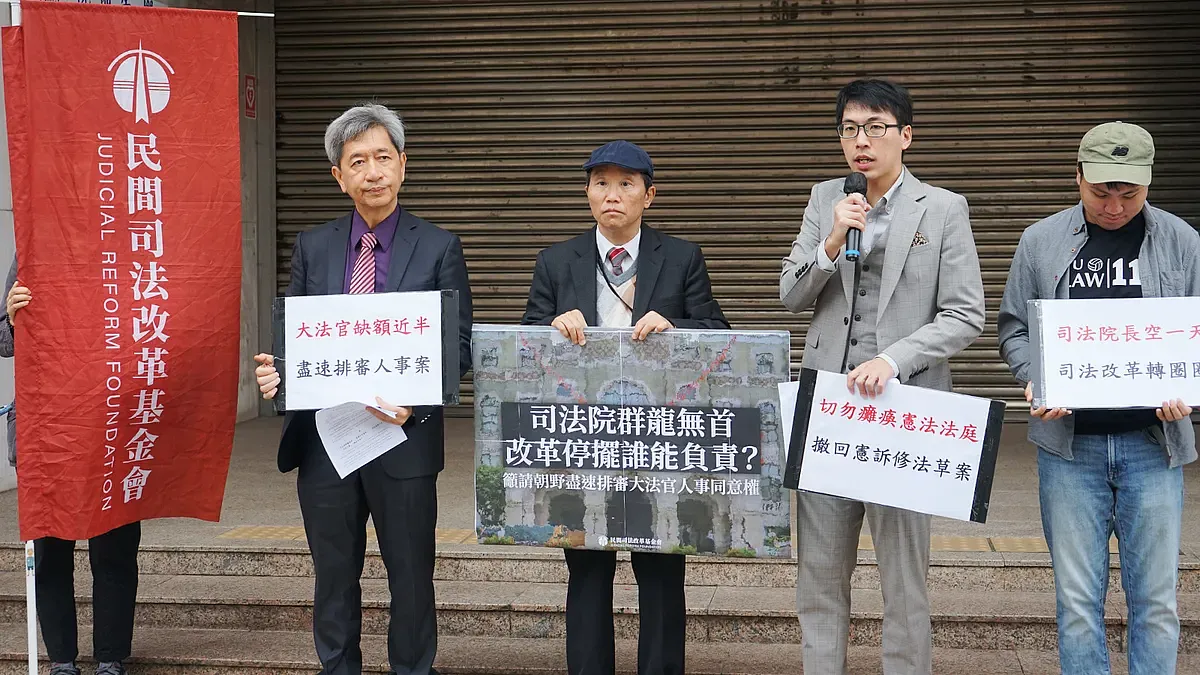
Press Conference|Judicial Yuan Without Leadership and Reforms Stalled: Who Can Be Held Accountable? Urging the Legislature to Promptly Schedule Confirmation Hearings for Grand Justices
Last edited: 2026-11-03
The President and Vice President of the Judicial Yuan, along with five Grand Justices, stepped down on October 31, yet the Legislative Yuan has not yet scheduled the confirmation hearings for the nominees for Grand Justices. The vacancies in the leadership of the Judicial Yuan, currently filled on an acting basis by a senior Grand Justice, have brought the advancement of judicial policy and reform to a standstill, ultimately harming the rights and interests of the people.
Currently, the Constitutional Court has only eight members, which is barely over the statutory quorum. Meanwhile, the draft amendments to the Constitutional Court Procedure Act proposed by Kuomintang (KMT) legislator Weng Hsiao-ling are about to enter party caucus negotiations. If passed in the third reading, this would result in the legislative branch unilaterally forcing the judicial branch to a halt, impeding the people's right to effective judicial remedies and severely undermining the checks and balances among state powers.
In light of this, the Judicial Reform Foundation solemnly puts forward two demands and issues the following statement:
1. All party caucuses in the Legislative Yuan should actively engage in negotiations, promptly schedule the review dates for the personnel consent appointments of the President and Vice President of the Judicial Yuan as well as the Grand Justices, and face up to the predicament where the Judicial Yuan and the Constitutional Court cannot operate normally.
2. The Kuomintang should withdraw the draft amendments to the Constitutional Court Procedure Act; it must not turn back the clock on reform, undermine the separation of powers, or trample upon the people's right to constitutional remedies.
At the same time, regarding the crisis where the judicial branch's check on other powers is about to stall, we also call upon all sectors of society and civic organizations to stand up and voice their opposition, urging politicians of all parties to strictly adhere to the bottom line of constitutional operation and refrain from using the judiciary as a sacrificial lamb for political struggle.
1. The Judicial Yuan Lacks Leadership: Who Will Take Responsibility for "Overworked Grassroots Judges," "Technological Investigation Sub-laws," and "Judicial Personnel Matters"?
In addition to serving as the President of the Constitutional Court and rendering constitutional judgments, the responsibilities of the President of the Judicial Yuan include overseeing general court administration and supervising subordinate judicial organs. The Vice President of the Judicial Yuan acts on behalf of the President and handles matters entrusted by the President.
According to Judicial Yuan Interpretation No. 530, based on the principles of judicial independence and judicial autonomy, the Judicial Yuan has the power to issue rules regarding matters of adjudication. Furthermore, to safeguard the public's right to judicial benefits and ensure that individuals have adequate and effective rights to a fair trial, the Judicial Yuan inherently possesses the authority for judicial administrative supervision. In other words, apart from participating in adjudication, the more crucial responsibilities of the President and Vice President of the Judicial Yuan lie in the exercise of "judicial administrative power" and "rule-making power."
Therefore, to uphold judicial independence and the people's right to a fair trial, the President of the Judicial Yuan must shoulder the heavy responsibility of judicial reform and actively promote related judicial policies. At least the following four major issues are currently urgent, in dire need of reform, and awaiting planning:
(1) Alleviating the Judicial Burden:
According to the Judicial Yuan's statistical yearbook, over the past decade, the number of concluded civil cases in district courts nationwide has been steadily rising, growing from 2.39 million in 2014 to 2.7 million in 2020, and reaching 3.07 million cases in 2023. On average, each judge completed 60 to 70 cases per month. Similarly, the number of newly received criminal cases in district courts has also shown an upward trend over the past three years, growing from 407,000 cases in 2020 to 483,000 cases in 2023.
Last November, Judge Hsiao at the High Court collapsed after intensively working overtime to hear cases and was rushed to the hospital for the emergency installation of a cardiac stent; this February, Clerk Ch'en at the Miaoli District Court passed away from illness, suspected to be due to excessive work pressure and prolonged extreme exhaustion; in April, a female civil judge Ch'en at the High Court suddenly collapsed in her office while reviewing case files in the evening, regaining consciousness only after being rushed to the hospital for emergency treatment. This amply demonstrates the heavy burden carried by judges and related judicial staff, which is in urgent need of alleviation. "Alleviating the judicial burden" concerns not only the labor rights of judges, court clerks, and grassroots judicial personnel, but also the quality of trial procedures and public trust in the judiciary. To prevent judicial personnel from being overburdened, the Judicial Yuan should effectively adjust judicial resources, properly plan judicial personnel arrangements, and optimize judicial procedures to enhance the quality of adjudication.
(2) Combating Fraud and Technological Investigation:
In July this year, amendments to the Code of Criminal Procedure added a dedicated chapter on "Technological Investigation," providing a legal basis for investigative agencies such as the police and prosecutors to conduct technological investigations. However, as the competent authority for the Code of Criminal Procedure, the Judicial Yuan still needs to deliberate and formulate sub-laws to ensure the smooth operation of the new system. In addition to responding to the diversification of technological crime methods, it is all the more necessary to ensure that individuals do not suffer rights violations as a result of investigative methods.
In other words, these sub-laws—which determine whether the new system can operate smoothly—also require a final decision by the President of the Judicial Yuan.
(3) Judicial Personnel Appointments and Deliberation Powers:
The President of the Judicial Yuan manages the staffing establishment, human resources planning, and personnel recruitment of judicial organs, and also holds the power to evaluate the presidents of first- and second-instance courts. Important personnel cases are coordinated by the President of the Judicial Yuan through the "Personnel Review Committee" chaired by the President, thereby forming a team to advance judicial reform.
For instance, the pivotal "Personnel Review Committee" has 11 members directly designated by the President; the transfer lists of division chiefs in various courts are ultimately decided by the President of the Judicial Yuan after referencing election results and conducting consultations. Directors of the Legal Aid Foundation are also ultimately selected and appointed by the President of the Judicial Yuan, and the current term of directors will expire next March, with the candidate recommendation process already underway. In addition, important positions big and small, such as judges of the Criminal Compensation Tribunal and members of the Document Review Committee, are directly designated by the President of the Judicial Yuan.
(4) Reforms to the Citizen Judges Act:
Pursuant to the Citizen Judges Act, the majority of major criminal cases will, in principle, enter the citizen judge procedure. As the citizen judge system has been in operation for less than two years, issues requiring continuous reform still persist, including the asymmetry of prosecution and defense resources, the lack of sentencing plea procedures, and stratified screening mechanisms, among others.
As the chairperson of the "Evaluation Committee on the Performance of the Citizen Judges System," the President of the Judicial Yuan must also make decisions and bear responsibility for the continued refinement, success, or failure of this policy.
Aside from the aforementioned urgent matters, court-related judicial reform policies and issues are myriad. If a leadership figure with decision-making capacity and accountability fails to emerge, these matters can only be postponed indefinitely.
In other words, the duties of the President of the Judicial Yuan extend far beyond participating in the rendering of constitutional judgments; their remit involves concrete arrangements for judicial administration, personnel appointments and deliberations, and the implementation and promotion of judicial policies. Although these tasks do not directly involve the core of individual case adjudication, the paralysis of judicial administrative operations will correspondingly affect court trials and judicial reform, indirectly infringing upon the people's judicial rights and interests.
2. An Acting President of the Judicial Yuan Lacks the Authority and Responsibility to Promote Judicial Reform; the Ruling and Opposition Parties Should Recognize Political Realities, Break the Political Stalemate, and Actively Exercise the Power of Consent for Grand Justice Appointments
On October 31, following the retirement of the President of the Judicial Yuan, pursuant to Paragraph 5, Article 7 of the Judicial Yuan Organization Act: "When the President and Vice President of the Judicial Yuan are simultaneously vacant, the President of the Republic shall designate one of the Grand Justices to act as the President; the period of such acting shall last until the day the President of the Republic nominates a successor President and Vice President, who are approved by the Legislative Yuan and appointed by the President of the Republic." At present, the President has directly designated an acting president in accordance with official powers.
However, viewed through the framework of the constitutional structure, the President of the Judicial Yuan must be nominated by the President of the Republic and consented to by the Legislative Yuan in order to be appointed, which aligns with the principle of the separation of powers. Although an acting president may temporarily exercise the powers of the judicial head, their function is merely to maintain the basic operations of the Judicial Yuan prior to the assumption of office by the new President of the Judicial Yuan, acting in the capacity of a "caretaker president." In other words, an acting president can only execute and advance existing policies; in reality, they cannot—nor are they suited to—formulate and promote major judicial reform policies, nor can they bear responsibility for the success or failure of reforms. Meanwhile, the Secretary-General, who currently assists the President in managing judicial affairs, recently resigned; the acting Deputy Secretary-General has also resigned and been reassigned to the Disciplinary Court, though the reporting date remains undetermined simply due to the lack of leadership.
It can be said that as long as the office of the President of the Judicial Yuan remains vacant for a single day, it means Taiwan's judicial reform and important policy decisions will stall for a day.
Regarding situations where the Legislative Yuan passively refrains from exercising its consent power, causing other constitutional organs to be unable to exercise their official powers, Judicial Yuan Interpretation No. 632 has long explicitly pointed out that this will result in damage to the integrity of the state's constitutional system, which is impermissible under the Constitution. The crisis facing us this time involves the Judicial Yuan, which shoulders an even more vital function within our constitutional system, and the resulting damage cannot be underestimated.
Therefore, the Legislative Yuan should fulfill its duty of loyalty to the Constitution by immediately conducting substantive reviews on the Grand Justice personnel cases, rather than passively refusing to exercise the personnel consent power. In this regard, we once again solemnly appeal that all parties should uphold their duty of loyalty to the Constitution, refrain from turning a blind eye to the predicament where the Judicial Yuan and the Constitutional Court cannot operate normally, and promptly schedule the confirmation hearings for the Grand Justice appointments. Furthermore, political parties should, from the perspectives of judicial professionalism, human rights protection, and democratic ideals, allow party members to vote freely rather than using party discipline to hijack lawmakers' decisions.
3. Withdraw the Draft Amendments to the Constitutional Court Procedure Act, Maintain the Current Resolution Thresholds and Deliberation Quorum, and Prevent the Paralysis of the Constitutional Court and Resulting Damage to Public Rights
Kuomintang legislator Weng Hsiao-ling has proposed amending the resolution threshold of the Constitutional Court from "attendance of the current total number of members, with the consent of one-half or more of the current total number" entirely to "attendance of two-thirds or more of the current total number, with the consent of two-thirds or more of the current total number." This amendment represents a regressive legislative move reverting to the old system. Moreover, raising the deliberation quorum by requiring the "current total number" to equal the "statutory total number" undoubtedly stipulates that at least 10 Grand Justices must participate in deliberations and at least 10 Grand Justices must consent before a constitutional judgment can be rendered. Conceivably, this legislative distortion that disregards plain textual meaning will hollow out the operations of the Constitutional Court. In other words, caught in the crossfire between Grand Justice vacancies and amendments to the voting system, the constitutional review function of the Constitutional Court risks paralysis, and the public's opportunity to seek judicial justice through the Constitutional Court will be sacrificed. Needless to say, amidst a chaotic legislative ecology marked by political turmoil and clashes between the ruling and opposition parties, the public can hardly expect to protect human rights and fundamental freedoms through the legislative path.
Furthermore, viewed from comparative constitutional law, even systems that adopt the "statutory total number" as a deliberation quorum threshold are accompanied by complementary measures when the quorum is not met. For instance, based on the principle of decentralized review, when the deliberation quorum is not met in the United States and Canada, the Chief Justice of the United States can issue an order requiring a circuit court of appeals to hear the case in dispute, while the Chief Justice of Canada supplements personnel through an ad hoc judge system. Germany, which shares a "centralized review" system with Taiwan, designs its Federal Constitutional Court system with two senates; when one senate fails to meet the deliberation quorum, judges are drawn by lot from the other senate to supplement numbers.
In addition, although neighboring Japan has no complementary measures for failing to reach the deliberation quorum, judges of the Supreme Court of Japan are appointed by the Cabinet without requiring parliamentary consent, meaning its system has never experienced long-term vacancies.
Returning to the current legislative amendment, legislator Weng Hsiao-ling argued that the amendments are intended to prevent a single view or a minority of viewpoints from dominating judgments, hoping to encompass diverse opinions out of concern that constitutional judgments might be rendered with the consent of only a minority of Grand Justices; thus, she seeks to enhance the legitimacy of judgments by raising the deliberation quorum and voting thresholds. However, this amendment has been rushed and exhibits shoddy legislative quality, failing to account for the legal interpretation under Article 12 of the Constitutional Court Procedure Act: "Grand Justices who recuse themselves pursuant to this Act shall not be counted in the headcount of the current total number." It creates the risk that, due to Grand Justices taking leave, illness, or recusal, the deliberation quorum may not be met, plunging people's constitutional litigation applications into a predicament where cases are accepted but cannot be adjudicated.
As the last line of defense for the protection of people's rights, if the Constitutional Court comes to a standstill, the rights and interests of the vast innocent public will be affected. We believe that the current proposal by KMT legislator Weng Hsiao-ling has completely failed to consider its impact on the people's right of litigation. We therefore solemnly call upon political parties not to disregard the reasonable operation of the Constitutional Court nor impede the people's right to effective judicial relief merely for the sake of temporary political defense or partisan interests.
The stance of the Judicial Reform Foundation has always remained unchanged: whether concerning the operation of the Constitutional Court or the selection criteria for the President of the Judicial Yuan, both must be capable of safeguarding Taiwan's free and democratic constitutional order. First, apart from handling highly political institutional dispute cases, the Grand Justices of the Constitutional Court are simultaneously guardians of fundamental human rights and a vital cornerstone of Taiwan's free and democratic constitutional order; second, the President of the Judicial Yuan must shoulder the heavy responsibility of promoting judicial reforms beneficial to the people, while also comprehending and understanding the difficulties and challenges people encounter within the judiciary, sincerely engaging in dialogue with the public, and fostering continuous communication between the judiciary and civil society to realize the true meaning of a free and democratic constitutional order.
Finally, the Judicial Reform Foundation calls upon the Kuomintang to withdraw the detrimental amendments to the Constitutional Court Procedure Act, demands that the Legislative Yuan immediately schedule confirmation hearings for Grand Justice appointments, and urges that the separation of powers not be destroyed by political struggles, the Constitutional Court not be paralyzed by political interests, and judicial reform not be sacrificed for the sake of ideology.
Attendees
Huang Hsu-t'ien | Chairman, Judicial Reform Foundation
Lin Yung-sung | Standing Board Director, Judicial Reform Foundation
Lu Cheng-yen | Director of Policy Department, Judicial Reform Foundation
Press Contacts
Lu Cheng-yen, Lin Ch'eng-ch'ing, Judicial Reform Foundation
Phone: 02-2523-1178#14
Email: kacan@jrf.org.tw
This article is an AI-generated translation of the original Chinese text. In the event of any discrepancy, the Chinese version shall prevail.