
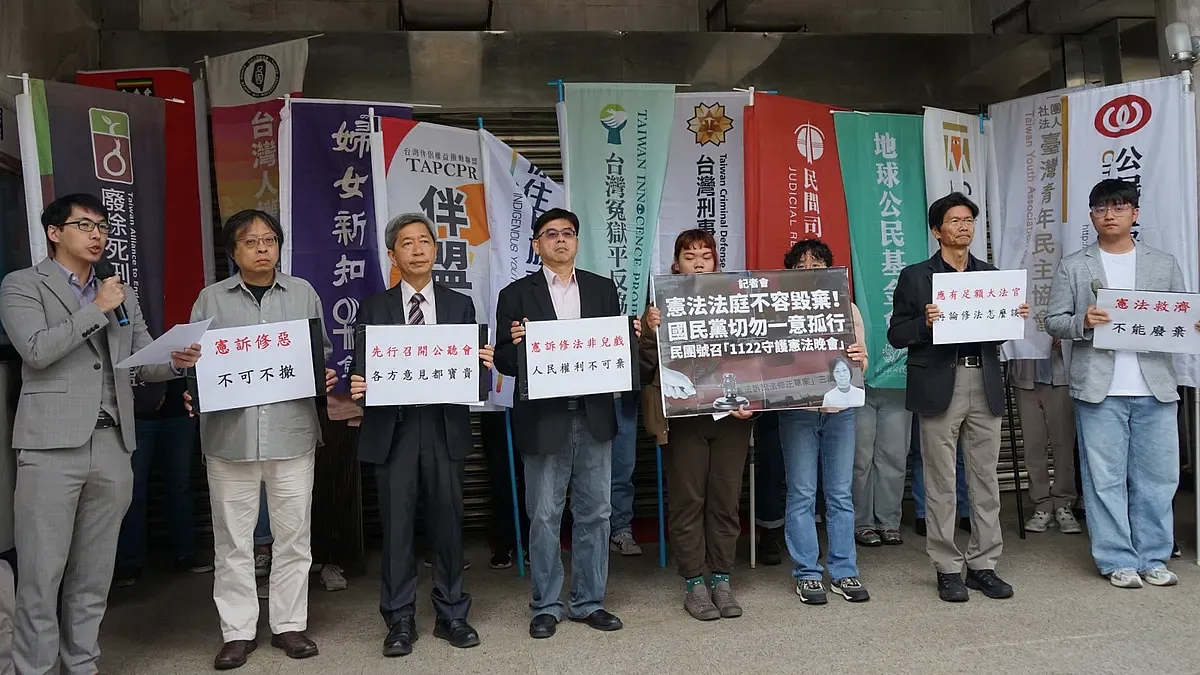
Press Conference | The Constitutional Court Must Not Be Destroyed; The KMT Must Not Act Arbitrarily! Civil Society Groups Call for the "November 22 Guarding the Constitution Evening Rally"
Last edited: 2026-07-27
Last Thursday (November 14) afternoon, the draft amendments to the Constitutional Court Procedure Act entered party caucus consultations. The three major parties failed to reach a consensus on the version proposed by KMT Legislator Weng Hsiao-ling, leaving Legislative Yuan President Han Kuo-yu to reconvene consultations. Once the consultation cooling-off period expires on November 24, the remaining second and third reading procedures could be completed as early as late November or early December.
Recently, multiple local bar associations have issued successive statements. Last Saturday (November 16), the legal profession also launched the "Guard the Constitution March" to sternly condemn the KMT-led legislative amendments, which will destroy Taiwan's vital democratic and rule-of-law foundation.
Currently, the Judicial Yuan and the Constitutional Court are facing an operational crisis. Because the acting president lacks the authority to formulate and promote major judicial policies, judicial reform in Taiwan has stagnated. Meanwhile, because only 8 Grand Justices remain to form a review panel, the Constitutional Court has had to reduce its panels from 5 to 3. Notably, Grand Justice Yu Po-hsiang must concurrently serve on 2 panels just to sustain the operation of the review panels. The Constitutional Court has also acknowledged that, with vacancies left unfilled, delays in processing constitutional interpretation cases can be expected in the future, severely impacting the efficiency and function of constitutional relief.
Despite this widespread backlash, the KMT continues stubbornly to push forward with its "malicious amendments to the Constitutional Court Procedure Act," arbitrarily and unreasonably smearing all opposing voices as "wingmen/proxies." In response, 18 organizations—including the Judicial Reform Foundation, the Covenants Watch, the Citizen Congress Watch, the Economic Democracy Union, the Taiwan Alliance to End the Death Penalty, the Taiwan Indigenous Youth Public Participation Association, the Taiwan Alliance for Advancement of Civil Partnership Rights, the Taiwan Labour Front, the Taiwan Association for Innocence, the Taiwan Association for Human Rights, the Taiwan Criminal Defense Lawyers Association, the Taiwan Teachers' Association, the Taiwan Youth Association for Democracy, Hongkong Outlanders, Amnesty International Taiwan, the Awakening Foundation, the Citizen of the Earth, Taiwan, and the Indigenous Youth Front—solemnly issue a severe warning to the KMT and call upon the public to take to the streets on November 22 to join the "Guard the Constitution Evening Rally." They demand that the KMT immediately withdraw the draft amendments to the Constitutional Court Procedure Act proposed by Legislator Weng Hsiao-ling and refrain from using the Constitutional Court as an object of political struggle.
Accordingly, civil society groups jointly and solemnly call for action and present 5 demands as follows:
1. The KMT must immediately withdraw the draft amendments to the Constitutional Court Procedure Act and publicly apologize for treating legislative amendments like a child's game.
2. We urge the TPP to oppose the aforementioned legislative direction and criticize the KMT's improper amendments.
3. Before reviewing the appointment consent of Grand Justices, the Legislative Yuan should not paralyze the Constitutional Court through legislative amendments.
4. The Legislative Yuan should hold public hearings to listen to opinions from legal scholars, civil society groups, and all sectors of society regarding the amendments to the Constitutional Court Procedure Act.
5. Legislators who value human rights protections—such as gender equality, the rights of indigenous peoples and minority groups, and workers' rights—should transcend party lines to oppose this legislative amendment and jointly safeguard the normal operation of the Constitutional Court.
"November 22 Citizens' Guard the Constitution Evening Rally" Event Information
Time:
November 22 at 5:00 PM (expected to run until 9:00 PM)
Location:
No. 1, Sec. 1, Jinan Rd., Zhongzheng Dist., Taipei City (next to the Csun-Hsien Building of the Legislative Yuan)
Organizer:
Judicial Reform Foundation
Co-organizers:
Covenants Watch, Citizen Congress Watch, Economic Democracy Union, Taiwan Alliance to End the Death Penalty, Taiwan Indigenous Youth Public Participation Association, Taiwan Alliance for Advancement of Civil Partnership Rights, Taiwan Labour Front, Taiwan Association for Innocence, Taiwan Association for Human Rights, Taiwan Criminal Defense Lawyers Association, Taiwan Teachers' Association, Taiwan Youth Association for Democracy, Hongkong Outlanders, Amnesty International Taiwan, Awakening Foundation, Citizen of the Earth, Taiwan, Indigenous Youth Front (Invitations ongoing)
I. Defining the "Existing Total Number" as the "Statutory Total Number" is an Absurd Amendment That Calls a Stag a Horse!
The draft amendment by KMT Legislator Weng Hsiao-ling seeks to define the "existing total number" of Grand Justices constituting the Constitutional Court as the "statutory total number" of 15. Her approach is to add Paragraph 3 to Article 4 of the Constitutional Court Procedure Act: "The existing total number of Grand Justices referred to in this Act shall mean the number of Grand Justices prescribed in Article 5 of the Additional Articles of the Constitution."
In terms of legislative wording, the so-called "number of Grand Justices prescribed in Article 5 of the Additional Articles of the Constitution" (15 persons) is the "statutory total number," whereas the "existing total number" by its literal meaning should refer to the "actual number of Grand Justices currently appointed in accordance with the law." Both ordinary meaning and interpretation show that "existing total number" and "statutory total number" are distinct concepts. Generally speaking, even if legislators intend to raise the statutory quorum for the operation of the Constitutional Court, they would not adopt a legislative approach that confuses these definitions and calls a stag a horse.
We believe that amendments to the constitutional litigation system can certainly be revised after rational debate based on actual institutional needs and their pros and cons. However, the two draft bills to amend the Constitutional Court Procedure Act proposed by KMT Legislator Weng Hsiao-ling were precisely introduced at a time when the opposition party intended to boycott the Grand Justice appointment case and nearly half of the Grand Justices were set to leave office on October 31.
During the 2019 amendment process of the Constitutional Court Procedure Act and after its passage, the KMT never formally proposed differing opinions regarding the composition and voting thresholds of the Constitutional Court. Yet, after the Grand Justices adjudicated the "Congressional Expansion of Power / Reform Bills" case, KMT legislators frequently used legislative amendments to "express concern" over the constitutional litigation system. Objectively speaking, there is good reason to suspect that this KMT-led legislative amendment aims to intimidate and influence the Constitutional Court's adjudication of the "Congressional Expansion of Power / Reform Bills."
II. Raising the Voting Threshold is an Ignorant Amendment That Turns the Clock Back on Judicial Reform!
Another proposal by KMT Legislator Weng Hsiao-ling attempts to change the voting threshold under the Constitutional Court Procedure Act from "attendance of two-thirds of the existing total number, and consent of one-half of the existing total number" uniformly to "attendance of two-thirds of the existing total number, and consent of two-thirds of the existing total number." This amendment represents a regressive return to the old system.
The current voting threshold under the Constitutional Court Procedure Act is a conclusion reached by synthesizing the past 73 years of constitutional interpretation experience of the Grand Justices. This proposed amendment broadly cites "extreme cases" that have rarely occurred in practice to turn back the clock on reform, which will undermine the effectiveness of citizens in obtaining constitutional litigation outcomes and is highly inappropriate.
If it is necessary to review the voting threshold, a more meaningful approach would be to conduct more meticulous discussions based on different trial procedures and the importance of the subject matter of the trial. However, the KMT's amendment requires the consent of 10 or more Grand Justices to render a constitutional judgment—a threshold much higher than the improperly high threshold designed before the Constitutional Court Procedure Act took effect in 2019. It will cause constitutional judgments to repeat the painful historical experience prior to 2019, when such judgments were difficult to render; moreover, because the threshold it sets is even higher than the pre-2019 system, it risks producing institutional results far worse than past painful experiences.
The KMT's draft amendment to the Constitutional Court Procedure Act will trigger a constitutional crisis of a substantially paralyzed Constitutional Court and will severely undermine the foundations of Taiwan's democratic constitutional order. This Foundation feels deep concern and unease regarding the amendment and calls upon all party caucuses in the Legislative Yuan not to pass this extremely inappropriate amendment proposal.
III. The TPP and Human Rights-Supporting Legislators Must Transcend Party Lines to Oppose This Legislative Amendment!
Given that the current draft amendments to the Constitutional Court Procedure Act are undergoing party caucus consultations, if passed through the third reading, it will create a scenario where the legislative branch unilaterally forces the judicial branch to a standstill, obstructing citizens' rights to constitutional relief and severely disrupting the system of checks and balances. The majority party using its numerical advantage to arbitrarily pass bills with political retaliatory implications disregards the communication and consultation mechanisms essential to democratic procedures.
Furthermore, if the amendments pass, we harbor an even greater fear that if the ruling party fails to actively schedule appointment consent bills, or if the opposition party uses numerical boycotts to refuse reviewing Grand Justice appointments, it will hollow out the Constitutional Court and paralyze its constitutional interpretation function of protecting people's rights. We solemnly call upon all political parties to oppose Weng Hsiao-ling's draft amendment based on judicial professionalism, human rights protection, and democratic principles. We specifically point out that certain legislators should not be controlled by political parties amidst the political confrontation between the ruling and opposition camps, reducing their important decisions to voting fodder for party lines.
First, we call upon individual TPP legislators: please remember that the 8 precious seats you hold in the Legislative Yuan can exercise the power of a critical minority in Congress. You should not restrict your position to the political maneuvers of the "KMT-TPP alliance." As the congressional "third force," you should reflect all the more upon the importance of your critical seats. We affirm Legislator Huang Shan-shan's willingness to brave public criticism to oppose Weng Hsiao-ling's draft amendment, explain the serious consequences of the amendments based on her own legislative professionalism, specially emphasize the importance of judicial independence, and advocate that the Legislative Yuan should actively review the Judicial Yuan's budget and Grand Justice candidates. At this critical juncture, we believe the TPP, as the third force in Congress, must break free from the current political quagmire and oppose the amendments from the perspective of protecting civil rights.
On the other hand, we believe the primary goal of indigenous legislators must be to protect and strive for indigenous rights. In other words, indigenous legislators should represent the rights and interests of indigenous peoples as a whole, rather than submit to partisan politics. The victims of this legislative amendment are not merely ordinary citizens' rights to constitutional relief, but also the constitutional pursuit of indigenous collective rights. Looking at current constitutional interpretation practice, there are a total of 5 constitutional interpretations and judgments concerning indigenous rights. Although their interpretive reasoning and outcomes are not entirely flawless and require review and criticism, they have indeed achieved a certain degree of progress in protecting indigenous rights. From the perspective of indigenous peoples striving for rights, constitutional interpretation is an even more vital advocacy channel. Therefore, we solemnly call upon all indigenous legislators to oppose this constitutional litigation amendment to prevent the constitutional relief rights of our people from being sacrificed and to avoid cutting off the opportunity to pursue indigenous collective rights through constitutional interpretation.
In addition, we urge legislators who affirm the values of gender equality never to let their decisions once again become voting fodder for party lines. Looking at Taiwan's constitutional interpretation practice, Grand Justice interpretations and constitutional judgments concerning gender equality are numerous, and several important standards for reviewing equal rights have been developed in constitutional practice. Furthermore, in most cases involving women's equal rights, the contributions of women's movement groups in pursuing rights through constitutional interpretation cannot be overlooked, highlighting that the pursuit of gender equality involves not only decisions by Grand Justices but also struggles by the people. Building upon this, we advocate that legislators who affirm gender equality must also oppose this amendment, for the reason that it paralyzes not only the operation of the Constitutional Court, but may also stifle the practice and protection of gender equality under the Constitution.
In summary, we are concerned that this legislative amendment in Taiwan will not only severely impact ordinary citizens' rights to constitutional relief, but may also block the constitutional practice of indigenous rights and equal rights. We once again call upon indigenous legislators and legislators supporting gender equality to rely on their own ideals of constitutional democracy, equality, and freedom, bravely resist the domination of party lines, and stand up to oppose this constitutional litigation amendment. In addition, we strongly demand that individual TPP legislators exercise their critical seats' vital influence, break free from the existing political structure, and oppose the malicious amendments to the constitutional litigation laws from the perspective of protecting civil rights.
Press Conference Time
Monday, November 18, 2024, 10:00 AM
Press Conference Location
Entrance of Csun-Hsien Building, No. 1, Sec. 1, Jinan Rd., Zhongzheng Dist., Taipei City
Attendees
- Lin Yung-sung | Standing Director, Judicial Reform Foundation
- Huang Cheng-han | Researcher, Economic Democracy Union
- Hsu Wei-kuo | Convener, Covenants Watch
- Tseng Chien-yuan | Chairperson, Citizen Congress Watch
- Savungaz Valincinan | Chairperson, Taiwan Indigenous Youth Public Participation Association
- Huang Chi-chou | Board Member, Taiwan Youth Association for Democracy
- Chen I-chin | Standing Supervisor, Taiwan Youth Association for Democracy
- Chien Chih-chieh | Secretary-General, Taiwan Alliance for Advancement of Civil Partnership Rights
- Huang Po-hsuan | Deputy Secretary-General, Awakening Foundation
- Wang Hsi | Deputy Secretary-General, Taiwan Association for Human Rights
- Cheng Tzu-yun | Education Outreach Specialist, Citizen of the Earth, Taiwan
- Sky | Secretary-General, Hongkong Outlanders
- Ch'ien Chien-jung | Executive Committee Member, Taiwan Alliance to End the Death Penalty
- Yang Shu-wei | Deputy Secretary-General, Taiwan Labour Front
- Chen Li-chen | Executive Secretary, Taiwan Criminal Defense Lawyers Association
- Cheng Hsiao-chun | Legal Specialist, Taiwan Association for Innocence
- Liu-Li Chun-da | Legal and Policy Officer, Amnesty International Taiwan
- Yuli Ciwas | Member, Indigenous Youth Front
Press Contacts
Lü Cheng-yen, Attorney-at-Law, Director of Legal Policy Department, Judicial Reform Foundation
Phone: 02-2523-1178#37
Email: elvin@jrf.org.tw
Lin Cheng-ching, Legislative Assistant Researcher, Judicial Reform Foundation
Phone: 02-2523-1178#14
Email: kacan@jrf.org.tw
This article is an AI-generated translation of the original Chinese text. In the event of any discrepancy, the Chinese version shall prevail.