
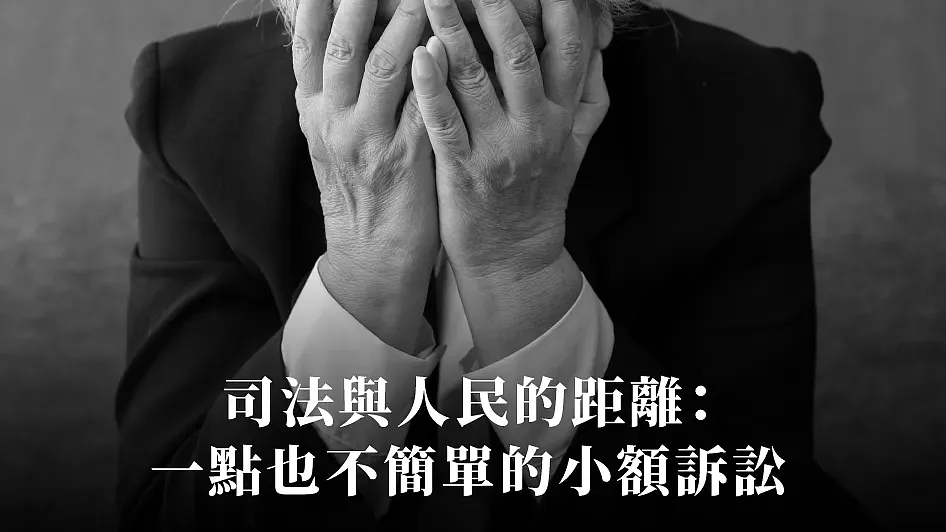
The Distance Between Justice and the People: Small Claims Litigation Is Anything But Simple
Last edited: 2026-07-27
The Distance Between Justice and the People: Small Claims Litigation Is Anything But Simple
Auntie Lai, a retired high school teacher, got into a dispute with a construction contractor over waterproofing issues at home. To protect her rights, she filed a small claims lawsuit. She thought that because the disputed amount was small, a small claims proceeding would be sufficient—allowing her to protect her rights while making the other party understand the importance of business integrity.
However, reality turned out to be far more complex than she imagined. When she received official documents from the court, they stated: "Submit a written brief to the court within the specified time limit to confirm the specific amount requested in each statement and confirm whether all claims comply with the small claims litigation procedure; furthermore, if this is a partial claim, please submit a statement reporting to this court that no further legal action will be taken regarding the remaining balance, otherwise it will violate regulations."
To Auntie Lai, these legal terms were simply like reading a heavenly book. She read them over and over again, yet still had no idea what she was supposed to do. She had no choice but to seek help once again from the court's litigation guidance section, but the answers she received still left her completely baffled. As the lawsuit progressed, Auntie Lai kept receiving various notices from the court. She could not understand why a simple lawsuit had become so complicated. She just wanted to get back the money that belonged to her; why did she have to face so many legal obstacles?
What left her most dumbfounded was that, even after completely following the advice of the litigation guidance section and the instructions of the court, the court ultimately dismissed her claims on the grounds that: "The newly added claims do not conform to the small claims litigation originally filed, and therefore a separate lawsuit should be re-filed."
Auntie Lai could not understand why legal regulations had to be so complex, leaving an ordinary citizen with simply no way to adapt.
Official Documents That Even a High School Chinese Teacher Cannot Understand
"Even I, as a Chinese teacher, cannot understand the contents of the official documents, let alone the general public, or even the elderly and lower-income groups?"
For legal professionals, those technical terms may just be everyday habits, but for the general public, especially the elderly, these classical-Chinese-like legal terms are no different from reading ancient scripts.
I once visited a court's litigation guidance section and found that many citizens face the exact same predicament. They wait in line for consultations, only to often feel confused because they do not understand legal terminology. Even with volunteers assisting, due to limited manpower, the consultation time available to each person is constrained.
The existence of the law is to protect everyone's rights, but if the language of the law is so obscure, how can the law truly serve the people?
Small Claims Turn Into Big Trouble? Judicial Procedures Leave Citizens Helpless!
Auntie Lai originally thought small claims litigation was simple, but she never expected to run back and forth between the court and the litigation guidance section for half a year. The dispute she originally thought could be resolved quickly ended up with her being told she had to re-file the lawsuit.
According to research, public satisfaction with courts in Taiwan is not high, especially among those who have personally participated in litigation. Why is this? Perhaps we can find the answer in Auntie Lai's experience.
When facing legal issues, many citizens often feel helpless. They do not know how to draft a legal complaint, nor do they know how to respond to court notices. Even when the litigation guidance section provides assistance, the help is often minimal.
Small claims litigation should have been designed to allow citizens to resolve disputes more quickly and conveniently, but in reality, it leaves many people feeling even more troubled. This shows that there is likely still significant room for improvement in our judicial procedures.
The JRF's Judicial Reform ER project is currently collecting citizens' judicial experiences. If you have also encountered difficulties in judicial procedures, you are welcome to share your story with us. Your voice will become the driving force behind our push for judicial reform.
▌Book an Appointment with the Judicial Reform ER➤➤ Judicial Reform ER
Editor's Note: After accepting Auntie Lai's petition, the JRF sent an official letter to the Taipei District Court in September 2024, hoping that the Taipei District Court would take note of the public's confusion and inconvenience. In October of the same year, the Taipei District Court replied stating that it would review relevant official document templates to make official wording more plain and easy to understand, remind the litigation guidance section to inform people about the limitations of procedural conversion, and—while the judge's ex officio inquiry to parties regarding consent for procedural conversion remains a matter of judicial independence and discretion—promotional awareness will also be conducted.
Attachment: Taipei District Court Official Letter dated October 8, 2024
This article is an AI-generated translation of the original Chinese text. In the event of any discrepancy, the Chinese version shall prevail.