
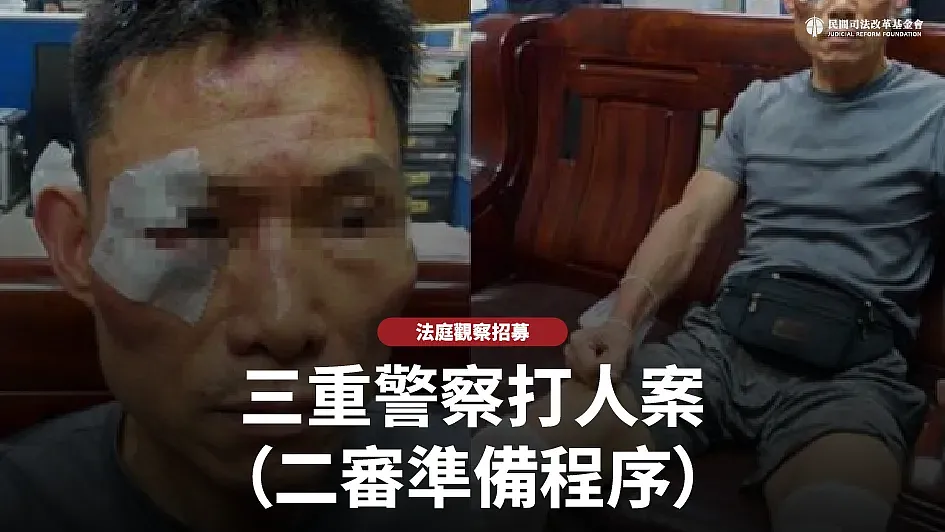
Court Observation Recruitment | Sanchung Police Assault Case (Second Instance Preparatory Proceedings)
Last edited: 2026-07-27
In September 2022, two police officers surnamed Weng and Chiang from the Yungfu Police Precinct of the New Taipei City Police Department's Sanchung Precinct, while on duty at night, mistakenly identified a citizen surnamed Huang as a wanted person, subjected him to an arrest, and applied unlawful and excessive physical restraint, causing severe injuries to Mr. Huang. This violated relevant provisions of the Police Powers and Duties Act and the Criminal Code. Afterwards, rather than reflecting on their actions, they instead filed a counter-charge of assault against the victim, Mr. Huang.
On June 25, the New Taipei District Court rendered its verdict regarding the assault charge filed by Officers Weng and Chiang, finding Mr. Huang not guilty. The prosecutor appealed the decision, and the Taiwan High Court will hold preparatory proceedings on January 8, 2025. In response, the JRF will dispatch personnel to launch a court observation action. We hope to invite citizens concerned about police illegality and law enforcement violence to attend in person during the second-instance stage, extending support and encouragement to Mr. Huang! After the session, time permitting, defense attorneys in this case or JRF colleagues will briefly walk everyone through the facts of the case and discuss the legal controversies.
Court Observation Schedule
Time
January 8, 2025 (Wednesday) at 2:50 PM
Location
Special Courtroom 1, Criminal Court Building, Taiwan High Court (2nd Floor, No. 127, Bo-ai Rd., Zhongzheng Dist., Taipei City)
Case Facts
Officers Weng and Chiang of the Sanchung Precinct failed to "wear uniforms" or "present relevant identification documents" to prove their identities as law enforcement officers in accordance with Article 4, Paragraph 1 of the Police Powers and Duties Act when questioning Mr. Huang, nor did they afford Mr. Huang the opportunity to refuse pursuant to Paragraph 2 of the same article.
More gravely, as Mr. Huang stepped out of his home, Officer Weng directly grabbed Mr. Huang by the shoulder, hurled profanities at him, and proceeded to pin him down, kick him, and punch him. Even after Mr. Huang had already been pinned to the ground, they sprayed pepper spray directly into his eyes. Throughout the process of the police's unlawful enforcement, Mr. Huang repeatedly cried out, "You've got the wrong person," and "My ID is in my pocket," but the officers completely ignored him and failed to verify his identity, continuing to strike his face and body.
Although other arriving officers subsequently informed them that Mr. Huang was not the wanted suspect sought by the police in this operation, Officer Weng still insisted on forcibly handcuffing and shackling the bruised and battered Mr. Huang and dragging him back to the police station, subsequently filing a criminal assault charge against him.
First-Instance Judgment
First, the court held that Officer Weng's actions of attacking and verbally abusing Mr. Huang constituted the offense of assault causing injury under Article 277, Paragraph 1 of the Criminal Code and the offense of public insult under Article 309, Paragraph 1 of the Criminal Code. Furthermore, since Officer Weng possessed the status of a public official, pursuant to the first half of Article 134 of the Criminal Code regarding "aggravated punishment for crimes committed by public officials," the court determined that Officer Weng intentionally committed the offenses of assault and public insult by taking advantage of the power and opportunities of his public office, warranting an enhanced penalty. The court then adjudicated the matter based on the rule of imaginary concurrence under Article 55 of the Criminal Code, convicting him of the more severe offense of "intentional assault committed by a public official taking advantage of the power and opportunities of office."
In addition, Officer Weng's unauthorized act of forcibly handcuffing the bruised Mr. Huang and dragging him back to the police station constituted the offense of compulsion under Article 304 of the Criminal Code, resulting in a conviction for "intentional compulsion committed by a public official taking advantage of the power and opportunities of office." Finally, considering factors such as the defendant Officer Weng's denial of the offenses after the fact, his failure to reach a settlement or obtain forgiveness from Mr. Huang, his post-offense attitude, the degree of harm caused by the crimes, and the fact that Officer Weng had no prior criminal record resulting in a sentence of imprisonment, the court comprehensively weighed these factors and sentenced him to five months of imprisonment for the assault offense, and ten days of detention—commutable to a fine—for the compulsion offense.
As for the counter-charge of assault filed against Mr. Huang, the court found him not guilty.
References:
- Statement | Police Violence Unrepentant, Performance Evaluation System Requires Urgent Review—Press Conference on the Verdict of the Sanchung Police Assault Case
- Taiwan New Taipei District Court 112-Yi-1202 Criminal Judgment
Contact Person
Legal Specialist Ch'en Kuan-chen
Email: olivia@jrf.org.tw
Phone: 02-25231178#21
This article is an AI-generated translation of the original Chinese text. In the event of any discrepancy, the Chinese version shall prevail.