
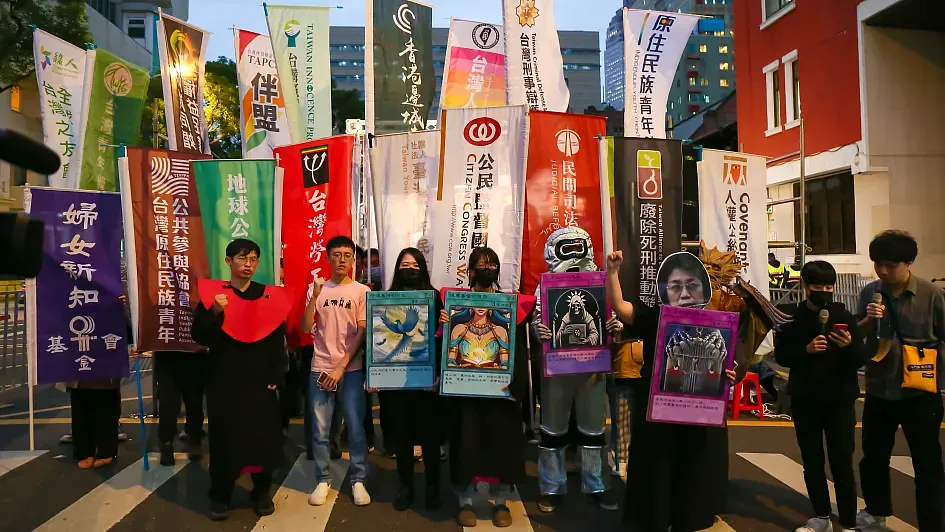
Short Speeches Quotations | Nov 22 Citizens' Rally to Guard the Constitution
Last edited: 2026-11-03
📍Huang Hung-hsia (Former Grand Justice)
Guarding the rights and interests guaranteed by the Constitution is not solely the responsibility of the Grand Justices; regardless of party affiliation, everyone should step up, make their voices heard, and protect the Constitution. The recusal provisions under the current system are sound, and the Grand Justices do not neglect their duties—every one of them works with conscientious dedication. Taking recently retired Grand Justices as an example, during their final few months, they held meetings every morning and afternoon, and even had to hold additional evening sessions on days when typhoons hit. Please trust that, as long as the Legislative Yuan grants its consent, the Grand Justices will truly strive to fulfill their responsibilities at their posts.
📍Lin Chia-ho (Associate Professor, College of Law, National Chengchi University)
Whether during the martial law era, the Chiang family authoritarian era, or the subsequent democratization era, Taiwan has never encountered a political party like the one today—a party, along with its legislators, determined to paralyze an essential constitutional organ of power that checks the executive branch, and particularly the legislative branch. Shall we watch the roles played by the Grand Justices in exercising constitutional adjudication, defending human rights, and conducting political oversight walk toward the end of history right before our generation's eyes? As an unremittingly present member of Taiwan's democracy, I hope we can all strive together for Taiwan's democracy.
📍Lin Chun-yuan (Associate Professor, College of Law, National Taiwan University)
When we can speak so freely, sit here, and enjoy being free citizens on this land of Taiwan, I know that I have not made much contribution. But I know that I should deeply cherish this hard-won achievement. Taiwan's democracy was not created by elections; it was fostered by Judicial Yuan Interpretation No. 261 rendered by the Grand Justices. The Constitution serves to assist, restrain, and consolidate democracy, allowing democracy to continue, freedom to exist, and the rule of law to prevail. The purpose of the Constitution is to protect the rights of the people and to counter abuses of power and dictatorship. Even if legislators are elected by us, when they seek to expand their powers, claim they can disregard any decisions made by other constitutional organs, and assert that they can bring the Constitutional Court to a halt, that constitutes an abuse of power and is inherently anti-democratic.
📍Yen Hsin-yin (Attorney-at-Law)
Back then, in the Hsu Tzu-chiang case, the death penalty had been finalized, and execution could take place at any time. At that time, statements made by defendants did not require cross-examination, meaning they were unable to confront the witnesses. Defense lawyers petitioned the Grand Justices for an interpretation, arguing that this violated the defendant's fundamental rights. Consequently, the case was remanded for retrial, and Hsu Tzu-chiang was ultimately acquitted. Without Grand Justices' Interpretation No. 582, this case could never have been overturned. To legal professionals, the Grand Justices are formidable seniors because they are knowledgeable individuals who devote themselves deeply to scholarly pursuits. How to protect human rights and how legal interpretations can comply with the principle of proportionality are matters they wholeheartedly strive to pursue. Among the current candidates for Grand Justices is an exceptional female candidate who enjoys immense international prominence and an excellent reputation—what a source of pride this is for Taiwan. Yet, the KMT and TPP refuse even to review the nominations, leaving vacancies in the Constitutional Court, rendering it unable to hear other cases, and causing the Constitutional Court to grind to a halt. Please do not drag down Taiwan's judiciary, and respect these prestigious and highly accomplished Grand Justices.
📍Savungaz Valincinan (Chairperson, Indigenous Youth Public Participation Association, Taiwan)
Constitutional litigation procedures are connected to everyone whose rights have been infringed, determining whether they have a higher recourse to fight for their rights and defend their right to survive within this country. This concerns not only indigenous peoples, but also involves issues of survival and equality for more minority groups in Taiwan. For each other, for indigenous peoples, and for all Taiwanese people together, let us tell these disruptive, destructive legislators that they are wrong!
📍Liao Hui-fang (Attorney-at-Law, Board Member of Taiwan Association for Human Rights / Taiwan Labour Front, Chairperson of Taiwan Occupational Safety and Health Connection)
Looking back at past laws today, some violated gender equality and equity between the sexes; we now consider them outdated and unconstitutional. Therefore, we need the Grand Justices to deliver interpretations of the law and the Constitution that fit our current era. Just like when the Grand Justices issued the interpretation upholding the constitutionality of same-sex marriage—whenever I talked about human rights abroad and could pull out this interpretation, I felt like I walked with a swagger. Is the Constitutional Court Procedure Act important? It is very important. The Constitutional Court Procedure Act concerns you and me. After exhausting all remedies, constitutional litigation becomes the final line of hope for the protection of rights. Weng Hsiao-ling, stop destroying the constitutional order and running amok!
📍Performance: Mu Yu-feng (Attorney-at-Law)
Everyone standing up today is not to support any particular political party, but to uphold the dignity of our democratic country and ensure that the Constitutional Court can operate smoothly. Because if the Constitutional Court cannot operate, a democratic country will become like a baseball game without an umpire, unable to maintain order.
📍Wu Hao-jen (Professor, Department of Law, Fu Jen Catholic University)
Whenever the values of a free and democratic constitutional order are lost, one becomes a stumbling block to democracy. As long as great constitutional values are lost, democracy will degenerate into mobocracy, and the Chunghsien Building will turn into a hall of mobs.
📍Shen Pei-ling (Deputy Secretary-General, Ozasean Alliance)
How can we say to citizens whose rights have been infringed, "There is still controversy over the judge candidates, please wait a little longer"? Especially when it involves litigation at the constitutional level? Legislator Weng's public remarks have shown us her rashness and lack of consideration; she has consistently maintained that the paralysis of the Constitutional Court is a good thing for enhancing the quality of judgments. This is a very cold-blooded legislative attitude. Human rights workers in Taiwan are all well aware that the advancement of human rights relies upon the judgments of the Constitutional Court.
📍Hsu Yung (Convener, Social Democratic Party)
No one can step on the brakes for a runaway Legislative Yuan. This bunch of KMT and TPP legislators, relying on their majority, will turn Taiwan into a runaway train plunging off a cliff. Throughout this entire year, the Legislative Yuan has continuously manufactured various incidents, from expanding parliamentary powers and maliciously raising the threshold for recall, to now attempting to paralyze the Constitutional Court. If the Constitutional Court is messed with and paralyzed in this manner, not only will the people's rights be unprotected and the values of fairness and justice unvindicated, but we may also face the direct threat of the KMT and TPP parties damaging Taiwan without limitation. Therefore, we cannot lower our guard; we must let both the KMT and TPP parties hear the voice of the people and withdraw these harmful laws! Guard the Constitution!
📍Wang Yen-han (Spokesperson, Taiwan Green Party)
Legislator Weng Hsiao-ling said that the lawyers who initiated the petitions and rallies are political wingmen. Yes, we are wingmen! We are wingmen of democratic constitutionalism! We are wingmen of progressive values! We are wingmen of the Constitutional Court and the separation of powers! We are also wingmen of upright, public-spirited, and outstanding legislators! The Constitution exists to protect minority groups, specific genders, and social classes; it exists to prevent the state from making catastrophic mistakes and serves as the ultimate bottom line of the nation's conscience. In political maneuvers, alienation, name-calling, and labeling are common, but when they set themselves against the people—and even wield a heavy hand to violently overturn the Constitutional Court Procedure Act, which safeguards the avenues of relief for citizens' basic rights—we will also step forward to continue paying attention to and supervising the parliament. We will outlast the legislators who destroy the constitution and disrupt the government; the Taiwanese people are not afraid!
📍Pan Wei-yu (Deputy Secretary-General, Taiwan Teachers' Union)
As public servants of the people, legislators ought to listen to public opinion, exercise their professional expertise, and supervise the executive branch! But today, KMT Legislator Weng Hsiao-ling not only disdains the people and ignores the warnings of tens of thousands of citizens, lawyers, and scholars, but also stubbornly insists on paralyzing the operation of the Constitutional Court! As an educator, the essence of education is to cultivate citizens' capacity for rational discussion and public participation. Such legislative amendments will only foster the transmission of erroneous values. Some might say that the court's shutdown will not affect daily life, but our responsibility is to remind students and citizens that when the rule of law is gradually eroded and democratic systems face collapse, the entire populace will bear the burden. We are striving not only for the Constitutional Court, but also for the next generation and for the democratic spirit of Taiwan.
📍Chang Hung-lin (CEO, Citizen Congress Watch)
The Constitution is a contract between the state and the people. When the people believe there are doubts regarding the contract, they naturally raise petitions for constitutional interpretation; this is the protection of the people's rights. These so-called constitutional interpretation cases all arise because citizens believe their rights have been infringed upon, and after exhausting the remedial system, feel they cannot obtain a satisfactory answer. At the very least, they can ultimately petition for constitutional interpretation so that the Grand Justices may examine and interpret these matters. The Constitutional Court mediates our people's rights and interests, mediates disputes between the people and the state, and renders rulings. Yet Weng Hsiao-ling actually claims that a shutdown does not matter, and even asserts that a minority of Grand Justices can render resolutions—is this not destroying the constitutional order and creating political chaos?
📍Chen Yen-gen (Attorney-at-Law, Lecturer of General Education Courses, National Taiwan Normal University)
Let me ask Legislator Weng Hsiao-ling: how can a non-functioning Constitutional Court be a legitimate bill? How can you tell and teach students to support this bill? Legislator Weng Hsiao-ling, how would you tell your students how the legislative draft paralyzing the Constitutional Court conforms to the principle of the separation of powers you speak of in your heart? Please muster the conscience expected of a scholar, professor, and director of a general education center, and proactively withdraw this draft. Legislator Huang Kuo-chang, can you accept a legislative amendment to your Code of Civil Procedure where the parliament strips citizens of their right to file civil lawsuits? Please, Legislator Huang Kuo-chang, oppose this proposal. Please summon the backbone and conscience you had when you were a teacher, and face the students you once taught.
📍Huang Ching-ting (Deputy CEO, Citizen of the Earth, Taiwan)
An important precondition for civic groups to perform their functions is that Taiwanese society must remain a democratic society. What is not done well in a democratic society must be supervised; our civic groups need to exercise the power of oversight and avoid falling into extreme KMT-DPP polarization. Let me remind everyone: over the next three-plus years, do not lower your guard. A legislator's term is four years—how long they will endanger the constitutional system is a matter of great importance.
📍MAUNA (Member, NTU Indigenous Student Anti-Discrimination Action Group)
Throughout Taiwan's democratization process, indigenous peoples have always been present and have served as a supporting force. Today, in opposing the malicious amendments to the Constitutional Court Procedure Act, we are here as well. There are still many rights in society that have not received thorough protection and attention, requiring our further efforts. Constitutional litigation is the final line of defense for the protection of rights, and it requires our attention and guardianship.
📍Lin Cheng-ching (Member, Indigenous Youth Front)
What saddens me is that it seems only the issue of discrimination against indigenous peoples transcends political parties. Raising the threshold of the Constitutional Court will only make the struggle for indigenous rights even more difficult, yet Blue-camp legislators are merely amending the Public Officials Election and Recall Act for their own political interests, without questioning why Weng Hsiao-ling wants to raise the threshold! A Grand Justice nominee who cares about indigenous rights issues rather than merely political interests is a truly precious nominee for indigenous peoples. Please have President Lai Ching-te thoroughly review the list of nominees.
📍Lo Fang-chen (Staff Attorney, Environmental Jurists Association)
The Legislative Yuan has completely turned its back on civil society, continually engaging in obstructionism, passively refusing to review the list of nominees, and putting forward amendments to the Constitutional Court Procedure Act that paralyze the Constitutional Court by manufacturing a shortfall from the statutory quorum. We consider such a situation to be a very severe disruption to the democratic constitutional system.
The Constitutional Court currently holds oral argument sessions, which can be broadcast via livestreaming and even make written briefs public, demonstrating that the Constitutional Court, through the course of democratization, has continually strengthened its functions of social communication and dialogue with the public.
This draft of the Constitutional Court Procedure Act, regardless of the stated rationale for amendment or the statutory provisions, cannot withstand scrutiny, and we believe it runs counter to the historical developmental trajectory forged by the Constitutional Court.
I hope everyone will continue to work hard at their respective positions and on their respective issues.
📍Pan Tien-ching (Attorney-at-Law, Chairperson, Taiwan Alliance to Promote Civil Partnership Rights)
The importance of the Constitutional Court and the Grand Justices lies in protecting the rights of minorities and promoting social progress. When our executive and legislative branches are ineffective and fail to protect minority rights, we look forward to overcoming this predicament through the Constitutional Court, ensuring that Taiwan's judiciary does not merely protect the majority. We must take note that each and every one of us may become a minority person or minority group at some point in time.
We call on the Legislative Yuan to first deliberate on the power of appointment of Grand Justices so that the Constitutional Court can operate normally before discussing whether any parts need to be amended. Finally, I hope everyone will keep striving because this battle may be a long one.
📍Liu Li-chun-ta (Bill and Policy Officer, Amnesty International Taiwan)
When the state commits offenses or engages in discrimination today, we must rely on the Constitutional Court to safeguard our fundamental human rights. Often, it is the most vulnerable, marginalized people—those without many supporting legislators or broad public opinion backing them—who seek remedy through the Constitutional Court and constitutional review. This is a very important step for the Taiwanese spirit and human rights.
The struggle over the Constitutional Court Procedure Act will continue; this bill is still in the Legislative Yuan and will not vanish just because our rally ends. Therefore, we invite everyone—as we wield our magic card to guard the Constitution—if you still possess magic and spells, to go back and invite more friends to maintain their continuous attention. Although the threshold for understanding is somewhat high, it is closely intertwined with everyone.
📍Performance: REX (Music Creator)
Everyone is suffering from the cold here today, taking to the streets for our democratic constitutional order; it has not been easy for anyone. I hope Taiwan gets better and better, and that we all get better and better.
📍Sang Pu (Hong Kong Lawyer, Chairperson of Taiwan-Hong Kong Association)
I walked through Hong Kong in 2019 and 2020. At that time, during the push for the fugitive offenders ordinance and the National Security Law, and throughout the anti-extradition movement, there were identical wicked laws. This is very much like Hong Kong back then—starting from an opinion war and psychological war to a legal war. Hong Kong was destroyed by legal warfare; legal warfare has the greatest impact—striking suddenly and exerting a profound effect.
Now the KMT is preparing to paralyze the entire Constitutional Court. Once the "Constitutional Court Procedure Act" amendments pass, they will aggressively push through harmful laws, and many of our laws will encounter problems because there will be no constitutional review mechanism.
Weng Hsiao-ling is a Doctor of Laws from Ludwig Maximilian University of Munich, and Legislator Wu Tsung-hsin is a senior prosecutor. With such strong legal expertise, why do they stubbornly persist in pushing wicked laws? What are their underlying motives?
📍Huang Hui-chen (Spokesperson, High School History Teachers' Grassroots Alliance)
I am a high school history teacher. Some people tell me that high school students are hard to teach; I do not think so—legislators are harder to teach than high school students! Legislators think that because they have votes and get elected, they can do whatever they want. Slackers among students can be failed, but slacking legislators cannot be recalled.
Taiwan's democracy is an achievement pursued by three generations over the past 100 years. I never expected that 100 years later, we would still have to stand here telling the legislators we elected to care about public opinion, not to treat everyone like air, and not to confiscate the people's right to recall.
📍Huang Sung-li (Director of Policy Center, Covenants Watch)
Democracy is something we fought hard to attain, and if we do not guard it well, it will regress. Even Chiang Kai-shek and Chiang Ching-kuo did not dare to leave a constitutional organ vacant and claim that the Grand Justices of the time did not need to exist.
We must view Weng Hsiao-ling's actions within the context of global democratic backsliding, as well as within the struggle between democracy and authoritarian rule. She would rather wreck the constitutional system than fail to serve the interests of the KMT. Please recognize the true nature of the KMT and do everything in your power to stop these proposals that destroy the constitution and disrupt the government.
📍Lin Chun-hung (Chairperson, Taiwan Association of Criminal Defense Lawyers)
On November 16, Weng Hsiao-ling first labeled the lawyers who stepped forward as DPP wingmen, declaring everything they said untrustworthy. She crudely listed everyone out, placed them in boxes, and claimed that because of what we had done, we were equivalent to DPP wingmen, making baseless connections. Yet while they destroy the constitution and disrupt the government, the legal community possesses ample evidence. As everyone is well aware, this bill will result in the Constitutional Court being unable to function, and she herself has admitted that the long-term paralysis of the Constitutional Court is also a good thing.
Weng Hsiao-ling clearly knows the consequences that will be caused if this amended bill passes: it is our nation's safety valve, preventing our state organs from running amok and ensuring that the laws enacted do not exceed the framework of the Constitution. Once the Constitutional Court is unable to operate, both the Legislative Yuan and the Executive Yuan can run amok.
This article is an AI-generated translation of the original Chinese text. In the event of any discrepancy, the Chinese version shall prevail.