
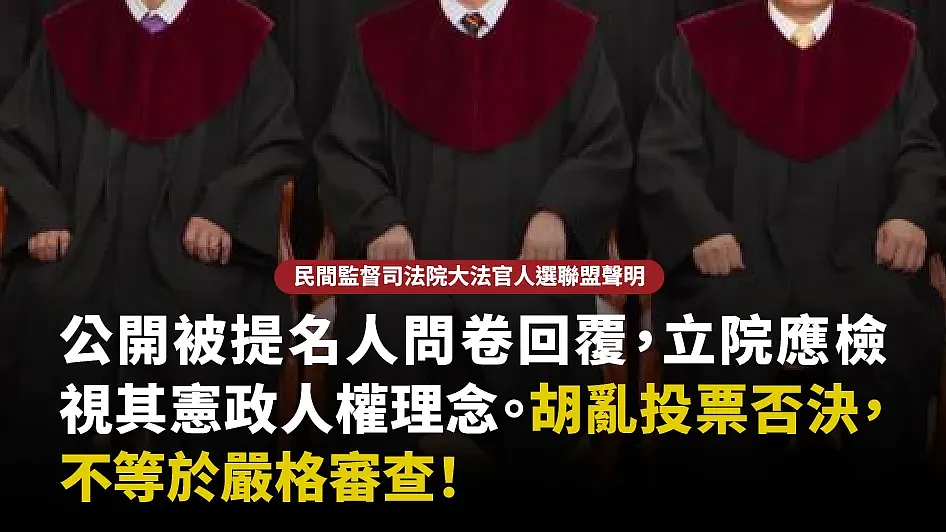
Press Release | "Publish Questionnaires and Responses of Nominees; The Legislative Yuan Should Scrutinize Their Constitutional and Human Rights Views, Not Veto Them Recklessly Under the Guise of Rigorous Review!" Statement by the Alliance for Monitoring Judicial Yuan Grand Justice Nominees
Last edited: 2026-07-27
Updated at 4:00 PM on December 23, 2024:On December 23, 2024, Legislator Kuo Kuo-wen's office informed this Alliance that Legislator Kuo was undergoing surgery on the day of the questioning, which is why he submitted written questions instead. However, the Democratic Progressive Party has a total of 51 party-affiliated legislators and should have avoided assigning a legislator who was unable to attend in person to conduct the questioning from the outset.
Last week (December 10–12), the Legislative Yuan conducted the review and questioning sessions for the personnel consent of Grand Justices. Although the recent amendments to the Act Governing the Legislative Yuan's Power have introduced slightly stricter procedural regulations for personnel consent reviews, overall, the content and depth of the review process showed no progress compared to the past and remained merely formalistic.
In response to the chaotic state of the Legislative Yuan's review of Grand Justice personnel consents, the "Alliance for Monitoring Judicial Yuan Grand Justice Nominees," consisting of 12 civil society organizations, has put forward the following 4 major demands:
1. Using opposition to the abolition of the death penalty as the sole standard for a Grand Justice's suitability is an absurd farce.
2. Nominees have responded to public inquiries; society should jointly examine their constitutional and human rights visions.
3. Formalistic Grand Justice personnel reviews fail to break free from partisan political struggles.
4. Five arrows for substantive review to prevent the exercise of consent from degenerating into a political farce.
Arrow 1: Implement written questioning and articulate constitutional and human rights visions prior to the review.
Arrow 2: Within a reasonable scope, the Legislative Yuan should request and openly solicit more comprehensive review materials.
Arrow 3: Invite nominees to attend public hearings and subject themselves to the scrutiny of civil groups and experts.
Arrow 4: Thoroughly overhaul the questioning procedure to prevent time-wasting and fragmented answers.
Arrow 5: All political parties should clearly state their voting reasons and standards to fulfill responsible politics.
1. Using opposition to the abolition of the death penalty as the sole standard for a Grand Justice's suitability is an absurd farce
Over the past few months, the Kuomintang (KMT) has continuously manipulated the issue of Grand Justices "promoting substantive abolition of the death penalty," equating "abolishing the death penalty" with "harming the families of crime victims," and using whether nominees support the abolition of the death penalty as the sole basis for vetoing them.
The problem is that ever since the establishment of our constitutional interpretation system, the cases accepted and handled by the Grand Justices have not been limited to the death penalty; any issue involving fundamental human rights may be handled by the Constitutional Court. However, aside from the death penalty, the KMT has shown no interest in the nominees' opinions on diverse issues such as labor rights, gender, indigenous peoples, international human rights law, freedom of the press, and housing justice. Their review criteria are exceedingly narrow, which we deeply regret.
In fact, just this September, the Constitutional Court declared the death penalty system "constitutional," and the likelihood of the Constitutional Court re-evaluating "whether the death penalty system is unconstitutional" in the next eight years is low. Viewed from this perspective, the KMT's obsession with legal issues that nominees are unlikely to handle as the sole basis for denying their suitability clearly reflects a severe lack of rational criteria. Such crude and irrational reviews will deter capable individuals and prevent the country from recruiting top talent to serve the public.
This Alliance believes that political parties and legislators certainly have a duty to strictly review the suitability of nominees, but such evaluation should be conducted comprehensively through perspectives such as moral integrity, academic and professional expertise, and human rights advocacy, rather than reducing the death penalty issue to a binary question of abolition and then hastily judging a Grand Justice's suitability based solely upon it.
2. Nominees have responded to public inquiries; society should jointly examine their constitutional and human rights visions
On December 16, the seven Grand Justice nominees responded to the public inquiries initiated by civil society. The questions spanned a wide range of topics, including international human rights law, referendums, minority rights, the right to litigation, land expropriation, prisoners' human rights, and equality and non-discrimination. The nominees for President and Vice President were also asked for their views on judicial reform. These responses should serve as a reference for all sectors of society to examine their constitutional and human rights philosophies.
Unlike the previous two batches of Grand Justice nominees who refused to respond to civil society inquiries, we affirm the fact that all seven nominees this time responded to our public questionnaire. We also expect future nominees to willingly accept inquiries and scrutiny from all sectors of society.
The Alliance has published the question responses of the seven nominees at this link and prepared a summary table for reference.
3. Formalistic Grand Justice personnel reviews fail to break free from partisan political struggles
Although the Legislative Yuan has continuously delayed the review of Grand Justice personnel consents this time, the review method remains identical to the past, amounting to nothing more than a formalistic "passing through the motions."
The review process proceeded as follows:
| Schedule | Procedure |
|---|---|
| Morning of December 2 | A 3-hour public hearing was held, inviting experts, scholars, and legislators. |
| Morning and afternoon of December 10–12 | Nominees appeared individually to take 20 minutes of questioning from each party's legislators. |
| December 24 | Legislators vote to exercise consent. |
First, the current public hearings merely invite scholars and experts to "voice their respective opinions" in a broad discussion. Most invitees do not express substantive opinions regarding the individual suitability of the nominees, offering almost no practical assistance to the Legislative Yuan's exercise of consent.
Furthermore, individual questioning by legislators consists of each nominee facing 20-minute questioning sessions from 3 KMT, 3 DPP, and 1 TPP legislators (based on party proportionality). Procedurally, the questioning time is extremely short and fragmented, with repetitive topics (such as the retention or abolition of the death penalty) constantly brought up. Nominees can only give similar answers, resulting in wasted time. In addition, each nominee undergoes questioning only once; regardless of whether issues are clarified or whether the answers help understand the nominee's suitability, no further reviews are conducted.
Even more disappointingly, amidst the precious face-to-face questioning opportunities with nominees, as many as eight DPP legislators (Wang Mei-hui, Hsu Chih-chieh, Lin Chun-hsiun, Chang Hung-lu, Kuo Kuo-wen, Lo Mei-ling, and Chiu Chih-wei) chose to submit written questions instead. Why forfeit the direct oral questioning opportunity? Why did the DPP assign legislators who could not attend to ask questions? Moreover, the contents and answers of these written questions have not been made public to this day; how can society scrutinize them? This leads one to suspect that the aforementioned DPP legislators and even the party caucus do not take personnel consent reviews seriously at all.
As for the vote next Tuesday (December 24), there will be no further questioning or discussion, and the public may not necessarily understand the reasons behind each party's or legislator's approval or disapproval.
In summary, this review process clearly lacks the procedures necessary to fully understand the nominees' suitability. Evaluating whether each nominee is suitable remains difficult, and the final decision to approve or reject candidates will likely ultimately degenerate into partisan showdowns. Is this the kind of review process we want? Can the review of personnel consents only be reduced to political attacks and confrontations, relegating professional opinions to mere window dressing?
4. Five arrows for substantive review to prevent the exercise of consent from degenerating into a political farce!
Arrow 1: Implement written questioning and articulate constitutional and human rights visions prior to the review
Pursuant to Article 29-1, Paragraph 2 of the Act Governing the Legislative Yuan's Power, party caucuses or independent legislators in the Legislative Yuan may request in writing that nominees answer questions and submit relevant materials. However, during this Grand Justice personnel review, only the Taiwan People's Party (TPP) publicly submitted written questions on September 23. Neither the KMT nor the DPP proactively made theirs public beforehand (though they can be found in the Legislative Yuan Gazette, Vol. 113, Issue 109).
While the appropriateness of the various political parties' questions is certainly open to public evaluation, it is regrettable that both the blue and green parties failed to make good use of this rare opportunity to further understand the nominees' philosophies through questions and answers, thereby informing the public and fostering discussion.
It is worth examining further that since the Constitutional Court only declared the aforementioned provisions constitutional on October 25, nominees might have found it difficult to decide whether to respond prior to that date. Nevertheless, when nominees visited the TPP caucus on December 2 (more than a month after the ruling), they still had not answered the questionnaire, which was less than ideal.
This Alliance suggests that political parties should implement the written questioning system, and nominees should complete questionnaire responses as soon as possible out of respect for the Legislative Yuan's review intent.
Arrow 2: Within a reasonable scope, the Legislative Yuan should request and openly solicit more comprehensive review materials
Under current law and practical operations, the written materials obtained by the Legislative Yuan are all provided by the nominating authority or the nominees. Consequently, the information obtained mostly favors the nominees. However, for a complete and substantive review, the Legislative Yuan should have access to both favorable and unfavorable information.
Under U.S. law, in addition to nominees providing the Senate with resumes, professional and financial disclosure information, and questionnaire responses, the Senate Judiciary Committee may also request other entities to provide information lacking in the nominees' questionnaire responses (for example, requesting employment records from former employers).
This Alliance suggests that institutionally and operationally, the Legislative Yuan should, within a reasonable scope, request information from other entities and solicit public submissions to facilitate a comprehensive review of information.
Arrow 3: Invite nominees to attend public hearings and subject themselves to the scrutiny of civil groups and experts
Because current public hearings only invite experts and scholars to express opinions without asking nominees to attend, the communication of opinions at these hearings often degenerates into experts and scholars merely expressing their own views. This Alliance suggests that public hearings should invite nominees to attend, allowing participating experts and civil groups to pose questions to the nominees publicly.
Regarding procedural design, since the invited experts are assisting the Legislative Yuan in clarifying the suitability of nominees rather than exercising the personnel consent power itself, the procedure—premised on respecting the nominee—could consider formats such as a Q&A or comprehensive replies. By incorporating more diverse societal voices and dialogue mechanisms, the transparency and legitimacy of the review process can be enhanced.
Arrow 4: Thoroughly overhaul the questioning procedure to prevent time-wasting and fragmented answers
The questioning sessions this time took place from December 10 to 12. However, observing the overall questioning, it was often difficult to foster deep, broad, and systematic communication and dialogue between nominees and legislators, and repetitive questions frequently arose.
Referring to the open hearings of the U.S. Senate Judiciary Committee, each senator is allotted three rounds of questioning (practically usually 30 minutes for the first round, 20 minutes for the second, and variable time for the third), which allows for much greater depth and breadth compared to our country's single round of questioning. Furthermore, after the nominees' questioning procedure concludes, the committee may hear witness testimony in subsequent proceedings. Individuals who appear as witnesses in practice include representatives from the American Bar Association, professional colleagues of the nominee, and representatives of groups supporting or opposing the nominee.
This Alliance suggests that to enable legislators to thoroughly question nominees, at least the following improvements should be made:
- The questioning procedure should adopt a review committee format: Questioning topics should first be consolidated through written questions and party-caucus negotiations to draft the review committee's agenda, allowing designated legislators from each caucus to raise questions on the same topic during designated agenda slots. For example, when all parties are concerned about the death penalty issue, a specific time slot can be arranged for all legislators to freely question the issue, allowing nominees to fully explain their views. This avoids problems where insufficient time leads to incomplete answers by nominees or allows nominees to use time constraints as an excuse to evade answers.
- The questioning procedure should not be limited to a single round. If necessary, opinions or testimony from interested parties should be heard.
Arrow 5: All political parties should clearly state their voting reasons and standards to fulfill responsible politics
In our country, the review of personnel consent is often followed shortly after the conclusion of questioning by a direct vote. However, party caucuses and legislators do not necessarily explain the reasons for their votes.
By contrast, under the U.S. system, after the Senate receives the review report from the Judiciary Committee, it debates the matter during subsequent floor proceedings. Following the debate, the floor conducts a roll-call vote.
This Alliance suggests that prior to personnel review votes, legislators should be given time to discuss the suitability of candidates. Even if mutual persuasion is difficult, the process should allow the outside world to understand the standards used by each party and legislator to judge a nominee's suitability, thereby facilitating the realization of responsible politics.
Regarding how the Legislative Yuan reviews personnel consents, systems from various countries can be compared and referenced. Nevertheless, our country's current haphazard and crude review procedures are completely unacceptable to civil alliances! By offering these opinions as food for thought, we hope that the controversies surrounding this personnel consent review can become a catalyst for reform, allowing us to take a step toward "substantive review" and refusing to let the scenario where "the ruling party blindly shields candidates while the opposition parties make unreasonable objections" repeat itself!
Alliance Member Organizations (12 groups in total)
Covenant Watch
National聯盟 of Persons with Disabilities, R.O.C.
Citizen's Congress Watch
Alliance for Constitutional Reform
Taiwan Association for Human Rights
Taiwan Alliance for Advancement of Civil Partnership Rights
Taiwan Association for Innocence
Taiwan Labor Front
Taiwan Alliance to End the Death Penalty
Judicial Reform Foundation
Taiwan Awakening Foundation
Environmental Jurists Association
Press Contacts
Lü Cheng-yen, Attorney-at-Law, Director of Legal Policy Department, Judicial Reform Foundation
Phone: 02-2523-1178#37
Email: elvin@jrf.org.tw
This article is an AI-generated translation of the original Chinese text. In the event of any discrepancy, the Chinese version shall prevail.