
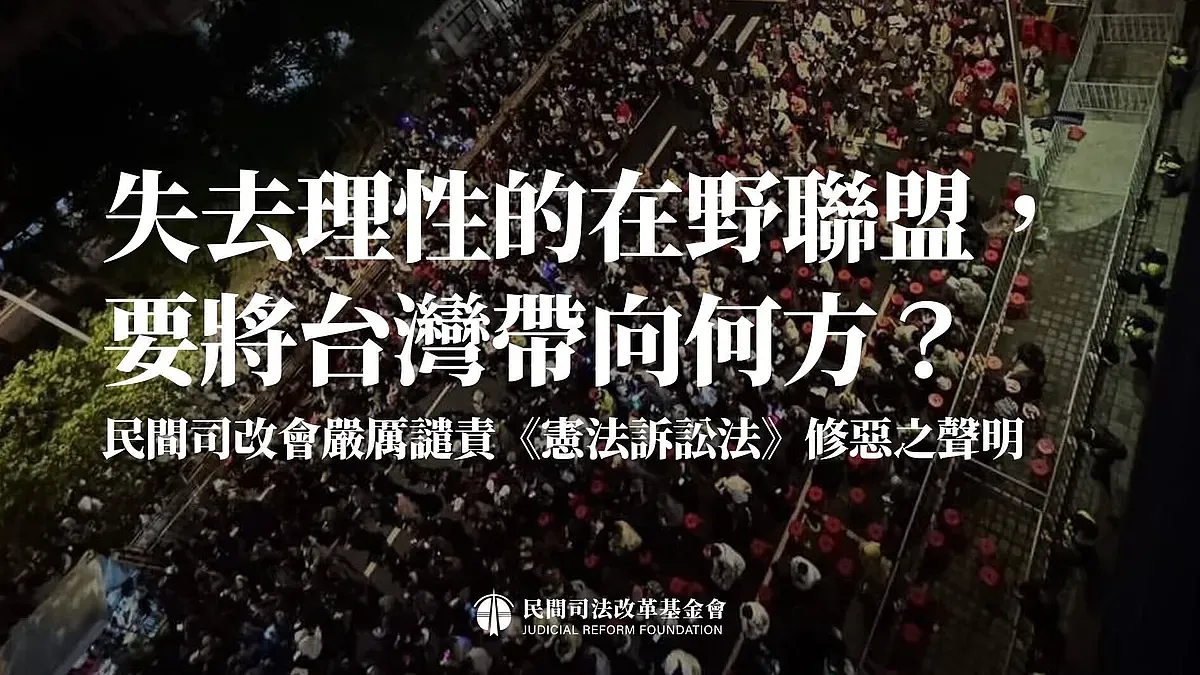
Statement | "Where is the Opposition Alliance, Having Lost Its Reason, Leading Taiwan?" JRF's Stern Condemnation of the Malicious Amendments to the Constitutional Court Procedure Act
Last edited: 2026-07-27
It is only after generations of a century-long pursuit that we have finally been able to enjoy the air of a democratic constitutional government and freedom on this land of Taiwan. We expect that the value consensus of freedom and democracy will not be destroyed by political confrontation.
Yesterday (the 20th), after the opposition alliance composed of the Kuomintang (KMT) and the Taiwan People's Party (TPP) occupied the podium using their numerical advantage, they once again rushed through amendments to the Constitutional Court Procedure Act by means of a show of hands and impromptu "counter-amendment motions," amidst legislative procedures riddled with flaws. The crudeness and haste of this legislative procedure even surpassed the "unconstitutional expansion of power case" in May. We cannot help but ask: Does the opposition alliance treat the Constitutional Court's Judgment No. 9 of 2024, which "respects" the legislative power, as something to be trifled with? When such abuse of parliamentary procedure has become the new legislative norm, its threat to democracy and constitutional government, as well as its unconstitutionality, is unlike anything seen in the past. Herein, our Foundation once again issues a stern warning.
The purpose of the opposition alliance's amendments to the Constitutional Court Procedure Act this time is to ensure that when the number of Grand Justices in the Constitutional Court falls below 10, no deliberation may take place; and when it falls below 9, no law may be declared unconstitutional (see the comparative table of provisions below). However, there are currently only 8 sitting Grand Justices in the Constitutional Court. In reality, once this Act is promulgated and takes effect by the President, the Constitutional Court will immediately cease operations.
On the other hand, the consent vote for the 7 Grand Justice nominees will be held next Tuesday (the 24th); and the Kuomintang has recently publicly stated that it may adopt a "total blockade." Even if the opposition alliance consents to 2 or more nominees so that the number of Grand Justices reaches 10 or more, the amended provisions themselves may still cause the Constitutional Court to be paralyzed in the future due to Grand Justices' terms expiring and there failing to be 10 or more sitting Grand Justices in time for various reasons. At this point, the Constitutional Court—which represents the judicial power supervising other constitutional branches—will perpetually face the possibility of paralysis due to unilateral amendments by the Legislative Yuan.
Analyzed from a rational perspective, the opposition alliance's act of forcing the bill through can only make people feel regret, surprise, and incomprehension. Prior to the amendments, our Foundation, the legal community, and numerous scholars had already used various legal arguments to warn of the constitutional crisis that improper amendments would trigger. We also clearly pointed out at the same time that, from a comparative law perspective, setting a minimum deliberation threshold for the Constitutional Court is not entirely without basis; meanwhile, the opposition parties also do not need to blindly accept all Grand Justice candidates nominated by the President. The problem is that if the threshold is raised while personnel appointments are simultaneously boycotted, resulting in vacancies among Grand Justices, the constitutional order will inevitably fall into chaos.
We are compelled to publicly question: What on earth is the public interest behind this amendment? What rights of the people has the Constitutional Court infringed upon that the opposition parties must rush to defend it? Why do the opposition parties practice the reality of paralyzing the Constitutional Court in the name of supervision and checks and balances?
This legislative amendment has sparked intense controversy, and scholars, lawyers, and politicians have successively proposed many lawful responses—and even ways to create constitutional conventions—but none of these paths are easy. The opposition alliance could fully foresee in advance that passing this amendment would not settle the matter once and for all, nor would the opposition parties necessarily achieve their political goals. The opposition alliance could likewise predict that after this bill is forced through, the responses of other constitutional branches facing a dilemma will only exacerbate domestic political disputes and chaos.
We believe that there are already a great many voices in society condemning the aforementioned unconstitutional actions. Aside from once again issuing a stern condemnation, our Foundation hopes that the opposition camp can grasp the gravity of this issue. We hope that all political parties, ruling and opposition alike, can realize that the current "hostile" political atmosphere has caused state organs and the entire Taiwan to grind to a halt. Accordingly, we solemnly call upon the two opposition parties to handle next Tuesday's consent vote with prudence, to avoid descending into opposition for opposition's sake, and to rein in their horses at the edge of the precipice before completely destroying the separation of powers. In this regard, political parties must stop returning to the old path of using party discipline to hijack lawmakers' free will regarding the personnel consent power for Grand Justices, and instead enable lawmakers to vote independently based on their personal conviction of the nominees' suitability.
However, regardless of the outcome of the exercise of the Grand Justice consent power, the opposition alliance's intention to paralyze the judicial power through legislative amendments cannot be ignored. Regarding the two opposition parties, we hope that enlightened individuals within the parties can respond to society by proposing wise propositions, pull the brakes on the current out-of-control situation, allow politics to return to negotiation and dialogue, and bring the supervision of the ruling party back onto a rational track. As for the ruling party, we also expect that when the opposition parties present reasonable demands and supervisory methods subject to public scrutiny, they should accept the necessity of reform and actively alleviate the confrontational atmosphere to achieve a political breakthrough.
Regardless of political turmoil, may the democracy, freedom, and constitutional government pursued by the Taiwanese people for a century truly become a social consensus that transcends partisan affiliation and differences.
Appendix: Provisions Passed by the Opposition Alliance under the Constitutional Court Procedure Act, Third Reading on December 20, 2024
※Red text indicates modified wording.
|
Provisions Passed by the Opposition Alliance under the Constitutional Court Procedure Act |
Current Provisions of the Constitutional Court Procedure Act |
|
Article 4
|
Article 4
|
|
Article 30
|
Article 30
|
|
Article 95
|
Article 95
|
Press Contact
Lü Cheng-yen, Attorney-at-Law, Director of the Department of Legal Policy, Judicial Reform Foundation
Telephone: 02-2523-1178#37
Email: elvin@jrf.org.tw
This article is an AI-generated translation of the original Chinese text. In the event of any discrepancy, the Chinese version shall prevail.