
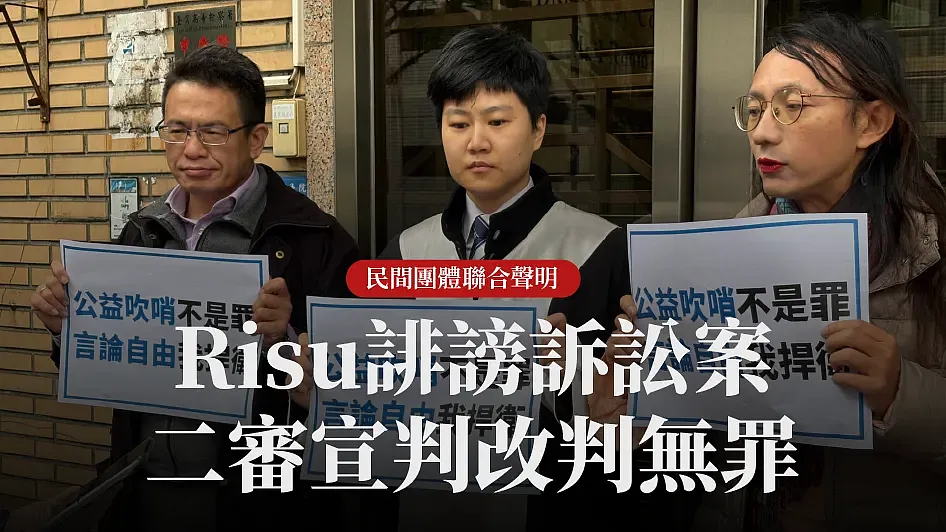
Joint Statement | "After the Wave of Reporting Risu Sexually Private Image Groups..." Joint Statement by Civil Society Organizations on the Acquittal of Wang Ying-ta in the Second Instance of the Risu Defamation Lawsuit
Last edited: 2026-07-27
In May 2023, the Risu Facebook group caused a public outcry over the leakage of sexually private images. The Taiwan Digital Power Women Alliance took the lead in exposing related issues and initiating a reporting campaign. Citizens responded to this action by actively reporting the content, during which Mr. Wang Ying-ta discovered that some groups were managed by "Bao-series administrators" and posted comments on his personal Facebook page suggesting that "Bao-Liao Commune" might be connected to the distribution of sexually private images in the Risu group. Bao-Liao Commune Co., Ltd. subsequently filed criminal and civil lawsuits against Mr. Wang Ying-ta, accusing him of aggravated defamation.
The Taiwan High Court rendered its judgment this morning (December 24) at 10:00 AM on the "Risu Defamation Lawsuit," explicitly affirming that the reporting actions undertaken out of public interest motives comply with Article 310, Paragraph 3 of the Criminal Code and are protected by law. In response, our organization and the appellant, Mr. Wang Ying-ta, feel gratified. This judgment not only restores his innocence but also highlights the judiciary's sensitivity toward public interest reporting and digital sexual violence. Accordingly, the Judicial Reform Foundation and the Taiwan Digital Power Women Alliance (hereinafter referred to as the civil society organizations) issue the following joint statement regarding the Risu defamation lawsuit:
1. This Case Affirms the Legitimacy of Public Interest Reporting and Protects the Freedom of Expression of Whistleblowers
Mr. Wang Ying-ta stated: "In responding to the campaign to report groups illegally disseminating sexually private images, I felt extremely anxious. Knowing that so many people's sexually private images were illegally published and potentially used to threaten and intimidate victims, I actively took part in the reporting action. During the process, I also conducted verification work, which led me to believe that a certain connection existed between Bao-series administrators and Bao-Liao Commune, and to question whether Bao-Liao Commune was involved in the illegal dissemination of sexually private images. Furthermore, I believe my purpose was for the public interest, and compared to the trauma suffered by countless victims whose sexually private images were leaked, the so-called damage to reputation claimed by the plaintiff is completely disproportionate."
Out of concern for the impact of the illegal dissemination of sexually private images on victims, and based on reasonable verification and the public interest, Mr. Wang Ying-ta raised questions regarding Bao-Liao Commune, which constitutes speech expression of high public interest. The court judgment held that Mr. Wang Ying-ta's actions met the provision of Article 310, Paragraph 3 of the Criminal Code that "defamation is not punishable if proven to be true," and, taking into account the constitutional balance between freedom of expression and the right to reputation, ruled him not guilty. This judgment not only protects Mr. Wang Ying-ta's public interest reporting actions but also demonstrates the judiciary's emphasis on the issue of digital sexual violence.
2. The Judiciary Prudently Avoids a Chilling Effect; the Protection of Public Interest Reporting and Judicial Reform Deserve Emphasis
Bao-Liao Commune Co., Ltd. filed criminal and civil lawsuits against Mr. Wang Ying-ta. Such actions are regarded as Strategic Lawsuits Against Public Participation (SLAPP). The judicial judgment ending these lawsuits with an acquittal—suits that could have created a chilling effect on civil society—sends a clear message to society: speech expressions and reporting actions based on public interest purposes should be protected by law, and reputation lawsuits should not be disguised as judicial harassment against whistleblowers.
Civil society organizations affirm the judgment of this case and call upon the judicial system to continuously uphold the value of public interest reporting and balance the boundaries between freedom of expression and the right to reputation. We will also monitor the subsequent civil trial proceedings of this case and continue to promote relevant legal reforms to ensure that more citizens can participate in public affairs discussions with peace of mind and contribute to exposing illegal activities.
Notably, recently the person in charge of Bao-Liao Commune Co., Ltd. was suspected of involvement in "FANS 17" and violating the Act for Prevention of Sexual Exploitation of Children and Youths. Although the "FANS 17" case has not yet reached a final judgment, it has indeed seen this enterprise, Bao-Liao Commune, once again cause public uproar and unease. Mr. Wang Ying-ta has been in protracted litigation with Bao-Liao Commune in this case, hoping through his own supervisory spirit and actions of caring for the public interest to continuously join society in addressing the issue of digital sexual violence prevention. We also urge all sectors of society to pay attention to the subsequent civil trial of this case and jointly safeguard the freedom of expression and public debate space of civil society.
Stating Organizations
Judicial Reform Foundation
Taiwan Digital Power Women Alliance
Press Contacts
Li Ming-ju, Deputy Executive Director, JRF mj@jrf.org.tw
Lin Cheng-ching, Legal Assistant Researcher, JRF kacan@jrf.org.tw
This article is an AI-generated translation of the original Chinese text. In the event of any discrepancy, the Chinese version shall prevail.