
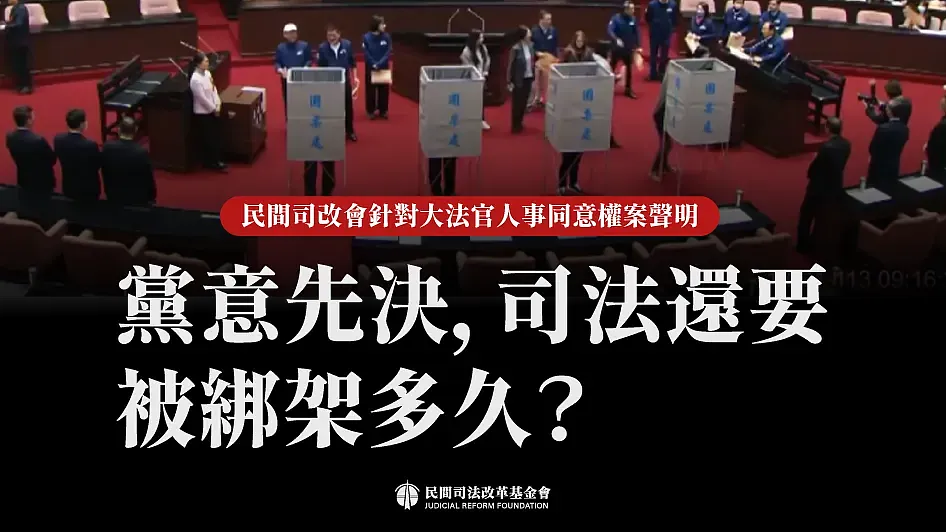
Statement | "Party Loyalty Comes First, How Much Longer Will the Judiciary Be Held Hostage?" JRF Statement on the Legislative Yuan's Exercise of the Consent Power for Grand Justices
Last edited: 2026-11-03
Yesterday (12/24), the Legislative Yuan exercised its consent power for Grand Justices, and the voting results showed that none of the 7 nominees passed the review. The JRF hereby puts forward the following assertions:
1. Urge the President to promptly re-nominate candidates, as judicial reform requires the support and promotion of judicial heads.
2. Condemn party lines hijacking the consent power! We urge all party caucuses in the Legislative Yuan to comprehensively review the review procedures for the second wave of personnel consent, and to allow legislators to vote freely based on professional standards such as constitutional human rights principles.
1. Urging the President to promptly re-nominate judicial heads who support judicial reform
To this moment, the positions of President and Vice President of the Judicial Yuan remain vacant, with Grand Justice Hsieh Ming-yang temporarily acting as President. Meanwhile, the Legislative Yuan has amended the Constitutional Court Procedure Act, and upon promulgation by the President, the Constitutional Court risks paralysis. The absence of formal judicial heads has brought the promotion and reform of judicial policies to a standstill, and the ultimate victims will be the rights of the people.
The responsibilities of the President of the Judicial Yuan include serving as the President of the Constitutional Court, rendering judgments in accordance with the Constitutional Court Procedure Act, overseeing the administration of the court, and supervising subordinate judicial organs. The Vice President handles matters entrusted by the President and acts on their behalf when the President is unable to discharge duties or when the office is vacant. To uphold judicial independence and the people's right to a fair trial, the President must shoulder the heavy responsibility of judicial reform and actively promote related judicial policies. Regarding urgent issues in dire need of reform at present, there are at least four major categories (for details, please refer to our November 8, 2024 press release): "reducing judicial burdens," "combating fraud and technological investigation," "judicial personnel appointments and deliberation powers," and "lay participation (Citizen Judges Act) reform," which still await continued research, planning, and promotion by the Judicial Yuan.
Under circumstances where the nominee for the President of the Judicial Yuan has also been rejected, although the Acting President may temporarily exercise the duties of the judicial head, it is practically inappropriate to formulate and promote major judicial reform policies, nor can they be held responsible for the success or failure of reforms.
Therefore, the JRF urges the President to promptly re-nominate candidates for Grand Justices, and to comply with public expectations by nominating a candidate for President who "supports judicial reform," so as to swiftly finalize the personnel of Grand Justices and judicial heads and allow judicial reform to continue moving forward.
2. Condemning party lines for hijacking the consent power! Urging all party caucuses to allow legislators to vote freely in the second wave of personnel consent and conduct reviews based on professional scholarship and standards
Regarding this nomination of Grand Justices, all party caucuses in the Legislative Yuan voted collectively as a bloc: the Kuomintang (KMT) voted down all 7 candidates; the Democratic Progressive Party (DPP) voted down nominee Liu Ching-i while voting unanimously for the rest, even employing the strictest measure of "expulsion from the party for deviating from the vote"; and the Taiwan People's Party (TPP) voted unanimously for nominee Liu Ching-i while voting down all the rest. Looking closely at the explanations given by various parties for their aforementioned voting stances, they are thoroughly perfunctory and unable to withstand the scrutiny of all sectors of society, undoubtedly confirming the criticism of "voting solely based on color and political stance." The JRF expresses its utmost regret over this.
In terms of the content and depth of the review procedures, the exercise of this consent power showed no progress compared to the past, while inter-party vicious infighting was worse than ever. In terms of the voting results, the intentions of each party caucus in exercising the consent power intertwined, resulting in all 7 nominees failing to pass, demonstrating across party lines that "party interests surpass the public interest."
Prior to the Legislative Yuan's exercise of the consent power this time, the JRF had repeatedly urged all political parties to allow independent voting; after all, regarding whether Grand Justice nominees are fit for office, every legislator entrusted by the public should possess their own criteria and values for independently judging their suitability. However, for all 7 nominees, every party caucus expressed unanimous consent or dissent through bloc voting. With party lines prevailing and legislators abandoning independent judgment, they have naturally failed the trust of the voters.
In view of this, the JRF earnestly urges that the nomination and review for the next wave of Grand Justice personnel consent should reference the recommendations put forward by the "Civilian Alliance for Monitoring Grand Justice Nominees," conducting a comprehensive prior review of the perfunctory review procedures of the past. Furthermore, all party caucuses should allow legislators to vote freely, and thoroughly examine the nominees' moral integrity, constitutional human rights concepts, scholarship, and professionalism, so as not to repeat past mistakes and allow the people's constitutional rights to continue being held hostage by party agendas.
Press Contact
Lü Cheng-yen, Attorney-at-Law, Director of the Department of Legal Policy, Judicial Reform Foundation
Telephone: 02-2523-1178#37
Email: elvin@jrf.org.tw
This article is an AI-generated translation of the original Chinese text. In the event of any discrepancy, the Chinese version shall prevail.