
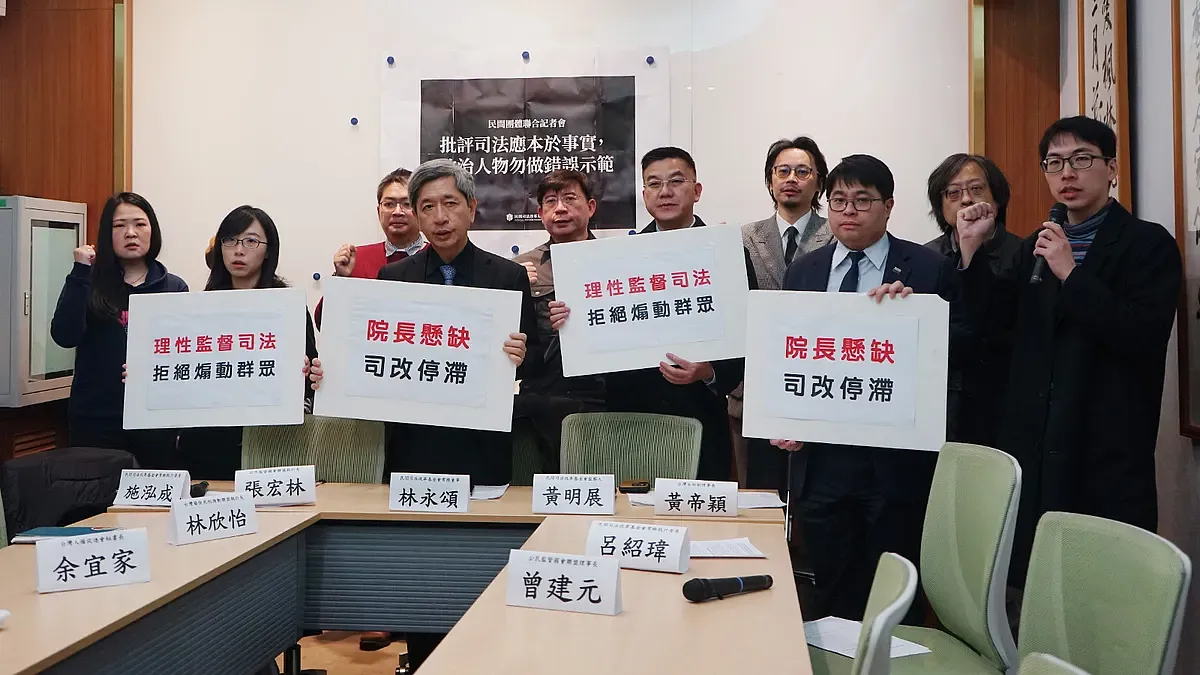
Statement|Criticism of the Judiciary Must Be Based on Facts; Politicians Must Not Set a Bad Example|Joint Press Conference of Civil Society Organizations
Last edited: 2026-07-27
Recently, regarding the criminal detention and indictment of former Taiwan People's Party Chairman K'o Wen-chê, several politicians have taken the lead in shouting "judicial injustice" and plan to mobilize crowds to take to the streets on Judicial Day (January 11) to "face off" and protest against "green judicial authoritarianism."
Regarding ongoing judicial cases, relevant individuals are not barred from making demands and comments concerning the facts and circumstances of a case; however, they must still be based on facts, and particularly avoid misleading statements that do not align with the facts.
In Taiwan's past history, there was indeed a "party-state judiciary" with "political intervention." However, with democratization and the continuous struggle for judicial independence by frontline judicial personnel, we cannot ignore that Taiwan's judicial independence has made substantial progress.
Therefore, we strongly condemn the minority of politicians and political parties that, for their own political agendas, indiscriminately smear the judiciary and mislead the public about the operation of Taiwan's judicial system. In response, we urge all political parties to base their criticisms of the judiciary and comments on individual cases on facts rather than making baseless accusations that undermine past efforts and trust in judicial independence.
Upholding its consistent persistence in judicial reform over the past 30 years, the JRF proposes 6 judicial reform and human rights issues on the eve of Judicial Day. We sincerely invite all political parties to support and respond to them, working together for "judicial independence" and "building a trustworthy judiciary."
I. Criticism of the Judiciary Must Be Based on Facts; Politicians Must Not Set a Bad Example
In this regard, this Foundation calls upon all: regarding ongoing judicial cases, demands and comments targeting the facts and circumstances of the case should be based on facts, avoiding misleading statements inconsistent with facts, and avoiding baseless accusations through the appropriation of concepts. Especially since politicians serve as opinion leaders guiding public sentiment, they truly should not mislead the public's understanding of the judicial system for political purposes.
Whether the evidence used by prosecutors to indict and apply for the detention of Mr. K'o Wen-chê is sufficient is independently judged by the court after synthesizing the evidence to determine whether there is guilt and whether detention is necessary. Meanwhile, the judgments of district courts remain subject to supervision by higher courts, and both defendants and prosecutors may seek remedies; a considerable number of judicial personnel participate in the process. Furthermore, as this case has attracted public attention, the Taipei District Prosecutor's Office simultaneously published the indictment upon filing it. Therefore, relevant comments on the case may also be specifically explained or questioned based on its contents (such as instances violating the "principle of non-publicity of investigations" during the investigation of this case), or further analyze the legal interpretations regarding detention to be subject to public scrutiny, without any necessity to arbitrarily damage judicial credibility with populist rhetoric such as "green judicial authoritarianism" or "green party-state."
We believe that regardless of political color, politicians who violate the law and abuse power will ultimately have to honestly face their own legal responsibilities. The effects of manipulating the public through slogans and consuming the judiciary will not only become increasingly poor, but will also fail to achieve the goal of extending political life. We urge politicians to return to legal and factual grounds to conduct case defense and offense; conversely, they must not attempt to pressure judicial personnel and affect the fairness of trials through political mobilization.
II. Promptly Appoint the President of the Judicial Yuan and Prevent Judicial Reform from Stagnating
Judicial reform should be people-centered, rather than a slogan or tool used to manipulate voters. The President and Vice President of the Judicial Yuan, along with 5 Grand Justices, stepped down on October 31. However, up to now, the positions of President and Vice President of the Judicial Yuan remain vacant, temporarily acted upon by senior Grand Justices. This has plunged the promotion and reform of judicial policies into a state of paralysis, and the ultimate victims are the rights and interests of the people.
Regarding important issues of judicial reform for this year, we believe there are at least the following 6 items. We hope that all political parties can promptly fill the vacancies of the Grand Justices, allowing judicial reform to continue moving forward rather than affecting the quality and rights of people receiving judicial services due to political struggles:
- The Legislative Yuan should re-deliberate the amendments to the Constitutional Court Procedure Act, so as not to paralyze the Constitutional Court and infringe upon the fundamental rights of the people.
- Comprehensively review the implementation of the "principle of non-publicity of investigations" and establish an effective supervisory and accountability mechanism.
- Alleviate the judicial burden through "subtractive thinking" and empirically and systematically evaluate the demand for judicial manpower.
- Strengthen "official supervision" by courts and prosecutors' offices at all levels over their personnel, strengthening supervision over unfit judges and prosecutors in matters not involving the core of trials.
- Initiate reforms to strengthen civil trials of fact, reinforce the civil appraisal system and witness cross-examination system, expand compulsory attorney representation, and implement a collegial panel system for first-instance major cases.
- Pass the "Enforcement Act of the Convention against Torture" and establish a "National Preventive Mechanism against Torture" to prevent systemic human rights violations.
Press Conference Time
January 10, 2025 (Friday) 10:00
Press Conference Location
Room 102, Legislative Yuan Research Building (Chung-hsing Building), No. 3-1, Sec. 1, Chinan Rd., Zhongzheng Dist., Taipei City
Attendees
Lin Yung-sung|Standing Director, Judicial Reform Foundation
Huang Ming-chan|Supervisor, Judicial Reform Foundation
Cheng K'ai-hung|Standing Executive Committee Member, Judicial Reform Foundation
Lü Shao-wei|Standing Executive Committee Member, Judicial Reform Foundation
Shih Hung-ch'eng|Standing Executive Committee Member, Judicial Reform Foundation
Tseng Chien-yüan|Chairperson, Citizen Parliament Watch
Chang Hung-lin|CEO, Citizen Parliament Watch
Huang Ti-ying|Vice Chairperson, Taiwan Association for Truth and Reconciliation
Yu Yi-chia|Secretary-General, Taiwan Association for Human Rights
Lin Hsin-i|CEO, Taiwan Alliance to End the Death Penalty
Chiang Meng-chen|Office Director, Civil Society Monitoring Network on Human Rights Conventions
This article is an AI-generated translation of the original Chinese text. In the event of any discrepancy, the Chinese version shall prevail.