
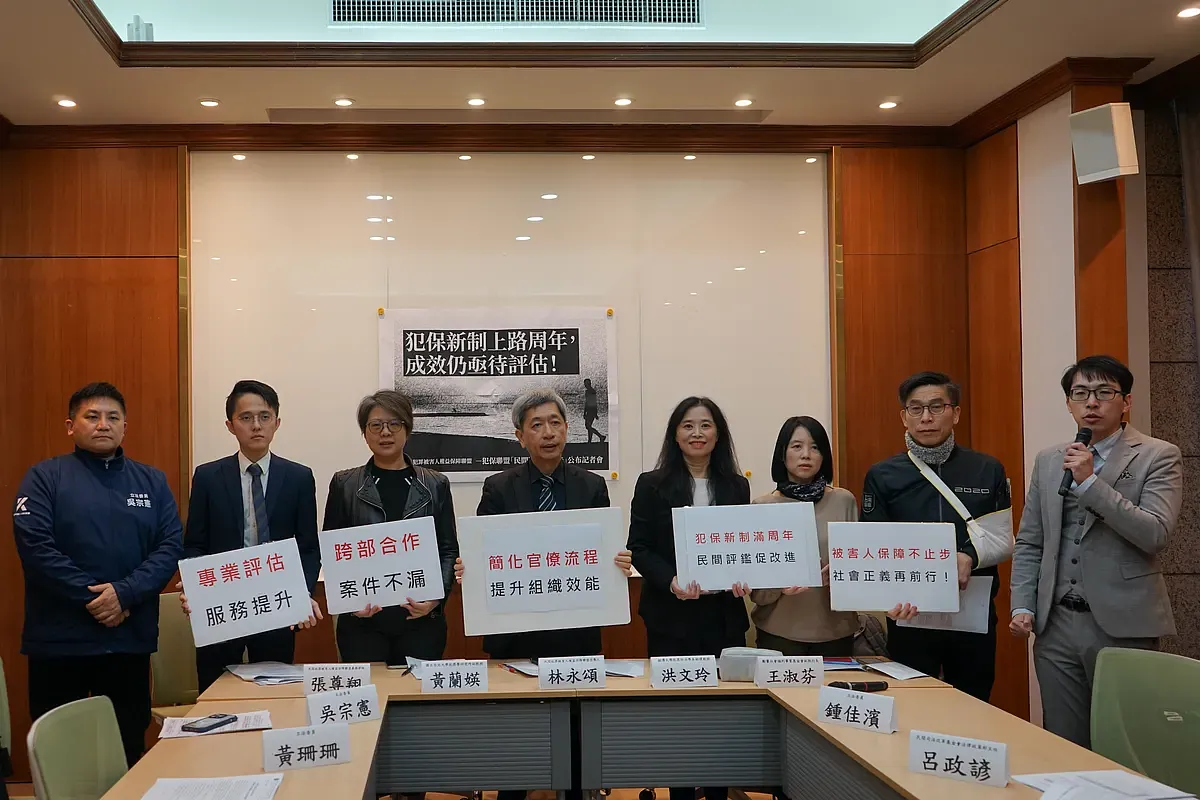
Press Release | One Year After the Implementation of the New Crime Victim Protection System, Effectiveness Still Needs Assessment! — Press Conference on the Release of the Crime Victim Rights Protection Alliance's "Civilian Evaluation Report"
Last edited: 2026-07-27
Full Text of the Civilian Evaluation Report
On January 7, 2023, the Legislative Yuan officially passed the third reading of the newly amended Crime Victim Rights Protection Act, opening a new chapter for crime victim protection in Taiwan. Following the consensus reached at the 2017 National Judicial Reform Guesses Conference, the "Crime Victim Rights Protection Alliance" was established in 2020. From drafting a civilian version of the bill to promoting legislative amendments, the Alliance has consistently spared no effort in providing input and active advocacy. It will also continue to monitor the competent authorities—namely the Ministry of Justice and the Association for Victims Support (hereinafter referred to as the "AVS")—in accordance with the spirit of the new law, to implement its intent and strengthen protections for crime victims.
The newly amended Crime Victim Rights Protection Act came into full effect in early 2024, marking nearly a year since its implementation. Reviewing the implementation status of the work undertaken by the AVS and related ministries under the new law over the past year, as well as the implementation of accompanying resolutions, and referencing the "Report on the Results of the One-Year Implementation of the New Crime Victim Rights Protection Act" submitted by the Ministry of Justice, this Alliance has proposed the Civilian Evaluation Report regarding the implementation effectiveness of the new law over the past year. It puts forward 10 major demands and 20 specific recommendations to the Ministry of Justice, the National Police Agency, and the AVS across dimensions such as organization, services, and systems:
Demand 1: Implement the Legislative Yuan's accompanying resolutions to respond to public expectations.
Demand 2: Work result reports should clearly and directly present whether performance indicators have been achieved; the formulation and modification of performance targets should be supported by professional evaluation and thorough explanation.
Demand 3: Establish a professional evaluation of service quality to facilitate the review and continuous improvement of service quality.
Demand 4: Comprehensively review the organizational design, simplify bureaucratic and hierarchical operations, and foster a new atmosphere in organizational culture.
Demand 5: Inter-ministerial collaboration to understand actual victimization situations, achieving true "zero dropped cases".
Demand 6: Implement 24-hour timely reporting to catch crime victims at the very first moment.
Demand 7: In accordance with the intent of the new law, review and evaluate the implementation status of volunteer training programs.
Demand 8: Strengthen communication and cooperation mechanisms with other organizations to simplify the inconvenience faced by victims seeking assistance.
Demand 9: Enhance the visibility of the AVS and implement impact evaluations for promotion budgets.
Demand 10: Advance news handling from "information provision" to "perspective advocacy" so that society can see the victims.
I. Implement Accompanying Resolutions to Respond to Public Expectations
The current Crime Victim Rights Protection Act was officially passed at the third reading by the Legislative Yuan on January 7, 2023, during which the plenary session also passed a total of 8 accompanying resolutions proposed by the New Power Party caucus and the Democratic Progressive Party caucus. The Alliance has reviewed and presented the implementation status of the content of these accompanying resolutions by the Judicial Yuan and the Ministry of Justice since the passage and implementation of the new law (Attachment 1).
Looking at the implementation status of the 8 accompanying resolutions, apart from the 4 that have already been implemented, there remain 2 that have not yet been implemented, 1 that has been incompletely implemented, and 1 whose implementation status is unclear, awaiting further explanation from the competent authorities:
For example, the Legislative Yuan's accompanying resolutions require competent authorities to compile statistics on the practical application of the evidence preservation system under Article 219-1 of the Code of Criminal Procedure, including applications made and the courts' approvals or denials, as well as the processing principles and implementation of educational training when cases involve violations of sexual privacy. However, competent authorities such as the Ministry of Justice and the Judicial Yuan have yet to fulfill the above requirements.
The Alliance calls on the Judicial Yuan and the Ministry of Justice to attach importance to and promptly execute the aforementioned unimplemented accompanying resolutions, proactively explain their implementation status, and periodically submit written reports on specific items to fulfill crime victim rights protection and respond to the demands of the Legislative Yuan and public opinion.
II. Work Result Reports Should Clearly and Directly Present Whether Performance Indicators Have Been Achieved; the Formulation and Modification of Performance Targets Should Be Supported by Professional Evaluation and Thorough Explanation
The most fundamental way for outsiders to review the work results of the AVS is to compare them against the association's annually published work plans and result reports. Observing the association's newly published "Work Results for 2023", it can be found that among the 16 quantitative benefit indicators self-established by the association, 6 met the targets, 2 did not meet the targets, and another 8 had unclear results (Attachment 2).
The Alliance believes that whether performance targets are met may not necessarily faithfully reflect the work results of the AVS; very often, what needs to be reviewed is the setting of the performance targets themselves. However, since the AVS has already set its performance targets, it should present them as objectively and faithfully as possible in order to conduct substantive reviews and reflections. From this perspective, the past work result reports of the AVS have fallen short of clarity, making it difficult for outsiders to intuitively understand whether performance targets have been achieved, and the contents also lack comparative charts of performance across the years. This issue was also specifically pointed out in the Ministry of Justice's on-site inspection report in May 2023, yet it remains unaddressed to this day.
The Alliance recommends that in future work result reports, the AVS should concretely and directly use tables to explain the achievement status of each indicator. If there are difficulties in statistics or data collection during execution, these should be explicitly stated in the report for the competent authorities and all sectors of society to know. Meanwhile, any modifications, additions, or deletions of performance indicators by the AVS should also be accompanied by clear and detailed explanations to facilitate all sectors in evaluating the quality and soundness of its policy decisions.
In addition, the Alliance also recommends that when submitting future work result reports, the Ministry of Justice, in addition to synthesizing policies and specific measures across ministries, should also incorporate evaluations of the execution effectiveness of victim protection businesses across various ministries to facilitate continuous review and refinement. It is further requested that the Executive Yuan convene inter-ministerial meetings, where the AVS and relevant ministries thoroughly examine work results and establish new work targets, updating the "Strengthening Crime Victim Protection Program" approved in 2018, so as to successively improve the crime victim protection system and strengthen victim protection measures.
III. Establish a Professional Evaluation of Service Quality to Facilitate the Review and Continuous Improvement of Service Quality
Apart from the aforementioned result presentation and target-setting issues concerning quantitative indicators, although the AVS describes "qualitative benefits," it lacks effective evaluation and review regarding them. Taking this year as an example, the AVS extensively held various activities across different regions, such as the May outdoor group activity for families of severely injured crime victims titled "Bridge Encounter Kenting ~ Relax ~", the Mid-Autumn Festival thanksgiving concert "Heart-Listening Feast, Singing Out of Love" in mid-September, and recreational activities like watching movies and ball games. However, regarding the frequent hosting of various activities by the association, we understand that frontline staff members of the AVS have increasingly raised doubts, offering criticisms such as a lack of professional evaluation, failure to achieve protection objectives, and activities merely serving to "increase service volume performance and budget execution rates." Relevant evaluations urgently require review and explanation by the AVS.
The Alliance recommends that local branches of the AVS avoid frequently holding recreational activities lacking evaluation merely for the purpose of increasing service volume or budget execution rates. Furthermore, feedback and satisfaction surveys should be collected from participants after activities conclude, and the nature and distribution of participants should be analyzed to evaluate whether large-scale activities achieve their expected benefits, which should then serve as the basis for adjustments in the association's annual policy planning direction and the planning of subsequent activities.
The Alliance also recommends that in future result reports, the Ministry of Justice, besides making extensive explanations on policy planning and execution circumstances, should focus more heavily on whether service quality has indeed improved, as well as on evaluations and subsequent modifications and reviews of policy execution processes, so as to effectively review work results and make policy adjustments toward the goal of optimizing overall service quality.
In addition to large-scale activities, the AVS should also establish satisfaction surveys targeting various types of protection service operations and evaluations by external experts. External supervision mechanisms should start from individual and group supervisions, utilizing methods such as case discussions, interprofessional collaboration, and program evaluation supervision to assist local branches in jointly reviewing work workflows, thereby achieving the goal of enhancing service quality. As for the current function of staff (psychological) support inherent in external supervision mechanisms, it can be maintained or handled through other specialized projects. In this way, in addition to feedback from victims, one can gain a deeper understanding of victims' feelings and suggestions during protection procedures as a foundation for the continuous refinement of protection services, thereby achieving the core objectives of improving service quality, perfecting assistance procedures, and executing various operations.
IV. Comprehensively Review Organizational Design, Simplify Bureaucratic and Hierarchical Operations, and Foster a New Atmosphere in Organizational Culture
The organizational positioning and core mission of the AVS lie in policy formulation and system development, such as the planning and integration of the victim protection system. Since the state has entrusted the mission of "crime victim rights protection" to the AVS, the institutional purpose fundamentally emphasizes the "de-bureaucratization" and operational "flexibility and efficiency" of the organization.
As pointed out on pages 8–9 of the AVS's "2023 Business Evaluation Report (Member Hsu Ch'eng-yin)", a single official document draft and submission memo within the AVS must internally go through 7 hierarchical levels and bear 9 signatures and seals. The well-intentioned "Charity Invoice Policy" of the AVS requires a total of approximately 57 person-times of operational workflows ranging from inventorying, witnessing, and matching to submitting memos for approval, yet the amount of invoices raised is merely NT$3,796. Does such a hierarchically controlled organizational form ignore considerations of tangible and intangible costs? Are cumbersome, time-consuming, and labor-intensive operational workflows running counter to the organizational positioning and institutional purpose of the AVS?
To achieve this institutional purpose, the Alliance recommends that the AVS comprehensively review current administrative operational procedures, reduce unnecessary paperwork and review stages, further enhance overall work efficiency, and genuinely implement a "subtractive engineering" approach to administrative operations. At the same time, it should re-examine the selection criteria and needs for branch chairpersons, widely incorporating more professionals to further enhance the decision-making quality and professionalism of local branch committees, and compile and publish the professional composition of committee members for public scrutiny, thereby maximizing the benefits of the organizational purpose.
V. Inter-Ministerial Collaboration to Understand Actual Victimization Situations, Achieving True "Zero Dropped Cases"
For criminal cases involving death and severe injury, the AVS is the sole state-supported crime victim service institution. In this regard, the primary task of the AVS is to catch all victims of death and severe injury cases without omission.
The statistics on the number of cases received and opened and the case-opening rates presented in the past work results of the AVS do not allow outsiders to understand how many corresponding cases judicial authorities actually or estimatedly handle, nor do they reveal how many crime victims are actually covered by these case-opening statistics. This part urgently requires precise estimation and explanation by the AVS. Although agencies such as the National Police Agency, the Ministry of Justice, and the Crime Prevention Research Center of the Judicial Officers Training Academy publish statistics related to criminal cases, they lack regularly published statistics on crime victimization statuses. To understand and study the actual situation of crime victimization in our country from a broader perspective, the Alliance believes it is necessary for the Executive Yuan to convene inter-ministerial liaison meetings pursuant to Article 4 of the Crime Victim Rights Protection Act, coordinating various ministries to reliably estimate the situation of crime victimization in our country through statistics.
Meanwhile, regarding the newly revised definition of "severe injury" under Article 3, Subparagraph 6 of the Crime Victim Rights Protection Act, which expands the scope of "severe injury" from injuries originally stipulated in Paragraph 4 of Article 10 of the Criminal Code to circumstances meeting the "major illness and injury items" under Paragraph 1, Article 48 of the National Health Insurance Act, looking at the "Ministry of Justice's One-Year Result Report," one can see that comparing the number of intake cases for severe injury before and after the implementation of the new law, there is a 69.3% increase. However, can this cover all crime victims? What is the coverage rate? This still requires research and clarification. The Alliance respectfully requests the AVS to strengthen communication and cooperation between its local branches and relevant government agencies and institutions in local police, health, social welfare, and labor administration (such as the "Hsin-An Service Counters" established by some branches in funeral parlors or vehicle accident adjudication committees), enabling local branches to grasp more complete statistical data on cases through inter-agency business communications, thereby facilitating the realization of true "zero dropped cases."
VI. Implement 24-Hour Timely Reporting to Catch Crime Victims at the Very First Moment
District prosecutors' offices and police departments are the sources that initially receive cases and are also the agencies most victims contact for the first time. If prosecutors and police can make timely reports or referrals at the very first moment, the AVS can catch victims who are still in a state of panic at the earliest possible time. For this reason, Article 28 of the Crime Victim Rights Protection Act requires the police to complete referrals within 24 hours of becoming aware of a case. In response, the AVS recently established the "Reference Indicators for Preliminary Judgment of Severe Injury Cases under the Crime Victim Protection Act" with the National Police Agency to assist police personnel in implementing timely reporting within 24 hours. However, although the related statistics in the AVS's "Work Results for 2023" include statistics on sources of accepted cases and reporting by crime victim protection officers of police agencies, and the "Ministry of Justice's One-Year Result Report" also compares changes within one year before and after the implementation of the new law (showing that compared to the past where cases mainly originated from judicial agencies, referrals by police agencies nearly increased 5-fold after the implementation of the new law compared to the year before), subsequent work plans have yet to make statistics or regulations regarding the response times of various units.
The Alliance recommends that when prosecutor, police, and related agencies transfer cases to the AVS, they should simultaneously provide information such as the time of case reporting and the time victims' families were notified, to facilitate subsequent delicate casework by the AVS and review statistics for streamlining workflows. Furthermore, upon receiving a case, the AVS should set the work objective of "first-time contact and connection" in its work guidelines, investigate and compile statistics on the actual execution and communication status of each local branch, and optimize service workflows based thereon.
VII. In Accordance with the Intent of the New Law, Review and Evaluate the Implementation Status of Volunteer Training Programs
Professional backgrounds of professional staff and volunteers at the AVS are broad, covering fields such as social work, psychology, crime prevention, and law. According to statistics from the Control Yuan's "2023 General Investigation and Research Report on 'Crime Victims' Rights of Program Participation and Protection'", as of the end of 2023, the total ratio of professional staff to volunteers at the AVS was approximately 1:7, indicating that the development and operation of protection services heavily rely on volunteer manpower.
The current training methods and evaluations for volunteers are explicitly stipulated in the "Program for Protection Volunteers Participating in Crime Victim Protection Work." However, although page 24 of the AVS's "2023 Work Plan" lists the "passing rate of professional training for protection volunteers" and the "rate of excellent performance among protection volunteers" as performance standards, pages 12 to 14 of the "Work Results for 2023" only mention the frequencies and participant numbers of trainings and courses, while making no mention of volunteers completing training, and remain entirely silent on performance metrics such as passing rates and excellence rates. Likewise, the "Ministry of Justice's One-Year Result Report" only briefly explains the hosting of volunteer training courses, without further introducing educational training, training evaluations, or relevant execution circumstances for protection volunteers.
The Alliance respectfully requests the AVS to further explain and compile statistics on the implementation status of volunteer training programs to serve as the basis for policy review and refinement. In addition, policies and regulations concerning volunteers should be reviewed alongside the new law to establish a more complete, systematic, and professional system.
VIII. Strengthen Communication and Cooperation Mechanisms with Other Organizations to Simplify the Inconvenience Faced by Victims Seeking Assistance
The AVS operates the "Accompanying You All the Way—Legal Assistance" program, providing services such as legal consultation, assistance in mediation or settlement, drafting of legal documents, litigation representation, or commissioning lawyers for representation and defense. The Legal Aid Foundation (hereinafter referred to as "LAF") has also established a "single-window operation model" with the AVS, transferring cases between the two associations based on the needs and willingness of victims or their families to ensure that victims obtain adequate legal resources. The "Ministry of Justice's One-Year Result Report" also points out that the LAF and the AVS jointly printed the "Legal Aid Foundation & Association for Victims Support Single-Window Referral Service" brochure in April 2023 to provide victims with multiple choices and complete services.
With budgets and manpower currently more adequate compared to the past, the AVS should urge local branches to implement the "Regulations on Single-Window Service Operations with the Legal Aid Foundation," face relevant issues squarely, and continuously refine diversion mechanisms with the LAF and local domestic violence and sexual assault prevention centers. The Alliance respectfully requests that local branches of the AVS establish and implement liaison meetings with local LAF and domestic violence centers, or invite local LAF branches and domestic violence centers to attend when convening local government business liaison meetings, so as to jointly establish comprehensive diversion and referral mechanisms from the perspective of avoiding burdens and inconveniences for victims.
IX. Enhance the Visibility of the AVS and Implement Impact Evaluations for Promotion Budgets
The AVS's "2023 Work Plan" previously set a target of achieving a reach growth rate of over 15% for media dissemination and e-newsletter distributions. However, comparing the work results of the AVS for 2022 and 2023 reveals that the cumulative number of social media posts, reach counts, and issuance periods and quantities of e-newsletters in 2023 actually decreased rather than increased, failing to meet the planned indicators. The "Control Yuan's 2023 General Investigation and Research Report on 'Crime Victims' Rights of Program Participation and Protection'" also pointed out that interviews with crime victims in certain literature showed victims felt unfamiliar with the AVS prior to victimization, or refused assistance due to unfamiliarity, and some noted that even certain government agencies were unaware of the AVS and its functions. It recommended that the Ministry of Justice and the AVS appropriately utilize cross-domain cooperation, public-private partnerships, and other professional promotional methods to make the Crime Victim Rights Protection Act and its related protection services and measures more widely known.
Regarding the implementation of advocacy and promotion, although one can perceive the dedication and efforts of the Ministry of Justice and the AVS from the observations, seminars, various promotional activities, and courses held by local AVS branches and local prosecutors' offices mentioned in the "Ministry of Justice's One-Year Result Report," as well as promotional activities on the new crime victim law by agencies such as the Ministry of Education, the Ministry of Culture, and the NCC, the activity listings and explanations in the "Ministry of Justice's One-Year Result Report" still fail to demonstrate the operational benefits and promotion effectiveness of these activities.
Looking at the "2024 Budget" of the AVS, its protection promotion budget has substantially increased, making such refinement and improvement even more imperative. The Alliance recommends that the AVS establish performance indicators, review the shortcomings of diverse advocacy channels—such as social media and e-newsletters—used in past years to engage the public in crime victim issues, and integrate the aforementioned service and activity feedback mechanisms along with the establishment of a professional review system to facilitate rolling adjustments and ensure that relevant services and activities truly align with the needs of victims.
X. Advance News Handling from "Information Provision" to "Perspective Advocacy" so That Society Can See the Victims
In recent years, multiple major high-profile cases have occurred in our country, attracting high levels of social attention. Government agencies and numerous non-governmental organizations have also successively reviewed deficiencies in current systems at the earliest moment and suggested subsequent policy planning directions. However, regarding these high-visibility, high-issue cases closely related to the AVS and their corresponding future policy discussions, the voice of the AVS was absent, resulting in a missed opportunity for the public to see the AVS.
For example, at the height of the "#MeToo" movement, we expected the AVS to stand up and tell the public how people can protect their rights when encountering violations of sexual autonomy, such as sexual assault, obscenity, or emerging digital gender-based violence cases that have emerged endlessly in recent years like sextortion and the leakage of sexual imagery. In the "Kai-Kai Case" at the end of 2023, we had expectations for the AVS to stand together with the government and relevant non-governmental units to review how to strengthen communication and jointly construct a more complete "social safety net."
The Alliance recommends that the AVS and its local branches establish a real-time response mechanism for major cases and news to achieve the effect of engaging in dialogue with society and conducting issue advocacy to increase social visibility. Furthermore, following major high-profile social cases—provided that personal privacy data of the parties involved is not implicated and the principle of non-disclosure of investigation is observed—while media and online public opinions are running high, the AVS should stand up to swiftly respond to media and public attention, speak out and express viewpoints for crime victims from the perspective of frontline services, while simultaneously providing accurate information and explaining the relevant assistance the AVS can offer to families.
Attendees
Lin Yung-sung|Convener, Crime Victim Rights Protection Alliance
Hung Wen-ling|Assistant Professor, Department of Criminology, Ming Chuan University
Huang Lan-ying|Associate Professor, Graduate School of Criminology, National Taipei University
Wang Shu-fen|Deputy Executive Director, Garden of Hope Foundation
Chang Tsun-hsiang|Pro Bono Lawyer, Crime Victim Rights Protection Alliance
Lü Cheng-yen|Director of Legal Policy Department, Judicial Reform Foundation
Wu Tsung-宪|Legislative Member
Huang Shan-shan|Legislative Member
Chung Chia-pin|Legislative Member
Press Contact
Attorney Lü Cheng-yen, Director of Legal Policy Department, Judicial Reform Foundation
Phone: 02-2523-1178#37
Email: elvin@jrf.org.tw
This article is an AI-generated translation of the original Chinese text. In the event of any discrepancy, the Chinese version shall prevail.