
Anti-Black Box CSSTA Pro Bono Lawyers Group | Description of the 2021 Taipei Bar Association Outstanding Pro Bono Lawyer Award (Group Category)
Last edited: 2026-11-03
Origins of Formation
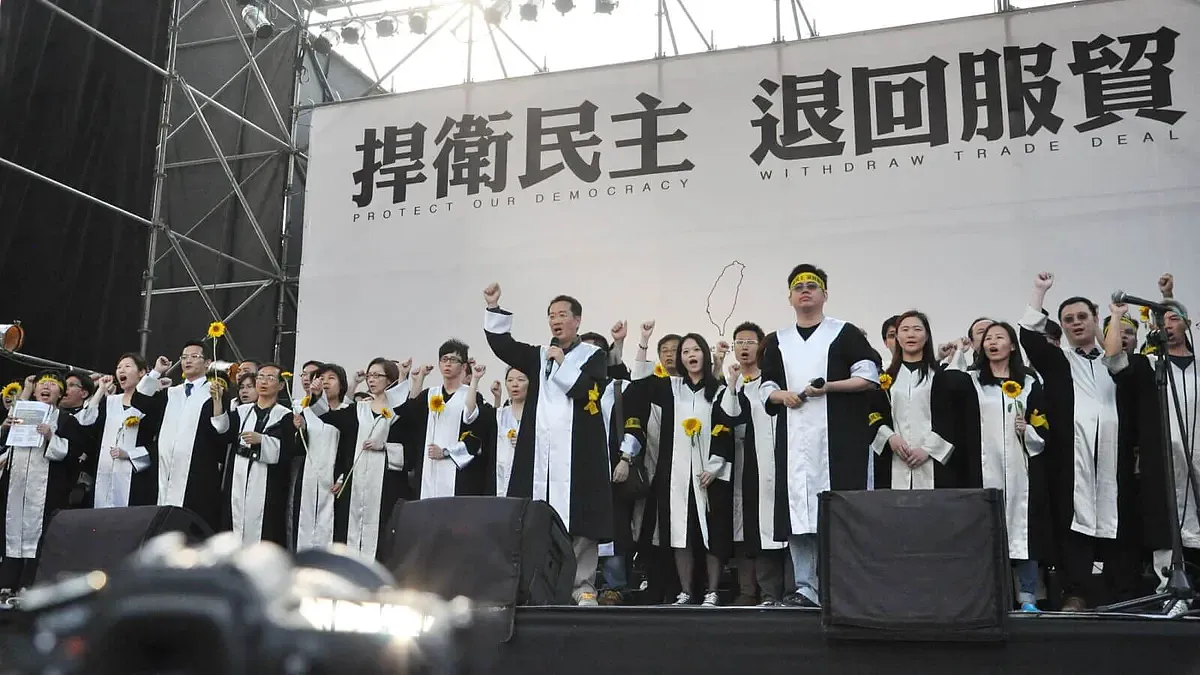
On March 17, 2014, Chang Ch'ing-chung (張慶忠), the convener of the Internal Administration Committee of the Legislative Yuan, violated the resolution on article-by-article review reached through cross-party consultation. In less than 30 seconds, he unilaterally declared that the review period for the Cross-Strait Service Trade Agreement (CSSTA) had exceeded three months, sending the agreement out of the committee and forwarding it to the Yuan plenary meeting for recordation. Students and civil groups launched a sit-in protest outside the Legislative Yuan. In the early hours of the following morning, citizens opposed to the black-box CSSTA escalated their protest tactics by storming into the Legislative Yuan and occupying the legislative chamber, demanding the retraction of the CSSTA. Thus, the 318 Movement unfolded.
On March 19 of the same year, Attorney Ku Li-hsiung (顧立雄), co-convener of the pro bono lawyers group, invited multiple lawyers to the Judicial Reform Foundation to discuss the possibility of filing a constitutional interpretation regarding this procedure. At the same time, concerned that escalating tensions in the police-civilian standoff might lead to mass arrests of citizens by the police—creating a demand for lawyers to accompany clients during interrogations—it was decided to organize a pro bono lawyers group. The JRF would serve as the coordinating organization and communication platform for lawyers, handling tasks such as accompanying clients during police interrogations, providing legal consultation, and assisting with subsequent litigation up to the present day.
Assisted Clients
-
The primary group assisted by the lawyers group consists of participants in the 318 occupation of the Legislative Yuan and the March 24 Executive Yuan violent dispersal incident: Following the 318 occupation of the Legislative Yuan, the occupiers were prosecuted for offenses such as intrusion into a residence. The lawyers group assisted the clients facing state prosecution with their defense. As for the March 24 Executive Yuan violent dispersal incident, on the night of March 23, 2014, although the 318 occupation had been underway for six days, the government still ignored the people's demands. Some protestors shifted their target of occupation to the Executive Yuan, entering the compound starting at 7:00 PM that evening. Those who assisted in maintaining order at the scene were prosecuted for offenses such as property destruction, intrusion into a residence, and incitement to commit an offense; the lawyers group assisted in their defense. In the early hours of March 24, the police used violent means to disperse the unarmed crowd. Some injured citizens subsequently filed private prosecutions and state compensation lawsuits with the assistance of the lawyers group to jointly hold accountable those responsible for the violent dispersal of citizens on the night of March 24, hoping to investigate and restore the truth of that night through litigation.
-
The scope of assistance provided by the lawyers group also extended to participants in other social movements that occurred in 2014, such as the April 11 "Passing by the Zhongzheng First Police Station" case, the April 28 Anti-Nuclear Occupation of Zhongxiao West Road case, the April 29 Anti-Nuclear Vehicle-Blocking case, the June 26 Wulai Vehicle-Blocking case protesting the visit of Taiwan Affairs Office Director Zhang Zhijun, and the defendants in the paint-splattering protest case that occurred on the fourth anniversary of March 24.
-
Number of assisted persons and lawyers per case
Case 4/28 Private Prosecution 4/28 State Compensation 4/29 Defense 6/26 Defense 3/24 Paint-Splattering Defense Assisted Persons 17 16 6 8 6 Assisting Lawyers 36 25 14 27 16 Case 3/18 Defense 3/23 Defense 3/24 Private Prosecution 3/24 State Compensation 4/11 Defense Assisted Persons 22 132 48 31 4 Assisting Lawyers 40 113 101 54 6
Members of the Lawyers Group
- 318 Occupation of the Legislative Yuan Incident
Case List of Lawyers 3/18 Defense Case
- Yu Po-hsiang
- Wang Lung-k'uan
- Jen Chun-yi
- Yü Po-ju
- Wu Tzu-cheng
- Li I-t'ing
- Li Ai-lun
- Li Hsuan-yi
- Chou Han-wei
- Lin Tzu-lin
- Lin Tzu-hsiang
- Lin Chun-hung
- Ch'iu Hsien-chih
- Hung Chia-ch'eng
- Weng Kuo-yen
- Kao Yung-ch'eng
- Kuo Te-t'ien
- Kuo Hsien-chang
- Ch'en Hung-ch'i
- Ch'en Meng-hsiu
- Ch'en Chien-you
- Ch'en P'eng-kuang
- Tseng Wei-kai
- Huang Po-chang
- Huang I-wen
- Huang Hsin-wei
- Liu T'ing-yü
- Liu Chi-wei
- Ts'ai Wan-t'ing
- Ts'ai Ch'ing-yü
- Cheng Chien-kuo
- Cheng Shen-yuan
- Hsiao Yü-hsin
- Hsiao Yung-hsin
- Lai Ying-chen
- Hsieh Chia-ying
- Hsieh Meng-chao
- Lo Ping-cheng
- Lo Wan-t'ing
- Su Hsiao-lun
- Ku Li-hsiung
- March 24 Executive Yuan Violent Dispersal Incident (Private Prosecution, State Compensation, Defense)
Case List of Lawyers 3/24 Chou Ni-an Private Prosecution against Huang Sheng-yung Case
Private Prosecutor Agent - Yu Po-hsiang
- Wu Ming-ts'ang
- Lin Yü-ch'eng
- Kao Yung-ch'eng
- Kuo Hao-jen
Victim Agent - Wang Ch'en
- Shen Che
- Jen Hsiao-hsiang
- Ho Yen-hsun
- Li Ming-ju
- Li Hsuan-yi
- Li Chao-ch'ing
- Li Ch'üan-ho
- Li Hui-chen
- Li Hsi-yung
- Chou Cheng
- Lin Ming-chung
- Lin Chien-hung
- Lin Ch'i-ying
- Ch'iu Ch'i-hung
- T'u Li-yun
- Yao Meng-ts'en
- Hung Min-yü
- Hung Wei-sheng
- T'ang Yü-ying
- Sun Pin
- Chang Hsin-yang
- Chang Ching-ju
- Liang Shui-yuan
- Hsu Ming-chih
- Hsu Hui-feng
- Hsu Pi-chen
- Kuo I-ching
- Kuo Te-t'ien
- Ch'en I-ming
- Ch'en Meng-hsiu
- Ch'en Yü-lung
- Ch'en Wei-yuan
- Ch'iao Cheng-hsiang
- P'eng Yen-ju
- Huang Yü-chung
- Huang Kuo-ch'eng
- Huang Hui-min
- Yeh Shu-hung
- Yeh Wei-hsiang
- Liao Fang-hsuan
- Liao K'ai-wei
- Liao Hui-fang
- Hsiung I-ling
- Liu Kuan-t'ing
- Liu Chi-wei
- Ts'ai Tsung-lung
- Chiang Hsin-yu
- Hsiao Yü-hsin
- Lo I-tzu
- Hsieh Meng-chao
- Lan Tzu-han
- Wei Ch'ao-tsung
- Lo Wan-t'ing
- Yen Hsin-yin
3/24 Private Prosecution against Ma Ying-jeou, Chiang I-hua, Fang Yang-ning, Wang Cho-chun
- Yu Po-hsiang
- Wang Ch'en
- Shen Che
- Li Ming-ju
- Li Chao-ch'ing
- Li Hui-chen
- Li Hsi-yung
- Lin Chien-hung
- Ch'iu Ch'i-hung
- Hung Wei-sheng
- Ni Ying-hua
- T'ang Yü-ying
- Yüan Wei-ch'ien
- Chang Ching-ju
- Hsu Ming-chih
- Kuo Hao-jen
- Kuo Te-t'ien
- Ch'en Wei-yuan
- Ch'en P'eng-kuang
- Ch'iao Cheng-hsiang
- P'eng Yen-ju
- Huang Hsin-wei
- Yeh Shu-hung
- Liu Kuan-t'ing
- Chiang Hsin-yu
- Hsiao Yü-hsin
- Hsieh Meng-chao
- Ku Li-hsiung
3/24 Private Prosecution against Commanders Yang Hung-cheng, Hsueh Wen-jung Case
- Yu Po-hsiang
- T'ang Yü-ying
- Kuo Hao-jen
- Ch'en P'eng-kuang
- Liu Chi-wei
- Ku Li-hsiung
3/24 Private Prosecution against Unidentified Police Officers Case
- Yu Po-hsiang
- Wang Yu-cheng
- Shen Che
- Wu Chi-yü
- Lü Wen-cheng
- Li Hsuan-yi
- Li Chao-ch'ing
- Li Ying-chia
- Li Yen-jung
- Li P'ei-ch'in
- Li Ch'üan-ho
- Li Hui-chen
- Li Hsi-yung
- Lin Shih-hsiung
- Lin Tzu-lin
- Lin I-wen
- Lin I-cheng
- Lin Yü-ch'eng
- Lin Chien-hung
- Lin Chia-ju
- Lin Yin-t'ing
- Lin Ch'i-ying
- Hung Min-yü
- Hung Wei-sheng
- Hung Kuo-hsun
- Hung Ching-tai
- Hung Wei-te
- T'ang Yü-ying
- Sun Pin
- T'u Li-yun
- Kao Yung-ch'eng
- Chang K'e-hao
- Chang Hsin-yang
- Chang Yen-hsiang
- Chang Ning-chou
- Chang Ching-ju
- Chuang Chia-heng
- Hsu Ming-chih
- Hsu Hui-feng
- Hsu Chia-jung
- Hsu Pi-chen
- Kuo Te-t'ien
- Ch'en I-ming
- Ch'en Jen-hao
- Ch'en Meng-hsiu
- Ch'en Yü-fan
- Ch'en I-t'ing
- Ch'en Yen-chang
- Ch'en Yü-lung
- Ch'en Wei-ch'eng
- Ch'en Hsien-cheng
- Ch'iao Cheng-hsiang
- P'eng Yen-ju
- Huang Yü-shan
- Huang P'in-ch'in
- Huang Yü-chung
- Huang Kuo-ch'eng
- Huang Po-yen
- Huang Hui-min
- Yeh Shu-hung
- Yeh Wei-hsiang
- Liao Fang-hsuan
- Liao Hui-fang
- Hsiung I-ling
- Chao P'ei-yi
- Liu Kuan-t'ing
- Liu Ch'i-fu
- Liu Chi-wei
- Pan T'ien-ch'ing
- Ts'ai Wen-chieh
- Ts'ai Tsung-lung
- Chiang Hsin-yu
- Lo I-tzu
- Hsieh K'un-chün
- Hsieh Meng-chao
- Wei Ch'ao-tsung
- Lo Wan-t'ing
- Yen Hsin-yin
- Ku Li-hsiung
3/24 State Compensation
- Yu Po-hsiang
- Wang Yu-cheng
- Shen Che
- Chiang K'ai-yuan
- Wu Wei-t'ing
- Wu Yao-t'ing
- Lü Wen-cheng
- Li Ming-ju
- Li Hui-chen
- Li Hsi-yung
- Lin I-wen
- Lin Yü-ch'eng
- Lin Chien-hung
- Lin Yü-chih
- Ch'iu Ch'i-hung
- Yao Meng-ts'en
- Hung Wei-sheng
- Hung Kuo-hsun
- Hung Ching-tai
- Hu P'ei-ch'i
- Ni Ying-hua
- T'ang Yü-ying
- T'ang Te-hua
- Sun Pin
- T'u Li-yun
- Yüan Wei-ch'ien
- Kao Yung-ch'eng
- Chang Ch'ao-kang
- Hsu Ming-chih
- Hsu Hui-feng
- Hsu Pi-chen
- Kuo Hao-jen
- Kuo Te-t'ien
- Ch'en I-ming
- Ch'en Meng-hsiu
- Ch'en Yü-lung
- Ch'en Wei-yuan
- Ch'en Ching-jyun
- Ch'en P'eng-kuang
- Fu Hsin-yi
- Ch'iao Cheng-hsiang
- Huang Yü-chung
- Huang Hsin-wei
- Huang Hui-min
- Yeh Shu-hung
- Yeh Wei-hsiang
- Hsiung I-ling
- Liu Kuan-t'ing
- Liu Chi-wei
- Ts'ai Chia-jung
- Chiang Hsin-yu
- Hsiao Yü-hsin
- Wei Ch'ao-tsung
- Lo Wan-t'ing
- Ku Li-hsiung
3/23 Defense Case
- Ting Wen-sheng
- Yu Po-hsiang
- Wang Yen
- Wang Hsu-ming
- Wang Lung-k'uan
- Pai Yu-kuei
- Jen Chun-yi
- Chiang Jung-hsiang
- Ho Chao-tung
- Yü Jui-sheng
- Wu Wen-chun
- Wu Shih-tsung
- Wu I-te
- Wu Tzu-cheng
- Wu Hsuan-hua
- Wu Ch'i-hsuan
- Wu Ch'i-hao
- Lü Wen-cheng
- Li Ai-lun
- Li Hung-tse
- Li Ling-wei
- Li Ai-t'ing
- Shen Ch'iao-yuan
- Chou Chun-ta
- Chou Han-wei
- Lin Tzu-hsiang
- Lin Yü-ch'eng
- Lin Chun-hung
- Lin Chien-hung
- Lin Chia-ju
- Lin Yin-t'ing
- Lin Ch'i-ying
- Ch'iu Yu-jou
- Ch'iu Hsu-lun
- Ch'iu Ch'i-hung
- Ch'iu Ying-ch'i
- Hou I-hsiu
- Shih Hung-ch'eng
- K'o Chun-chi
- Hung Ta-chih
- Hung Kuo-hsun
- Hung Chia-ch'eng
- Weng I-hsien
- Weng Yi-hua
- Kao Yung-ch'eng
- Kao Pei-heng
- Kao Ch'u-ning
- Chang Jen-chih
- Chang K'e-hao
- Chang Ning-chou
- Chang Ching-ju
- Chang Yü-yin
- Chuang Wen-yü
- Hsu Hui-feng
- Lien Yuan-lung
- Kuo Te-t'ien
- Kuo Hsien-chang
- Ch'en K'e-yü
- Ch'en Hung-ch'i
- Ch'en I-chun
- Ch'en Yü-lung
- Ch'en Wei-yuan
- Ch'en Ching-jyun
- Ch'en Ting-chun
- Ch'en Chih-hung
- Ch'en Wei-ch'eng
- Ch'en Yao-nan
- P'eng Li-yen
- Tseng Wei-kai
- Huang Yü-chung
- Huang Ying-che
- Huang I-jen
- Huang I-wen
- Yang Shu-ling
- Yang Shih-ch'eng
- Yeh Shu-hung
- Tung Hui-p'ing
- Liao Fang-hsuan
- Chu Ying-shan
- Chao Shu-yü
- Chao P'ei-yi
- Chao Wei-ch'eng
- Liu Kuan-t'ing
- Liu T'ing-yü
- Liu Chi-wei
- Ts'ai Hsiu-fang
- Ts'ai Ming-shan
- Ts'ai Hsin-yü
- Ts'ai Ya-ying
- Chiang Hsin-yu
- Teng Szu-wen
- Cheng Fu-fang
- Cheng Hsin-ju
- Hsiao Yü-hsin
- Hsiao Yü-chieh
- Lai Ping-hsiang
- Lai Ch'iu-hui
- Lai Ying-chen
- Tai Wei-yü
- Hsueh Ch'in-feng
- Hsieh Chia-ying
- Hsieh Meng-chao
- Hsieh Fu-k'ai
- Chung Ch'ing-yü
- Chien Hsu-ch'eng
- Chien K'ai-lun
- Wei Ch'ao-tsung
- Lo Wan-t'ing
- Lo Hsing-chang
- Yen Hsin-yin
- Su Hsiao-lun
- Ku Li-hsiung
- Other Related Cases
Case List of Lawyers 4/28 State Compensation Case
- Yu Po-hsiang
- Wang I-chin
- Li Ming-ju
- Lin Chien-hung
- Ch'iu Ch'i-hung
- Hung Wei-sheng
- Hu P'ei-ch'i
- Sun Hao-t'ing
- Kao Yung-ch'eng
- Chang Heng-chia
- Chang Ling-ch'i
- Chang Po-ch'üan
- Chang Ching-ju
- Hsu Chu-hsien
- Hsu Ch'eng-chu
- Kuo Te-t'ien
- Ch'en You-hsin
- Ch'en Chien-you
- Ch'en Szu-ho
- Ch'en Po-chou
- Liu T'ing-yü
- Liu Hung-chieh
- Ts'ai Wen-chieh
- Ts'ai Hsiu-fang
- Lai Ying-chen
- Lo Wan-t'ing
- Yen Hsin-yin
4/28 Private Prosecution Case - Ting Wen-sheng
- Yu Po-hsiang
- Wang I-chin
- Yü Tsung-ming
- Li Hsuan-yi
- Lin Chien-hung
- Ch'iu Ying-ch'i
- Ch'iu Hsien-chih
- Hung Wei-sheng
- Kao Yung-ch'eng
- Chang Ling-ch'i
- Chang Ching-ya
- Chang Ching-ju
- Chang Yü-yin
- Hsu Ch'eng-chu
- Kuo Te-t'ien
- Ch'en You-hsin
- Ch'en Jen-hao
- Ch'en Chien-you
- Ch'en Szu-ho
- Ch'en Po-chou
- Huang Hui-min
- Liu Kuan-t'ing
- Liu T'ing-yü
- Ts'ai Wen-chieh
- Ts'ai Ming-shan
- Lai Ying-chen
- Chung Wen-yueh
- Lo Wan-t'ing
- Yen Hsin-yin
3/24 Fourth Anniversary Paint-Splattering Case - Wang Yen
- Li Ming-ju
- Li Ling-wei
- Chou Yü-hsiu
- Lin Chun-hung
- Ch'iu Hsu-lun
- Hu P'ei-ch'i
- Chang Ning-chou
- Ch'en You-hsin
- Ch'en Hung-ch'i
- Ch'en Li-t'ing
- Lu Yü-chün
- Huang Yü-chung
- Chu Ying-shan
- Liu Chi-wei
- Ts'ai Ch'ing-yü
4/29 Vehicle-Blocking Case - Yü Jui-sheng
- Chou Chun-ta
- Lin Chia-yun
- Lin Chia-ju
- Ch'iu Ying-ch'i
- Kao Yung-ch'eng
- Chang Shu-ying
- Kuo Shang-wei
- Ch'en Chien-chou
- Huang Yü-chung
- Chiang Hsin-yu
Chao Shu-t'ing6/26 Vehicle-Blocking Case - Ting Wen-sheng
- Yu Po-hsiang
- Wang Chan-hsing
- Yü Tsung-ming
- Lin Chun-hung
- Lin Chien-hung
- Kao Yung-ch'eng
- Chang Ching-ya
- Liang Yen-ni
- Ch'en Wan-yü
- Tseng Wei-kai
- Huang Po-chang
- Huang Kuo-ch'eng
- Liu Kuan-t'ing
- Liu Chi-wei
- Ts'ai Tsung-chao
- Chiang Hsin-yu
- Lai Ying-chen
- Lo I-tzu
- Hsieh Fu-k'ai
- Lo Wan-t'ing
- Ku Li-hsiung

Objectives and Achievements
Even after so many years of democratic transition, I still do not hold out hope that the courts will have the courage to find the police guilty. But through such litigation, we use judicial investigation to allow victims to voice their experiences of victimization, coupled with gathering all police evidence collection tapes and news footage to form the trial record of the court. History must be preserved in this way; otherwise, twenty years from now, no one will know what happened that night, and everyone will believe the official narrative, assuming that the protestors that night were rioters.
── Attorney Yu Po-hsiang, General Convener of the Lawyers Group @ Exhibition Lecture on "Missing Persons"
-
Persevering for eight years, providing pro bono support to clients until the very end
To comprehensively support the surging social movements starting in 2014, the pro bono lawyers group entered the Legislative Yuan in shifts starting on March 18, 2014, when ordinary citizens spontaneously entered the building to protest, providing nearby assistance for legal issues arising among the protesting citizens inside the building. Due to the government's improper dispersal on March 24 of the same year, the pro bono lawyers group began providing free private prosecution and state compensation litigation services for protesting citizens starting on March 27. Today, eight years later, the "Litigation Group" of the pro bono lawyers group has completed its mission as the private prosecution and state compensation cases have been fully concluded.
On the other hand, regarding criminal cases where citizens were prosecuted by the state for expressing their opinions spontaneously, because these cases have not yet been fully concluded, the pro bono lawyers group continues to provide pro bono defense with full effort for the remaining two citizens.
-
Through public trials, preserving a vast amount of state violence litigation documents, footage, transcripts, and other evidentiary materials, while fully demonstrating to the general public the government's improper dispersal actions of that year
Following the Executive Yuan occupation incident on March 24 of that year, in order to preserve police evidence collection materials at the earliest opportunity, the pro bono lawyers group promptly filed an application for evidence preservation with the Taipei District Court on April 3 of the same year, which was granted by the court. Consequently, the lawyers group obtained body-worn camera footage and police duty documents from the police's improper dispersal of citizens within the Executive Yuan compound and surrounding areas in the early hours of March 24. These images and documents were subsequently used in public trial procedures such as private prosecutions and state compensation lawsuits to make them known to the public, preserving precious evidentiary materials for future accountability and for our society.
Furthermore, in 2021, the pro bono lawyers group provided the aforementioned materials to the JRF for the "Missing Persons" exhibition. The JRF de-identified and organized the materials, publicly exhibiting trial transcripts examining the footage of that night, legal briefs, court official letters, as well as footage, news materials, and police body-worn camera footage collected from the public at the time. This ensured the effective preservation of the state's violent acts against citizens. In addition, the JRF and the pro bono lawyers group are currently digitizing these materials and building a database to facilitate future retrieval of relevant case materials by our society at any time.
-
Private Prosecution Cases: Challenging the interpretation of "same case" under the Code of Criminal Procedure, assisting victims in appearing in court to state their experiences of state violence, and prompting the court to recognize the fact of improper dispersal
The series of private prosecution cases assisted by this lawyers group supported a total of 66 clients who suffered improper police dispersal in filing private prosecutions against police commanders at the time, such as Fang Yang-ning, as well as the Premier and the President who held command and supervisory authority. They also petitioned for a constitutional interpretation regarding the traditional concept of the "same case" in the Code of Criminal Procedure.
During the litigation period, the pro bono lawyers group devoted tremendous effort to restoring the command chain at the time and identifying the assaulting police officers. Even before provisions safeguarding victims' right to state opinions were implemented in our Code of Criminal Procedure, they successfully fought to allow the victims in this case to appear in court to state their opinions.
Although the judgment results were not entirely satisfactory and failed to directly hold the regional dispersal commanders, Premier, and President accountable as they should have, the pro bono lawyers successfully led the court to recognize that the police officers responsible for the dispersal indeed committed improper dispersal and violent acts (Taipei District Court Judgment 103-Tzu-61).
-
Defense Cases: Prompting our judiciary to confront concepts such as "civil disobedience," "right of resistance," and "incitement to commit an offense," deepening democracy and the rule of law
The pro bono lawyers group assisted in the defense of 178 citizens. In addition to securing non-prosecution dispositions or acquittals for the majority of clients, during the defense period, the pro bono lawyers successfully drew the attention of our courts to emerging legal concepts such as "civil disobedience" and the "right of resistance," leading the Supreme Court to recognize the aforementioned concepts as one of the grounds for justification under our law (Supreme Court Criminal Judgment 109-Tai-Shang-3695).
Additionally, because prosecutors and courts in this case continued to use the "authoritarian criminal law" of that era to prosecute citizens participating in peaceful assemblies, members of the pro bono lawyers group, together with the JRF, the Taiwan Association for Human Rights, and the Taipei Bar Association, jointly organized the "Authoritarian Criminal Law and Transitional Justice: A Discussion Starting from Incitement and Insulting Public Organs" seminar and "From the Streets to the Courtroom | Occupation Movements and Freedom of Speech: Centering on Civil Disobedience and the Right of Resistance." These events enabled practitioners, academia, and official representatives to fully express their opinions on whether "authoritarian criminal law" (incitement offenses, insulting public organs offenses) should be deleted or amended. The records of the seminar have been incorporated as reference by the Executive Yuan, which has requested the Control Yuan to summarize and organize relevant investigative reports concerning current legal systems and police/prosecutorial practices that might infringe upon citizens' freedom of speech and assembly human rights. The investigation results and subsequent improvement measures were submitted as a written report to the Judiciary and Organic Laws and Statutes Committee of the Legislative Yuan to facilitate subsequent regulatory amendments (refer to the General Review Report of the Central Government General Budget Proposal of the Republic of China for Fiscal Year 2022). This demonstrates that the seminar has had a profound impact on the amendment of our "authoritarian criminal law," making a significant contribution to the realization of the rule of law in Taiwan.
-
State Compensation Cases: Confirming the state's liability to compensate for violent dispersal, securing compensation for citizens, and warning that future police dispersal methods must comply with the principle of proportionality
The pro bono lawyers group assisted 79 citizens in filing state compensation lawsuits. Among them, in the case of client Lin Ming-hui, the Taipei District Court took the lead on August 7, 2015, in ruling that the Taipei City Government should compensate the client NT$300,000 (Taipei District Court Civil Judgment 103-Chien-Tzu-107). For several other clients who were injured due to the improper dispersal action by the police on March 24, 2014, the Taiwan High Court ruled on January 27, 2022, that the Taipei City Police Department must pay a total compensation of NT$1,408,169, which became final (Taiwan High Court Civil Judgment 109-Shang-Kuo-16).
During the litigation period, the pro bono lawyers worked tirelessly, sifting through evidence collection footage to successfully locate images of improper police dispersal and violence among numerous body-worn camera recordings. This enabled the court to confirm and squarely face the issue of police officers using violence that exceeded the principle of proportionality against unarmed people, and led the court to specify criteria in its judgment for determining whether police engaged in improper dispersal, serving as a landmark case for state compensation issues concerning police law enforcement in Taiwan.
Chronology
Establishment of the Pro Bono Lawyers Group
| Time | Content |
| 2014.03.17 | Chang Ch'ing-chung, convener of the Internal Administration Committee of the Legislative Yuan, sent the CSSTA out of committee and forwarded it to the Yuan plenary meeting for recordation. |
| 2014.03.18 | The "Guard Democracy Night" rally was held outside the Legislative Yuan, after which students broke through police blockades to sit in inside the Legislative Yuan. |
| 2014.03.19 | The JRF 24-hour interrogation accompaniment hotline was launched. |
| 2014.03.20 | Pro bono lawyers were recruited and stationed in the legislative chamber in shifts. |
| 2014.03.23 | Some protestors occupied the Executive Yuan and were violently cleared out by police at midnight; lawyers also traveled to the scene in shifts to assist. |
| 2014.03.27 | A press conference denouncing state violence was held, alongside the 1st General Assembly of the pro bono lawyers group to discuss its operations, initially dividing into a Litigation Group and a Defense Group. |
| 2014.03.30 | 2nd General Assembly of the pro bono lawyers group. |
| 2014.04.03 | Applied to the court for the preservation of evidence related to police duty on the night of March 23. |
| 2014.05.30 | The pro bono lawyers group assistant project began assisting various respective projects. |
Timeline of Main Assisted Cases (318 Incident, 324 Incident)
- 3/18 Legislative Yuan Occupation Case (Defense)
Time Content 2015.02.10 The Taipei District Prosecutors Office indicted 22 people regarding the 3/18 Legislative Yuan occupation case. 2017.03.31 First-instance judgment rendered for the 3/18 Legislative Yuan occupation case, ruling all 22 people not guilty. 2017.06.07 Seven Criteria for Civil Disobedience? — Seminar on the Evaluation of the 3/18 Judgment. 2018.03.13 Second-instance judgment rendered for the 3/18 Legislative Yuan occupation case, finalizing the acquittal of all 22 people. (Case Closed) - 3/24 Executive Yuan Dispersal Case (Private Prosecution)
Time Content 2014.04.25 Held a press conference and filed a private prosecution regarding the March 23 Executive Yuan suppression event. 2014.06.08 3/24 private prosecutors and lawyers went to the JRF to verify video evidence. 2014.07.30 The 3/24 private prosecution case held its first court hearing at the Taipei District Court. 2014.12.30 The 3/24 private prosecution cases were successively dismissed without acceptance by the Taipei District Court and Taiwan High Court on the grounds of being the "same case"; the lawyers group filed an appeal with the Supreme Court. 2015.01.22 The Supreme Court dismissed the appeal for the 3/24 private prosecution case. 2015.03.21 Clients in the 3/24 private prosecution case filed to resume proceedings in the case of Chou Jung-tsung v. Ma Ying-jeou, Chiang I-hua, Wang Cho-chun, and Fang Yang-ning. 2015.04.10 Applied for a constitutional interpretation regarding the issue of identity in the "same case" under the Code of Criminal Procedure (Hui-Tai-Tzu Nos. 13359, 12513, 13452, 13332). 2019.07.18 First-instance judgment rendered for the 3/24 private prosecution case - Chou Ni-an v. Huang Sheng-yung, ruling Huang Sheng-yung, then-Commissioner of the Taipei City Police Department, not guilty. 2019.08.23 First-instance judgment rendered for the 3/24 private prosecution case against on-site commanders, ruling Hsueh Wen-jung, then-Chief of the Da'an Precinct of the Taipei City Police Department, and Yang Hung-cheng, then-Chief of the Nangang Precinct, not guilty. 2020.01.03 The Grand Justices resolved not to accept the application for constitutional interpretation regarding the issue of identity under the "same case" provision of the Code of Criminal Procedure. 2020.03.16 Second-instance judgment rendered for the 3/24 private prosecution case - Chou Ni-an v. Huang Sheng-yung, upholding the acquittal of Huang Sheng-yung, then-Commissioner of the Taipei City Police Department. 2020.09.15 First-instance judgment rendered for the 3/24 private prosecution against Ma, Chiang, Wang, and Fang, ruling all 4 individuals not guilty. (Case Closed) - 3/24 Executive Yuan Dispersal Case (Defense)
Time Content 2015.02.10 The Taipei District Prosecutors Office indicted 93 people regarding the 3/23 Executive Yuan occupation case. 2015.05.05 The Taipei District Prosecutors Office additionally indicted 39 people regarding the 3/23 Executive Yuan occupation case. 2016.05.20 The Executive Yuan withdrew complaints against the 126 clients involved in complaint-dependent offenses regarding the Executive Yuan occupation case; however, 21 clients remained under trial due to involvement in non-complaint-dependent offenses (obstruction of official duties, destruction of public property, and incitement to commit an offense). 2017.04.10 First-instance judgment rendered for the 3/23 Executive Yuan occupation, ruling not guilty on charges of incitement to commit an offense and aggravated larceny, and guilty on charges of obstruction of official duties and destruction of items officially managed by public servants. 2020.04.28 Second-instance judgment rendered for the 3/23 Executive Yuan occupation case, ruling 1 person not guilty and 16 people guilty (among whom 8 could not appeal, making their guilty verdicts final). 2020.10.30 The lawyers group appealed the 3/23 Executive Yuan occupation case, holding oral arguments at the Supreme Court and inviting experts to court to state opinions on the constitutionality of incitement to commit an offense and the right of resistance. 2021.01.18 Third-instance judgment rendered for the 3/23 Executive Yuan occupation case. The Supreme Court affirmed that the right of resistance can be applied by analogy to exclude illegality under emergency rescue provisions and narrowed the interpretation of incitement to commit an offense; however, because fact-finding in this case was incomplete, the original judgment was set aside and remanded to the High Court. 2021.10.08 Remanded retrial judgment rendered for the 3/23 Executive Yuan occupation case, ruling 2 people guilty of destruction of public property and dismissing prosecution for 6 people on incitement to commit an offense charges. (The final 2 people had their guilty verdicts finalized by the Supreme Court; a constitutional litigation was filed in April 2023 and is awaiting acceptance) - 3/24 Executive Yuan Dispersal Case (State Compensation)
Time Content 2014.04.23 Lin Ming-hui, a client in the 3/24 case, filed a state compensation lawsuit, marking the first state compensation lawsuit in the 3/24 case. 2015.08.07 First-instance victory in the first 3/24 state compensation case—the Lin Ming-hui state compensation case, ruling that the Taipei City Government should compensate NT$300,000. 2015.03.23 Clients in the 3/24 case filed state compensation lawsuits. 2019.10.30 First-instance judgment rendered for the 3/24 state compensation case, ruling that the Taipei City Police Department should compensate 14 people a total of NT$1,111,570. 2022.01.27 Second-instance judgment rendered for the 3/24 state compensation case, ruling that the Taipei City Police Department should compensate 19 people a total of NT$1,408,169. (Case Closed)
This article is an AI-generated translation of the original Chinese text. In the event of any discrepancy, the Chinese version shall prevail.