
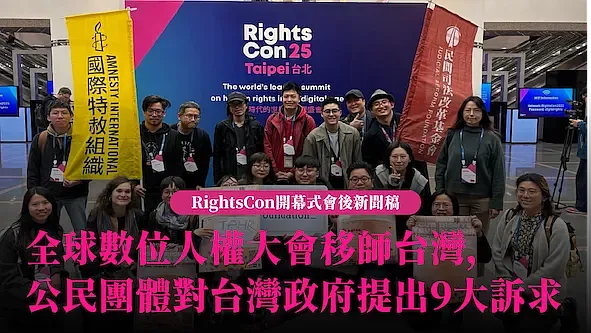
RightsCon Opening Ceremony Post-Event Press Release | Global Summit on Digital Rights Moves to Taiwan, Civil Society Groups Put Forward 9 Key Demands to the Taiwanese Government
Last edited: 2026-07-27
On February 24, 2025, RightsCon, the world's leading summit on human rights in the digital age organized by the international NGO Access Now, came to Taiwan for the first time, holding a four-day event at the Taipei International Convention Center. Civil society groups, government agencies, and tech companies including Meta from over a hundred countries gathered to discuss the human rights impacts of technologies such as artificial intelligence, digital platforms, and data security. Taiwanese groups focused on digital rights also proposed 9 core demands at the summit, urging the Taiwanese government to establish more comprehensive regulations and policies.
The 9 core demands, jointly proposed by local civil society organizations including the Judicial Reform Foundation, Open Culture Foundation, Taiwan Association for Human Rights, and Amnesty International Taiwan, cover digital rights, personal data protection, internet access, digital platforms, artificial intelligence, human rights due diligence, and open source.
During her opening remarks, Li Hsin-ying (李欣穎), CEO of the Open Culture Foundation—a local partner of the summit—invited Vice President Hsiao Bi-khim and Vice Premier Cheng Li-chiun in the audience to collaborate with civil society on formulating human rights protection policies for the digital age.
In her speech, Executive Yuan Vice Premier Cheng Li-chiun noted that unlike "authoritarian states that use digital technology to monitor citizens and conduct digital censorship," the social values of a democratic and free Taiwan will guide digital technology to serve democracy and human rights. Consequently, the government continues to narrow the digital divide and combat digital sexual violence, while policies such as the Personal Data Protection Commission and the Artificial Intelligence Basic Act are also set to be implemented. Vice President Hsiao Bi-khim emphasized that Taiwanese society faces risks including "various cyberattacks undermining democracy, such as the polarization of online discourse, disinformation manipulating public opinion, privacy violations, and algorithmic bias," underscoring the need to create a digital environment that safeguards fundamental human rights.
Civil society groups affirmed Vice President Hsiao Bi-khim and Vice Premier Cheng Li-chiun's remarks on the government's commitment to continuously strengthening human rights issues in the digital era. However, regarding specific policy contents, the groups pointed out that existing policies and regulations still require further revision and refinement to truly approach the "sound digital governance" mentioned in their speeches.
"As digital technology penetrates every aspect of government administration and law enforcement, corporate operations, and people's daily lives, it also means that everyone's rights are potentially subject to the impacts of digital technology," stated Li Ming-ju (李明洳), Deputy Executive Director of the Judicial Reform Foundation. She stressed that the Taiwanese government should immediately initiate the legislative process for a Digital Rights Act to establish the boundaries of civil rights, government obligations, and public authority, ensuring that individuals possess due process and remedy mechanisms when their rights are compromised by digital technology.
"The government holds a massive amount of real-name personal data, and even sensitive personal data, which also means the government has the obligation to protect everyone's personal data," pointed out Chou Kuan-ru (周冠汝), Deputy Secretary-General of the Taiwan Association for Human Rights. She noted that in addition to improving and implementing the personal data protection system through the Personal Data Protection Commission to be established by August and adhering to clear and robust privacy protection laws, the government also needs to establish contingency and remediation mechanisms for data breaches by public agencies. Furthermore, it must make public the lists of public and private sectors that have held or participated in the interfacing of household registration and household-household data, particularly following the nationwide household registration data breach incident in 2022. She further emphasized that even for data utilization with seemingly well-intentioned purposes, individuals must be respected. Specifically, the utilization of health data such as health and welfare data, national health insurance data, hospital medical records, and test results must grant individuals the rights to informed consent, post-utilization control, and the withdrawal of consent.
"Research conducted globally by Amnesty International has found that the algorithms and content mechanisms of platforms ranging from Facebook and X to TikTok cause mental and physical health harms to children and adolescents, amplify discrimination and hate speech online, and even translate into offline violence," emphasized Chiu I-ling (邱伊翎), Secretary-General of Amnesty International Taiwan. She stressed that while safeguarding freedom of speech, the government must establish a governance mechanism compliant with international human rights standards for very large online platform providers, and platform operators should likewise establish preventive mechanisms and transparent moderation systems. She also pointed out that the draft Artificial Intelligence Basic Act currently formulated by the Taiwanese government is overly rudimentary regarding human rights impact assessments and response mechanisms, and that the government must join hands with civil society to advance relevant legislation to ensure that AI legislation, product technology, and research and development comply with international human rights standards.
"The public sector has an obligation to guarantee internet neutrality and openness, and should not arbitrarily adopt internet blocking measures such as DNS RPZ without clear legal authorization," explained Li Hsin-ying (李欣穎), CEO of the Open Culture Foundation. She stated that restricting website access is an approach that heavily impacts freedom of speech, and the government should only implement measures restricting internet access under clearly authorized laws and transparent data mechanisms. She further indicated that the development and application of various technologies hold the potential to create positive values, but also carry the risks of misuse and abuse. The best approach is to incorporate open source and civic technology promotion into law and policymaking as core strategies for public services and digital development.
Initiating Organizations
Judicial Reform Foundation, Open Culture Foundation, Taiwan Association for Human Rights, Amnesty International Taiwan
Endorsing Organizations
Taiwan Labour Front, Taiwan Association for Death Penalty Abolition, Citizen of Asia Foundation
Appendix
Appendix: Joint Statement Flyer (Bilingual Chinese-English Edition)
This article is an AI-generated translation of the original Chinese text. In the event of any discrepancy, the Chinese version shall prevail.