
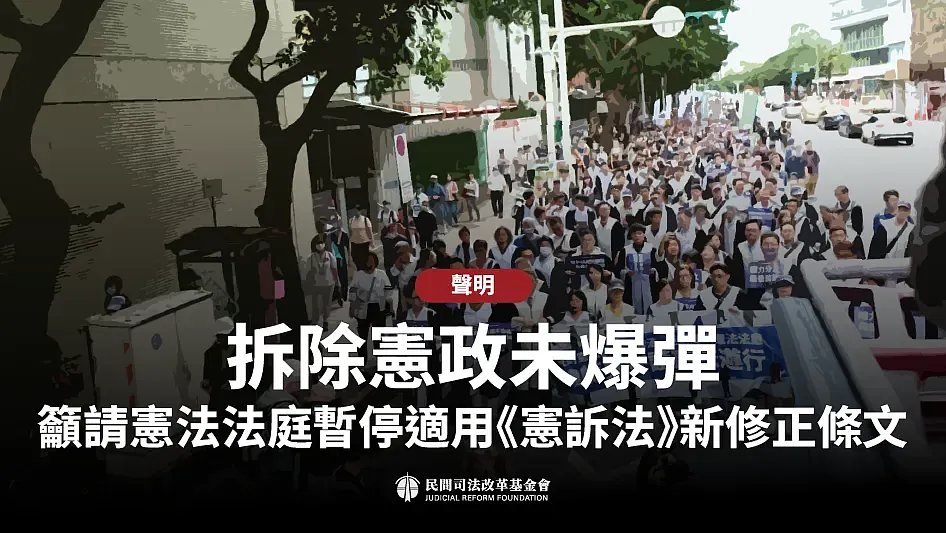
Statement | Defusing the Constitutional Time Bomb: Urging the Constitutional Court to Suspend the Application of the Newly Amended Constitutional Court Procedure Act
Last edited: 2026-07-27
The amended provisions of the Constitutional Court Procedure Act officially took effect on January 25, 2025. Because there are currently only 8 sitting Grand Justices, under the revised rules, the Constitutional Court is barred from conducting substantive deliberations or discussions on cases, and naturally cannot render judgments.
To date, while the Constitutional Court formally continues to deliberate, these sessions are merely screening panels preliminarily deciding whether to accept cases. For cases already accepted, substantive deliberations and judgments can no longer be conducted under the newly amended Constitutional Court Procedure Act. In other words, the Constitutional Court's constitutional function of checking and balancing the executive and legislative branches has been unilaterally paralyzed for a month. We do not know how long this situation will persist.
We must sound the alarm: the result caused by the amended provisions of the Constitutional Court Procedure Act—making it difficult for the Constitutional Court to deliberate or render judgments—is a severe "constitutional time bomb." When major constitutional controversies subsequently arise and there is no Constitutional Court to adjudicate them, it may detonate an even more severe constitutional crisis.
Currently, to hear this case, the Constitutional Court has officially issued an official letter requesting the Legislative Yuan to provide information and opinions. The Legislative Yuan also discussed this matter during yesterday's (the 5th) afternoon caucus consultation. In response, we further urge the Constitutional Court, before the crisis arrives, based on the legal principle that the Constitution prevails over the Constitutional Court Procedure Act, to first render a ruling to suspend the application of the newly amended Constitutional Court Procedure Act.
I. Checking and Balancing the Legislative and Executive Branches is the Duty of the Constitutional Court
As a long-standing monitor standing in opposition to the establishment, the Judicial Reform Foundation certainly has more criticisms than praises for the judgments and interpretations previously rendered by the Grand Justices. Recently, whether concerning the "death penalty case", the "trafficking of category 1 narcotics case", the "Tai Li-shen whistleblower dismissal case", or the "Hsu Kuo-yao dismissal case", we have publicly criticized the Grand Justices' judgments in order to expect and urge that the judiciary can make further progress.
However, regardless of the judgment outcome, out of respect for the judicial system, absent empirical evidence, we will not wantonly question the neutrality of the Grand Justices or arbitrarily accuse them of favoring specific partisan positions. We are deeply aware that as an important role in the separation of powers and checks and balances, challenges to the credibility of the Constitutional Court must not be baseless.
Regrettably, on one hand, the opposition parties have paralyzed its functions through legal amendments; on the other hand, they have launched a war of public opinion to trigger a crisis of public trust in the Constitutional Court. Politicians frequently use erroneous discourse to mislead the public. A case in point is the exploitation over the past half-year of misleading information such as "death row inmates will be released" and "the eight hurdles of the death penalty." Moreover, by declaring most provisions of the "Parliamentary Reform Act" unconstitutional, the opposition alliance directly and crudely labeled the Grand Justices as biased, unfair, and serving the ruling party; yet at the same time, as many as 123 legal scholars called on the Legislative Yuan to return the five parliamentary acts for re-examination, which to a certain extent reflects the mainstream opinion of the legal academia. These attacks and distortions against the Constitutional Court clearly cannot justify the legislative branch's unilateral act of suspending the powers of the Constitutional Court.
We believe that while the Kuomintang and the Taiwan People's Party voted down all nominees for Grand Justices, amending the Constitutional Court Procedure Act in an attempt to render the Constitutional Court non-functional has already crossed the red line of the rule of law. We believe the opposition parties' motivation in amending the law is not to reform the Constitutional Court, but to remove the stumbling block that checks and balances their legislative power. Regardless of whether past judgments of the Constitutional Court were agreed with or opposed, we call on all sectors to have a clear understanding and consensus on this: when facing unconstitutional acts that unilaterally usurp its constitutional powers, the Constitutional Court can certainly engage in self-defense and review and suspend the operation of the new Constitutional Court Procedure Act in order to faithfully fulfill its duty of checking and balancing the legislative and executive branches.
II. The Paralysis of the Constitutional Court is Taiwan's Constitutional Time Bomb
In fact, the current paralysis of the Constitutional Court has already turned on the red light for Taiwan's foundation of democratic rule of law, except that the crisis has not yet been detonated. This is because, even if the President, the Executive Yuan, or the Legislative Yuan engages in clearly unconstitutional acts, or if extremely serious constitutional controversies arise between them, there currently exists no institutionalized solution. At this point in time, the severity may still be difficult to feel, because the destruction of constitutional order is often a cumulative process. Once the crisis is detonated due to subsequent constitutional controversies and conflicts, it will become even harder to manage. Observing democratic backsliding faced by Eastern European countries such as Hungary and Poland, the judiciary has always been the primary target of attack. With the collapse of the judiciary, what people face is the endless expansion and authoritarianism of the executive and legislative branches.
We believe that the paralysis crisis of the Constitutional Court is a "constitutional time bomb" and we must never wait until other controversies subsequently occur to frantically ponder solutions; instead, this crisis should be addressed as early as possible to prevent it from serving as a fuse with other major constitutional controversies, which would detonate the crisis beyond control.
III. The Constitutional Court Has Yet to Express Its Opinion on the Unconstitutionality Controversy of the Constitutional Court Procedure Act Amendments
Cases claiming that the amendments to the Constitutional Court Procedure Act are unconstitutional or applying for provisional injunctions have already been submitted to the Constitutional Court. However, up to now, the Constitutional Court has not expressed any opinion.
We note that among the cases accepted and under review by the Constitutional Court, some applicants, worried that case outcomes will be adversely affected by the deterioration of the Constitutional Court Procedure Act amendments, have made additional applications regarding the new law. However, in the ruling on February 10, three Grand Justices (the screening panel) dismissed one of the applications on the grounds that "the additional application has exceeded the time limit" and "the original judgment did not apply the Constitutional Court Procedure Act." Judging from the content of the ruling, the Grand Justices did not mention any issues or legal opinions regarding the amendment of the Constitutional Court Procedure Act; but on the other hand, for the purpose of adjudication, the Constitutional Court has officially issued a letter requesting the Legislative Yuan to provide information and opinions.
Since the unconstitutionality issue of the Constitutional Court Procedure Act amendments concerns the constitutional practice of the system of checks and balances, the Grand Justices should adopt a quite prudent attitude in handling the legal issues, procedures, and adjudication progress of this controversy. While we express respect for the Grand Justices' procedural handling of this controversy, we also expect the Grand Justices to uphold their duty of safeguarding our country's constitutional order and defuse this constitutional time bomb of the new Constitutional Court Procedure Act.
IV. Supporting the Self-Defense of the Constitutional Court to Prevent the Destruction of Democratic Constitutionalism
Fortunately, up to now, Taiwan's professional community of legal workers and civil society have provided rich support on this issue.
In the system of separation of powers, the judiciary has always been the most vulnerable link—it neither has direct public opinion support like the legislative branch nor the massive organization and execution power of the executive branch. Unlike the executive and legislative branches, the judiciary's greatest weapon is to gain society's acceptance, trust, and respect for the judiciary through reasoning and argumentation.
Politicians certainly have the right to criticize and look down upon the judiciary; this is their freedom of speech. But when politicians begin to collectively and openly defy judicial judgments, and even attempt to silence the judiciary through power, it is a severe destruction of the constitutional system, and we should all be alert.
Right now it might look like "it's nothing" and "nothing will happen even if the Constitutional Court does not operate"; but it has actually sown the seeds for a greater constitutional conflict and crisis. We are unwilling to see the constitutional time bomb of a paralyzed Constitutional Court detonate together with other crises, only for people to suddenly realize: why has our democracy reached this point today? And how can it be prevented?
We call on all sectors to support the self-defense of the Constitutional Court and prevent the destruction of the checks and balances mechanism of democratic constitutionalism.
Press Contact
Lü Cheng-yen, Attorney-at-Law, Director of the Legal Policy Department, Judicial Reform Foundation
Telephone: 02-2523-1178#37
Email: elvin@jrf.org.tw
This article is an AI-generated translation of the original Chinese text. In the event of any discrepancy, the Chinese version shall prevail.