
Joint Statement | Forced Surgery is Unconstitutional! Demanding the Control Yuan Investigate the Ministry of the Interior for Unlawful Dereliction of Duty
Last edited: 2026-07-27
MOI Ruling Deemed Unconstitutional; Years of Waiting Yield No Results
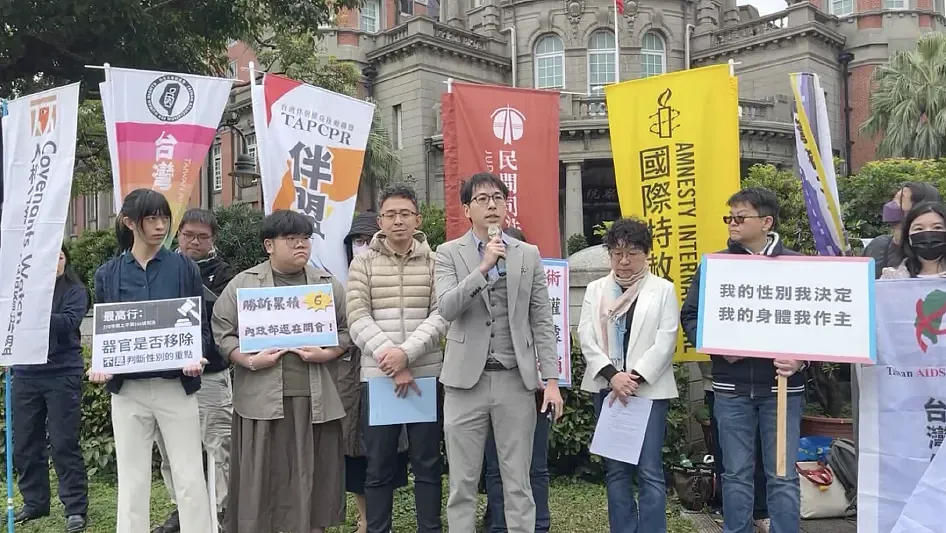
Even though the judiciary has repeatedly ruled that forced surgery is unconstitutional, under Taiwan's current administrative practices, transgender individuals wishing to change their gender marker must still submit medical diagnosis certificates proving the removal of their gonads and sex organs. Today (7th), groups including the Taiwan Alliance to Promote Civil Partnership Rights (TAPCPR), Taiwan Association for Human Rights, Amnesty International Taiwan, Covenants Watch, Judicial Reform Foundation, Taiwan Non-Binary Queer Waves, Association for Legal Rights of Intersex in Taiwan, Taiwan Lourdes Association, and Gender-Equality Student Advocacy Alliance visited the Control Yuan to file a petition requesting an investigation into the Ministry of the Interior for dereliction of duty—specifically, knowingly keeping unconstitutional regulations in place without amendment. Control Yuan Member Chi Hui-jung met with and received the petition from the groups.
According to the Ministry of the Interior's Official Letter No. 0970066240 issued on November 3, 2008 (hereinafter referred to as the 2008 MOI Ruling), transgender individuals applying for a gender marker change must present two psychiatric diagnosis certificates and complete sex organ removal surgery. Civil society organizations have advocated for years, arguing that the MOI's requirement for individuals to remove their sex organs as a prerequisite for changing gender markers violates the principle of legal reservation and severely infringes upon transgender individuals' bodily autonomy, right to health, human dignity, and personality rights. Although the Ministry of Health and Welfare previously requested that the MOI respect individuals' wishes and not require surgery as a condition for gender marker changes, more than a decade has passed and the MOI continues to stubbornly refuse to amend the aforementioned ruling.
Since 2008 TAPCPR legally represented a transgender plaintiff, Xiao E, in successfully changing her gender marker without submitting the aforementioned surgical proof, there have been a cumulative total of one Supreme Administrative Court judgment and six High Administrative Court judgments holding that the 2008 MOI Ruling is unconstitutional. Furthermore, former Grand Justice Chan Sen-lin and current Grand Justice and Acting President of the Judicial Yuan Hsieh Ming-yang both submitted opinions to the Constitutional Court declaring the 2008 MOI Ruling unconstitutional, affirming that the removal of sex organs should not be a mandatory prerequisite for gender marker changes. As pointed out in Supreme Administrative Court Judgment No. 110-Shang-558: "In gender marker change applications, the core review focus is whether the applicant's outwardly expressed gender presentation, based on their autonomous understanding, has persisted for a considerable period, rendering their gender identity stable with a high probability of not changing. Whether the applicant's original external physical characteristics—which did not align with their gender identity—have been removed is not an essential matter closely related to the essence of the affair."
However, over the three and a half years since the Xiao E case—the first judgment declaring forced surgery unconstitutional—the MOI has persisted in neither revoking nor amending the ruling, despite facing clear and repeated judicial determinations of its unconstitutionality. It merely uses future legal amendments as an excuse, allowing the illegal and unconstitutional status quo to persist. Whenever questioned about the progress of legislative amendments, the MOI repeatedly stalls with the excuse that "meetings are ongoing." A judge once bluntly stated during a court hearing: "Holding meetings does not constitute progress; meetings at best can be called people expressing their own views!" Representatives from the MOI could only offer a bitter smile.
Faced with Human Rights Deficiencies, the MOI Engages in Passive Inaction
Such a clear human rights deficiency on the part of the MOI goes beyond passive inaction; most infuriatingly, in one particular case, the New Taipei City Administrative Appeals Commission determined that the 2008 MOI Ruling was unconstitutional, thereby revoking the household registration office's original administrative disposition and demanding a lawful redisposition. Unexpectedly, when the household registration office wrote to the MOI for instructions, the MOI continued to shirk responsibility. In its reply, on the one hand, it directly instructed the household registration office that "prior to the completion of the Executive Yuan's legalization process, applications for gender marker changes shall still be handled in accordance with the MOI order dated November 3, 2008 (i.e., the 2008 MOI Ruling)." On the other hand, it spoke ambiguously, demanding that the household registration office handle the specific case in accordance with the administrative appeals decision. However, the administrative appeals decision explicitly determined that the 2008 MOI Ruling was unconstitutional and thus revoked the household registration office's original disposition. How on earth was the household registration office supposed to simultaneously follow the 2008 MOI Ruling and comply with the administrative appeals decision? Such an attitude by the MOI clearly shifts the entire responsibility for decision-making onto frontline household registration personnel. Yet, within the centralized bureaucratic culture of household registration administration, upon receiving such ambiguous superiors' replies that blatantly pass the buck, frontline household registration personnel naturally dare not make a "lawful" disposition that contradicts the 2008 MOI Ruling.
The MOI refuses to revoke the 2008 MOI Ruling while shifting responsibility to legislative amendment meetings with unknown progress; in individual cases, it completely shirks decision-making responsibility, forcing subordinate household registration offices to bear the pressure of administrative litigation and citizens fighting for their lawful rights. Once transgender plaintiffs win their lawsuits, the MOI uses high-sounding excuses like "the binding effect of judgments only applies to individual cases" to aggressively and blatantly refuse to conduct administrative self-correction on a ruling that is already illegal and unconstitutional. Its unlawful dereliction of duty is glaringly obvious!
Chiang Meng-chen, Office Director of Covenants Watch, stated that UN human rights bodies have explicitly stated that forced surgery violates international human rights standards, even constituting torture or cruel, inhuman, or degrading treatment, and representing discrimination based on gender identity and sexual orientation. In Taiwan, six international human rights conventions now possess domestic legal effect, and the concluding observations of CEDAW in 2014, as well as the ICCPR and ICESCR in 2017 and 2022, have all taken the position that forced surgery should be abolished. As early as 2013, the Ministry of Health and Welfare convened a meeting on "gender marker registration," resolving to decouple gender change procedures from medical interventions. However, the administrative branch has yet to implement this policy direction to this day, which is clearly passive inaction.
Attorney Lu Cheng-yen, Director of the Legislative Policy Department of the Judicial Reform Foundation (JRF), noted that the JRF Gender Working Group's attention to surgery-free gender recognition began with the "Xiao Nà Case" in 2023. At that time, the Supreme Administrative Court held that: "An individual's continuous self-gender identity falls within the core scope of human dignity, personality free development, and personality rights protected by Article 22 of the Constitution. Although the legal determination of an individual's gender initially relies on external physical sex characteristics at birth, when an individual's outwardly expressed gender tendency—based on their internal self-understanding and awareness—does not align with their legal gender classification, the state should respect the people's freedom and rights to autonomously determine their gender, provided it does not harm social order and the public interest, and recognize that individuals may apply to change the gender on their household registration according to Article 21 of the Household Registration Act." Aside from the Xiao Nà case, there have also been multiple successful judgments, demonstrating that abolishing forced surgery has become a stable judicial view.
Yu-ling, leader of the Taiwan Non-Binary Queer Waves project team and editor of Queer Transgression, pointed out that approximately one-quarter of Taiwan's transgender community is non-binary, meaning they cannot be fully defined as solely male or female. Among the non-binary community, nearly 80% support surgery-free gender recognition. The MOI's requirement for transgender individuals to remove their sex organs amounts to forcing them to choose between their gender identity and reproductive rights, treating transgender individuals as governance subjects "who should not procreate."
Wu Yi-ting, Chairperson of the Association for Legal Rights of Intersex in Taiwan, stated that over the past decade or more, they have promoted surgery-free gender recognition through various methods, urging the government to stop ignoring the rights of transgender individuals and leaving their gender identity trapped in emotional and economic predicaments. Although the judiciary has accumulated multiple winning judgments, not everyone has the resources and time to endure litigation.
Shang-yang, a member of the Gender-Equality Student Advocacy Alliance, called on the Control Yuan to listen to students' voices and urge the MOI to modify the outdated ruling. Citing a 2020 survey by TAPCPR, Shang-yang pointed out that nearly 50% of transgender students have experienced unfriendly treatment on campus. In Taiwan, many systems related to student rights—ranging from restrooms and dormitories to certain course designs—still operate within a binary gender framework. This practice not only violates human rights but also deprives students of their fundamental right to education.
Transgender Identities Have Been Decolumnized; The MOI Should Amend the Ruling Soon
Chien Chih-chieh, Secretary-General of TAPCPR, stated that the 11th revision of the International Classification of Diseases (ICD) released by the World Health Organization in 2018 already regards the incongruence between birth-assigned sex and gender identity as a natural and diverse human state. This state is not a disease, but merely a condition requiring supportive care and affirmation from medical institutions. The recommendations released by the UN in 2017 state that gender recognition procedures should be based on applicant self-determination, prohibiting forced medical treatment or medical interventions.
Chien Chih-chieh concluded by appealing that the MOI, knowing full well that the 2008 Ruling is unconstitutional and that the courts have established a new and stable legal view, nonetheless allows the 2008 Ruling to persist. This forces transgender individuals to choose between "being forced to undergo surgery according to the ruling" or "surviving prolonged administrative appeals and administrative litigation to obtain a winning judgment." This is a severe infringement upon citizens' fundamental rights and a contempt for democratic constitutional principles. It is hoped that the MOI will return to the right path and change course as soon as possible.
Control Yuan Member Chi Hui-jung, who was on duty today, listened attentively to the press conference and subsequently invited civil society groups and transgender representatives into the Control Yuan to submit a petition. The civil groups earnestly requested the Control Yuan to launch an investigation ex officio and demand that the MOI immediately revoke the unconstitutional ruling to safeguard the human rights of transgender individuals.
Attachment: Petition to the Control Yuan Regarding Gender Marker Changes and the Abolition of Forced Surgery
Press Conference Remarks
Attorney Lu Cheng-yen, Director of the Legislative Policy Department, Judicial Reform Foundation
The Judicial Reform Foundation focuses on the domestication and judicial practice of international human rights conventions. Regarding transgender human rights, paragraph 86 of the concluding observations and recommendations of the Committee on the Elimination of Discrimination against Women (CEDAW) in its third state report review in 2022 explicitly demanded the abolition of mandatory surgery as a prerequisite for gender reassignment.
The JRF Gender Working Group began focusing on surgery-free gender recognition at the end of 2023, prompted by the Supreme Administrative Court remanding the Kaohsiung "Xiao Nà Case." At that time, the Supreme Administrative Court put it very well: "An individual's continuous self-gender identity falls within the core scope of human dignity, personality free development, and personality rights protected by Article 22 of the Constitution. Although the legal determination of an individual's gender initially relies on external physical sex characteristics at birth, when an individual's outwardly expressed gender tendency—based on their internal self-understanding and awareness—does not align with their legal gender classification, the state should respect the people's freedom and rights to autonomously determine their gender, provided it does not harm social order and the public interest, and recognize that individuals may apply to change the gender on their household registration according to Article 21 of the Household Registration Act."
However, it was not until July of last year at the Kaohsiung High Administrative Court that the Xiao Nà case achieved victory. During this period, we mobilized students from gender studies institutes in the Kaohsiung area four times to conduct courtroom observations, hoping that the idea of legal "forced surgery" violating human rights would be fully discussed and understood during the judicial process.
Our presence here at the Control Yuan is precisely because, apart from the Xiao Nà case, the proposition that gender marker changes should not require surgery has become a stable legal view in our country's judicial practice through one lawsuit after another. Yet the MOI still refuses to amend the ruling mandating forced surgery, forcing transgender individuals to endure protracted administrative appeals and litigation procedures before they can request household registration offices to update their gender markers based on the final winning judgment.
The MOI's failure to keep pace with the times and adhere to human rights standards displays blatant dereliction of duty, which is why we call upon the Control Yuan to actively investigate.
Yu-ling, Project Team Leader, Taiwan Non-Binary Queer Waves
I would like to discuss the issue of gender marker change requirements from the perspective of Taiwan's non-binary community experiences and transgender bodily autonomy.
First, "non-binary gender" refers to individuals whose gender identity cannot be fully defined as either male or female. According to a questionnaire survey conducted by the Taiwan Alliance to Promote Civil Partnership Rights and the Taiwan Tongzhi (LGBTQ+) Hotline Association, approximately one-quarter of Taiwan's transgender community is non-binary. Taiwan Non-Binary Queer Waves also conducted non-binary community surveys in 2023 and 2024, discovering that the gender transition plans of most individuals in the non-binary community do not include sex organ removal or reconstructive surgeries. Last year's survey also revealed that nearly 80% of Taiwan's non-binary community supports surgery-free gender recognition. Consistent with administrative victory cases accumulated in recent years, they believe Taiwan should not make surgery a requirement for gender marker changes.
Despite the growing consensus among the non-binary community and judicial judgments in favor of surgery-free gender recognition, the MOI continues to direct household registration offices to follow the regulatory ruling mandating forced surgery. Sex organ removal surgery is inherently a major and irreversible medical procedure, and such a significant decision should be grounded in the individual's own will and bodily autonomy.
Within the Taiwan Non-Binary Queer Waves community, we have encountered a group of people who receive less attention: transgender and non-binary individuals who have reproductive plans. Although many assume that all transgender men hate their sex organs and inherently reject pregnancy, and while many treat the reproductive capacity of transgender women as an inherent threat, there are indeed transgender and non-binary individuals in Taiwan who wish to realize their reproductive plans. Unfortunately, Taiwan's current gender marker change system legally entrenches the gender framework that equates "transgender with sterilization," forcing this group to choose between gender recognition and reproductive rights. Here, I must ask: Is the cost of using sterilization as a threshold for gender recognition justifiable? When the Taiwan government treats a group of people as governance subjects "who should not procreate," on what grounds can we claim that Taiwan is a nation that respects human rights and freedom?
As pointed out in the reasoning of the Supreme Administrative Court's judgment in the Xiao Nà case: the MOI's administrative ruling mandating forced surgery "severely infringes upon the applicant's bodily autonomy, right to health, human dignity, and personality rights." At today's press conference, Taiwan Non-Binary Queer Waves joins in petitioning the Control Yuan to conduct an investigation in accordance with the law and demand that the MOI cease its dilatory behavior and immediately revoke the forced surgery ruling! Thank you.
Chiang Meng-chen, Office Director, Covenants Watch
The core mission of Covenants Watch is to ensure that human rights protections are truly realized in Taiwan through the promotion, monitoring, and implementation of human rights mechanisms, thereby making Taiwan a country where everyone's equality, dignity, and rights are protected.
Transgender Gender Recognition Rights and International Human Rights Standards
UN human rights bodies—whether treaty-based or charter-based—have clearly stated that requiring transgender individuals to undergo gender reassignment surgery in order to legally change their gender violates international human rights standards and even constitutes torture or cruel, inhuman, or degrading treatment. Such regulations are fundamentally a form of discrimination based on gender identity and sexual orientation, severely violating personal integrity and the right to self-determination. UN bodies strongly recommend that all states abolish such regulations.
Moreover, the European Court of Human Rights holds the same position, pointing out that mandatory medical interventions as a precondition for gender recognition violate transgender individuals' bodily autonomy and self-determination rights, and calling on states to ensure that transgender individuals can legally change their gender based on their own identity without unnecessary restrictions.
Taiwan's Human Rights Commitments and International Review Mechanisms
In Taiwan, six core human rights conventions now possess domestic legal effect—namely the International Covenant on Civil and Political Rights (ICCPR), the International Covenant on Economic, Social and Cultural Rights (ICESCR), the Convention on the Elimination of All Forms of Discrimination against Women (CEDAW), the Convention on the Rights of the Child (CRC), the Convention on the Rights of Persons with Disabilities (CRPD), and the International Convention on the Elimination of All Forms of Racial Discrimination (ICERD)—and have undergone multiple international reviews.
International review experts have repeatedly and explicitly demanded that the Taiwan government safeguard the human rights of transgender individuals, protect their freedom to choose their gender identity by law, and refrain from imposing unnecessary restrictions. Relevant recommendations can be found in: the 2014 CEDAW concluding observations, and the 2017 and 2022 two covenants concluding observations. In these documents, the review committees directly pointed out that the Taiwan government should abolish discriminatory regulations requiring "gender reassignment surgery to complete a gender marker change."
Policy Progress and Implementation Gaps in the Taiwan Government
As early as 2013, the Ministry of Health and Welfare convened meetings related to "gender marker registration," resolving to decouple gender change procedures from medical interventions. This resolution was cited by CEDAW international review experts in 2014, and the MOI also promised in its action response table at the time to consider multiple perspectives and seek appropriate methods that align with humaneness and respect transgender rights.
However, to this day, the administrative branch has yet to implement this policy direction, failing to remove forced surgery as a requirement for gender marker registration and even ignoring judicial judgments on the matter. This amounts to passive inaction, leaving transgender individuals to continue facing unfair treatment within the legal and administrative systems.
The Control Yuan Should Fulfill Its Human Rights Protection Responsibility and Launch Active Investigations
Therefore, Covenants Watch and partner organizations are holding this press conference today to call upon the Control Yuan to build upon its 2018 investigation and concern regarding human rights violations against gender-diverse individuals, launch deeper investigations and oversight regarding improper regulations within the gender marker registration system, and ensure that the rights of transgender individuals receive substantive protection.
Wu Yi-ting, Chairperson, Association for Legal Rights of Intersex in Taiwan
As one of the early organizations in Taiwan pushing for surgery-free gender recognition, we have spent the past decade or more advocating for it through various methods, and we even came close to succeeding in 2013.
Now, just like back then, we are on the verge of success, yet it has always remained stalled at the MOI. This step has taken us 12 years.
The banner in my hand today is the same banner the Association for Legal Rights of Intersex in Taiwan held from its very inception. This banner mirrors our stagnant transgender human rights: showing no progress whatsoever.
Standing here in front of the Control Yuan today, we urge the government to stop ignoring our rights. Countless transgender and intersex individuals remain trapped in emotional and economic predicaments because the government refuses to recognize their gender identity. These predicaments are the costs shifted onto us by this unfriendly society; these predicaments are the result of government inaction.
We thank our allied organization TAPCPR and our partners for their legal persistence over the past few years, which has allowed Taiwan to achieve successful rulings on surgery-free gender recognition. However, not everyone has the resources and time to wait for litigation.
In this unfriendly society, as day after day passes, transgender and intersex individuals continue to wait for surgery-free gender recognition, waiting for the state to recognize their gender identity. Please, government, do better; please, society, do better. And please, do not tell us to "keep it up"—society is forcing us to bear the consequences of this unfriendliness, and this is not what we desired.
Shang-yang, Gender-Equality Student Advocacy Alliance
I am Shang-yang, a member of the Gender-Equality Student Advocacy Alliance and currently a student at Shih Hsin University. We are composed of student members from inter-school gender equality committees, student gender organizations, and students who have long cared about gender issues. We are dedicated to promoting student rights and gender equality, undertaking gender equality advocacy actions in various arenas. Standing here today, we hope the Control Yuan will listen to students' voices and urge the MOI to squarely face the outdated gender marker change requirements in the 2008 ruling. These requirements not only prevent transgender individuals from existing in administrative systems and daily life with their self-identified gender identities, but the gender imaginations replicated by this system also force students into outdated gender frameworks. Furthermore, they exclude gender-diverse students from accessing school resources, participating in affairs, and exercising their fundamental right to education.
First, from a student's perspective, I would like to describe the living conditions of transgender and non-binary students on campus: According to the "Survey Questionnaire on the Current Status of Transgender Human Rights" conducted by TAPCPR in 2020, 47.68% of transgender individuals had experienced unfriendly treatment on campus. Moreover, the "Campus Experience Survey Report of Taiwan's Tongzhi Students" released by the Taiwan Tongzhi (LGBTQ+) Hotline Association in the same year pointed out that, compared to cisgender students, transgender students, non-binary students, and students exploring their gender identities are more likely to experience discriminatory policies and unequal treatment on campus.
We must recognize that in Taiwan, many campus systems closely tied to student rights still operate under traditional binary gender thinking. This subjects transgender and non-binary students to numerous predicaments throughout their educational journeys. From the gender registration fields on basic information forms submitted by students to administrative staff, to binary-gendered restroom spaces on campus, to campus dormitories where most schools still resort to expedient room-assignment mechanisms based on male-female binaries, and to gender-divided courses—all of this demonstrates that transgender students, non-binary students, and even cisgender students are all forced to coexist with binary frameworks. When a student feels anxious in dormitory spaces due to their gender identity, worrying about how others view them, how can we expect students to study with peace of mind? When a student resists exercise—or even gives up physical activity altogether—due to binary physical education course designs, how can we expect students to cultivate their potential? When a student cannot meet basic human bodily needs because there are no welcoming restrooms on campus, how can we expect them to develop freely in a comfortable environment? When a student resists interacting with administrative staff due to identity annotations, how can we guarantee a student's dignity? The existing gender frameworks on campus not only violate human rights but directly deprive students of their fundamental right to education. Meanwhile, the outdated gender imagination in the MOI's 2008 ruling repeatedly reinforces and reproduces these gender frameworks, leading people to mistakenly believe that gender boundaries are synonymous with gonadal boundaries, thereby refusing to expand diverse perspectives on gender boundaries and hindering the free development of students.
In recent years, an increasing number of plaintiffs have gone to household registration offices to apply for gender marker changes, yet the MOI continues to ignore relevant court judgments and orders household registration offices not to process these changes. Those whose applications are rejected include transgender students, non-binary students, and students constrained by gender frameworks. Therefore, the Gender-Equality Student Advocacy Alliance stands here to hope that the MOI will respect judicial judgments and immediately amend outdated regulations. We also call upon the administrative system to squarely face students' gender experiences on campus. Only by bringing systems up to speed with gender equality can campuses truly become places where all students can grow equally. Thank you.
Time
March 7 (Friday) 10:00
Location
Main Entrance of the Control Yuan
Moderator
Chien Chih-chieh | Secretary-General, Taiwan Alliance to Promote Civil Partnership Rights
Participating Organizations (in stroke order of Chinese names):
Shang-yang | Representative, Gender-Equality Student Advocacy Alliance
Yu-ling | Project Team Leader, Taiwan Non-Binary Queer Waves
Chiang Meng-chen | Office Director, Covenants Watch
Wu Yi-ting | Chairperson, Association for Legal Rights of Intersex in Taiwan
Lu Cheng-yen | Attorney, Judicial Reform Foundation
Chin Chia-yu | Secretary-General, Taiwan Lourdes Association
Shih I-hsiang | Senior Researcher, Taiwan Association for Human Rights
Pan Tien-ching | Chairperson, Taiwan Alliance to Promote Civil Partnership Rights
Jao Chia-jung | Equality and Non-Discrimination Policy Officer, Amnesty International Taiwan
Press Contacts
Taiwan Alliance to Promote Civil Partnership Rights Advocacy Specialist
Chen Hsuan-an 0911847601
This article is an AI-generated translation of the original Chinese text. In the event of any discrepancy, the Chinese version shall prevail.