
Sidelights|Marching Together, Peaceful and Militant: Taiwanese and Hong Kong Activists Share On-Site Protest Experiences
Last edited: 2026-11-04
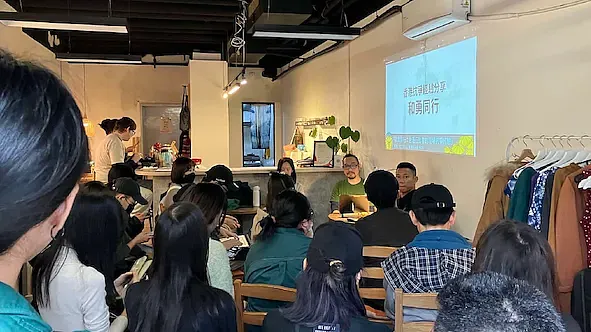
The seminar "Marching Together, Peaceful and Militant: Taiwanese and Hong Kong Activists Share On-Site Protest Experiences" was held at Lumaq. This topic primarily stemmed from the controversy surrounding the review and passage of a series of controversial bills in May, which sparked widespread public opposition in Taiwan and led to divergent views on the methods used to express demands through protests. The moderator, Savungaz Valincinan, noted that Taiwan has gradually established a consensus among participants in various social movements regarding advocacy, shouting slogans, and action procedures, as well as a consensus on how to respond during on-site actions. Since the 2014 Sunflower Student Movement, social movements have adopted a style of protest that allows for relatively greater space for communication. However, the divisions over protest methods resurfaced following the legislative protests in May, prompting this seminar to restart the discussion.
At the beginning of the seminar, moderator Savungaz Valincinan invited the participants to briefly introduce themselves and introduced the speakers: A-chü, representing the peaceful protest faction in the Hong Kong protest movement; Fu Tang, representing the militant protest faction; and T'ang Yü-ying, executive director of the Judicial Reform Foundation and volunteer lawyer for the 318 Sunflower Student Movement legal team, who shared their perspectives as activists and lawyers respectively.
The Tactical Division Between Peaceful, Rational, and Non-Violent (PRNV) and Militant Factions
As a representative of the Peaceful, Rational, and Non-Violent (PRNV) faction, A-chü actually felt that, given the relatively moderate nature of protests in Taiwan, they perceived themselves to be relatively radical. A-chü began by sharing the origins of the Hong Kong protest movement, tracing the story back to the 1967 riots—radical protest events initiated by leftist organizations involving strikes, demonstrations, and violent clashes, which led Hongkongers to establish a consensus and reflection that protest movements must not result in casualties. However, after 2014, the militant protest strategy gradually emerged, leading to conflicts and friction between the militants and the existing PRNV faction. A-chü shared that while the PRNV adhered to Mahatma Gandhi's peaceful protest path of "civil disobedience," the militants relatively adopted a "no-holds-barred" protest strategy. This created an impression that the PRNV and militants were prone to conflict, and raised concerns that it might violate movement codes of conduct and lead to criminal offenses. On the other hand, militants believed that the moral ideals of the PRNV were overly lofty and failed to achieve the goals of the protest, while also expressing dissatisfaction with the traditional faction's clinging to power within Hong Kong's political context. Both movement factions engaged in mutual criticism and suspicion, and subsequent factors such as masking and suspicions of government informants further intensified their antagonism, plunging Hong Kong's social movement into a low point.
From Confrontation to Marching as Brothers
A-chü went on to share that the turning point from confrontation to walking together came from the realization that both sides had their own support bases and neither could eliminate the other. As a result, they gradually built values that did not blindly negate each other. Citizens adopting the PRNV approach appealed to the militants not to completely reject the PRNV perspective—which would rule out the possibility of participation by certain protesters. For example, A-chü noted that during the Anti-Extradition Law Amendment Bill Movement, scenes of conflict actually stimulated public support, allowing the PRNV to see the effectiveness of the militants' strategies. They also discovered that militant actions were not without bottom lines; they still adhered to basic principles such as not indiscriminately harming the innocent, and not stealing or robbing. Furthermore, militants were not opposed to morality itself, but rather to ungrounded moral appeals. As mutual understanding developed, the two gradually marched together and exerted even greater strength in the protest movement.
Fu Tang, the speaker from the militant faction, shared that in the past, he was dissatisfied with the actions of the pan-democratic camp and particularly took issue with how the PRNV always lumped militants together with the Hong Kong protest group "Civic Passion" (derogatorily called "Hot Dogs"), a categorization that fostered negative evaluations of the PRNV.
The Risks of Militant Movement Strategies
Fu Tang shared that the primary objective of militant protest actions was to enter the Legislative Council to halt meetings, which inevitably meant facing conflicts with the police. Therefore, the methods they adopted primarily involved throwing objects like stones to confront the police, without the goal of engaging in violent physical combat with them. Fu Tang also shared that at protest sites, activists might face police traps, such as police provoking Hong Kong activists to induce criminal behavior. In addition, Hong Kong activists might encounter numerous fake news items at protest sites designed to disrupt the protest activities. To counter the spread of misinformation, Fu Tang shared that communication software such as Telegram, LIHKG, and Facebook were frequently used tools at protest sites to understand the situation. However, because a significant amount of fake news still penetrated these platforms, he also recommended using features like AirDrop to instantly transmit information about surrounding users as a rapid way to share news.
Drawing from his own experience as the first defendant in a protest case, Fu Tang shared how it made him realize that his actions would have a crucial impact on the legal risks subsequent protesters would face. This led him to reflect on the need to be more cautious about his actions—satisfying the immediacy required by the movement while gradually adjusting his role within it, such as shifting from frontline positional warfare against the police to guerrilla-style protest tactics. Additionally, Fu Tang shared that militant protests actually involved a division of labor and action plans, along with careful assessments of legal risks. For instance, they were well aware that the appearance of a protest action might border on illegality, but the purpose of the movement was for the public interest, targeting the regime rather than harming innocent people, contrary to outside perceptions that militant actions lacked purpose.
Law and Social Movements
Lawyer T'ang Yü-ying, who spoke next, addressed social movements from a legal perspective, discussing the legal risks social activists might face and offering guidance on how activists can make risk-reducing decisions when participating in protests. Taking her experience as a volunteer lawyer during the 318 Sunflower Student Movement as an example, Lawyer T'ang noted that after the event broke out, using the name "Anti-Black Box" highlighted the injustice of the procedures, attracting the agreement of more lawyers and providing increased legal resources for social movement participants. Lawyer T'ang mentioned that conflict scenes arising from protests might be evaluated differently based on various circumstances, but she reminded participants to actively and extensively gather evidence of potential unlawful law enforcement by police during conflicts, which could serve as favorable evidence for subsequent state compensation or criminal litigation. She also advised adopting methods during actions that do not affect other people or things, such as advocating for peaceful protest.
In addition, Lawyer T'ang specifically discussed how protest methods are legally evaluated, using legal concepts such as the "principle of proportionality" to explain aspects like the legitimacy of the purpose, the connection between the purpose and the means, and the balancing of interests in discussing lawful protest methods. Lawyer T'ang also noted that since activists' protest methods outwardly appear to be illegal actions, it is necessary to examine whether their substantive content meets the legal evaluation of "illegality." Although Taiwan's judicial practice has not yet universally recognized the right of resistance or civil disobedience as a legitimate right to protest, there are still grounds such as "material illegality" or "necessity/emergency distress" that can negate the illegality of an act.
Finally, Lawyer T'ang reminded participants of the crime of obstructing an officer, which is frequently established in practice. For instance, pushing and shoving clashes between activists and police during a protest are very likely to constitute obstruction of an officer, or police deliberately provoking and instigating behavior could lead activists to actively attack police, thereby incurring legal blame. To address these legal risks, Lawyer T'ang introduced the Protest Self-Defense Handbook produced by civil society organizations in response to the 318 movement, and shared search resources such as the Laws and Regulations Database of the Republic of China and the Judicial Yuan website. Activists can use these to search relevant laws (such as the Criminal Code or the Social Order Maintenance Act) and relevant judgments to understand the legal risks activists may face and how the judiciary evaluates protesters' actions, thereby helping actors understand the potential legal risks they might face when participating in protests.
This article is an AI-generated translation of the original Chinese text. In the event of any discrepancy, the Chinese version shall prevail.