
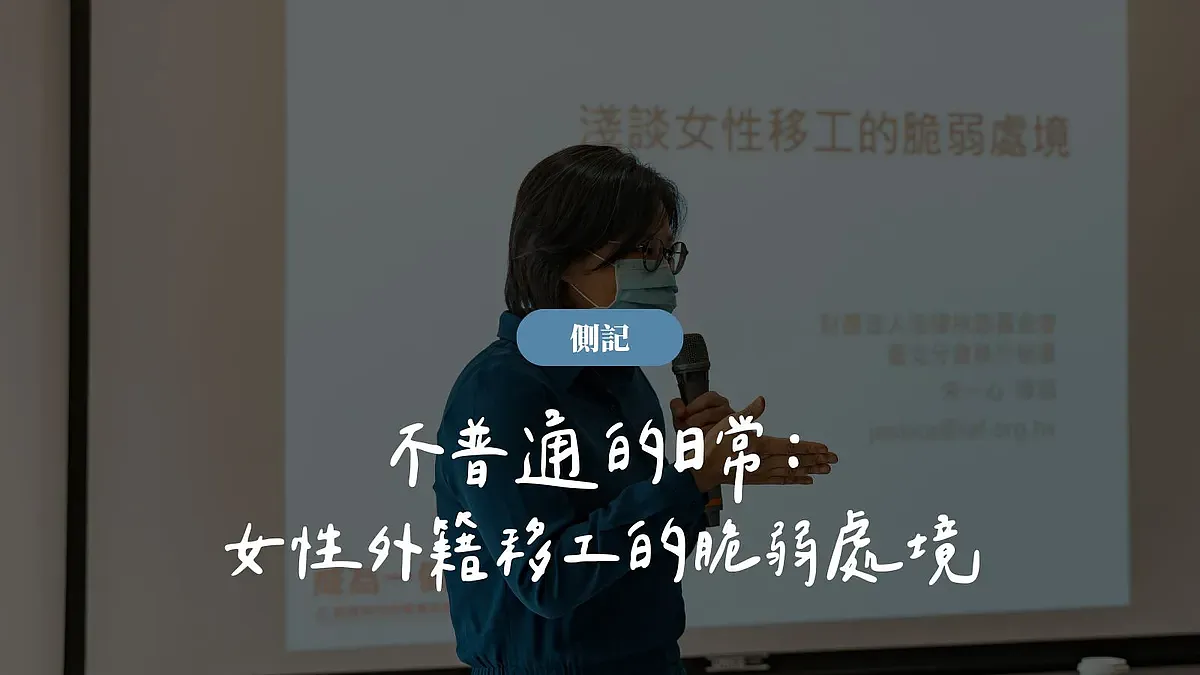
Sidelights | Part 1 | An Extraordinary Everyday: The Vulnerable Plight of Female Migrant Workers
Last edited: 2026-11-04
This lecture focused on the judicial plight of female migrant workers in Taiwan, featuring Attorney Sung I-hsin, convener of the JRF Gender Group, as the keynote speaker, with Attorney Liu Ching-yun presiding. Through case analysis and policy comparisons, the lecture guided the audience to reflect on the legal status of migrant workers in Taiwan and how judicial reform affects these workers who have long been marginalized in society.
Current Status of Migrant Workers in Taiwan and Institutional Comparison
At the opening, the speaker noted that 30 years ago there were approximately 200,000 migrant workers in Taiwan, a figure that has now exceeded 800,000, demonstrating Taiwan's high reliance on migrant labor. However, current regulations still impose harsh restrictions on migrant workers; for example, the maximum duration of employment is capped at 12 years without eligibility to apply for permanent residency, forming a sharp contrast with policies in countries like Japan that offer residency rights to migrant workers. In recent years, while the Ministry of Labor has actively reviewed migrant worker policies in hopes of increasing Taiwan's appeal as a work destination, problems persist. Furthermore, due to various reasons, some migrant workers choose to "lose contact," becoming undocumented workers (commonly known as "black market laborers") and exposing themselves to greater legal risks. Related documentaries, such as director Ts'ai Ch'ung-lung's Goodbye, Lovely Stranger and The Asian Angel (Note: referring to *The Lagoon* / *Lao Pao-sheng* / Nine銃), have also revealed the predicaments and dangers faced by missing migrant workers in Taiwanese society.
Judicial Predicaments: Broker Exploitation, Language Barriers, and Lack of Legal Protection
Attorney Sung I-hsin shared cases she has handled, pointing out that in addition to paying high broker fees, many migrant workers are additionally charged "commissions." With no caps or time limits on these fees, some migrant workers struggle to escape economic pressure even after working for many years. Although she once attempted to advocate for migrant workers' rights in court only to lose the case, it made her deeply aware of the law's limitations regarding disadvantaged populations.
Besides economic exploitation, language barriers are another judicial predicament faced by migrant workers in Taiwan. She mentioned an instance where a migrant worker, having been sent to the emergency room due to a work injury, was asked to sign documents entirely in Chinese. A colleague warned him not to sign because it was a settlement agreement, and filing a lawsuit afterwards would become very difficult. Such cases highlight the necessity of language interpretation in legal proceedings; without interpreters, migrant workers are very likely to forfeit their rights unknowingly.
Specific Predicaments of Domestic Caregivers
The situation of domestic caregivers in Taiwan is even more grueling because they are excluded from the Labor Standards Act, resulting in a lack of clear regulations on working hours and job duties. Aside from caring for the elderly or patients, many caregivers are required to perform extra housework or even face improper use by employers. For instance, some households lacking sufficient application qualifications apply for migrant workers under other people's names, or even privately "lend" them to other families, leaving families truly in need without appropriate care resources. Moreover, domestic labor mostly takes place in private spaces where government oversight is limited, making it difficult for migrant workers to file grievances.
Recently, although the government introduced short-term substitute care services allowing employers to temporarily hire short-term workers to replace caregivers, high reservation hurdles and numerous usage restrictions mean few actually benefit. This shows that Taiwan still has many institutional designs in migrant rights protection that need review and optimization.
Minimum Wage Hikes and Human Trafficking Issues
Attorney Sung I-hsin mentioned that Taiwan has raised the minimum wage for migrant workers in recent years, increasing it from NT$17,000 in 2021 to NT$20,000 (Note: figures reflect speaker's presentation context). While progress for migrant workers, this remains far below the basic salary of domestic workers and fails to truly achieve labor equality. Additionally, she shared a human trafficking case involving a Ugandan exchange student who came to Taiwan expecting education only to find herself forced into labor, with her employer withholding wages and even inflicting corporal punishment—acts constituting fraud and human trafficking under the Criminal Code. She emphasized that employer mistreatment of migrant workers sometimes carries humiliating elements, such as the employer in this case forcing the student to "experience" a patient's sensations by binding her with therapeutic straps as punishment. Such human rights violations demonstrate the current inadequacies in Taiwan's justice system regarding foreign migrant workers.
Audience Q&A and the Future of Judicial Reform
During the Q&A session, an attendee asked why migrant workers still need to find jobs through brokers after arriving in Taiwan. Attorney Sung explained that due to insufficient language proficiency, the difficulty of finding legal employers, and the complexity of transferring employers, migrant workers cannot freely seek jobs through legitimate channels, ultimately leaving them controlled by brokers. Some undocumented workers are thus forced into high-risk occupations, worsening their plight.
Finally, Attorney Sung emphasized that judicial reform should not be limited to domestic citizens but must encompass all laborers living and working in Taiwan. When the government discusses how to let domestic workers enjoy an "ordinary everyday life," can migrant workers also enjoy such rights? Can they receive legal protection, fair wages, labor conditions, and basic human rights just like Taiwanese people? These questions deserve profound reflection from everyone.
Conclusion: Enabling Migrant Workers to Become True "Ordinary People"
Through this lecture, we witnessed the judicial predicaments faced by foreign migrant workers in Taiwan. These are not merely issues of legal loopholes, but involve fundamental flaws in social structure, the labor market, and human rights protection. When the rights of migrant workers are exploited, can we afford to turn a blind eye? And how can judicial reform truly be implemented for these disadvantaged groups?
Looking ahead, we hope the law can genuinely protect all migrant workers laboring in Taiwan, ensuring they are no longer merely a "labor force when needed," but ordinary people possessing equal rights.
This article is an AI-generated translation of the original Chinese text. In the event of any discrepancy, the Chinese version shall prevail.