
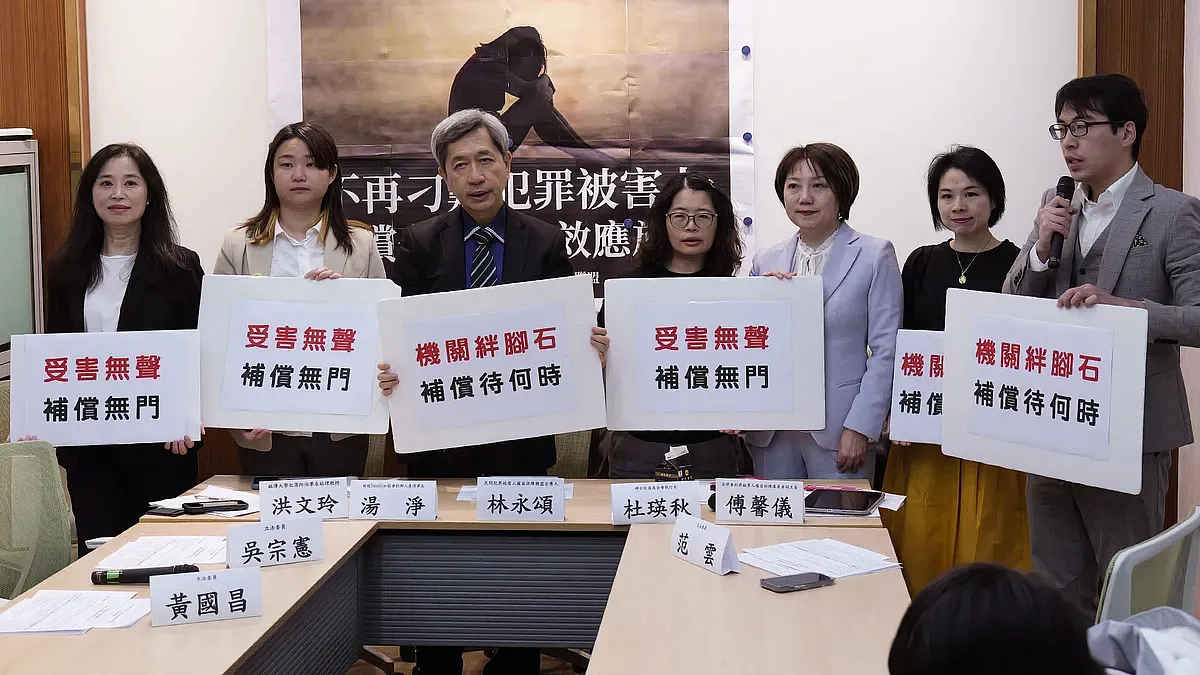
Press Conference | "Stop Making Things Difficult for Crime Victims, Compensation Claim Statute of Limitations Should Be Relaxed" Press Release
Last edited: 2026-07-27
Civil Version of the Draft Amendment to the Crime Victim Rights Protection Act
To protect crime victims, when individuals encounter criminal offenses resulting in death, severe injury, or sexual assault, they may claim compensation from the state in accordance with the Crime Victim Rights Protection Act. During the 2023 legislative amendments, to provide special protection for minor victims, the limitation period for claims was extended to "5 years after the victim reaches the age of majority."
However, under the current interpretation by the Ministry of Justice, this well-intentioned amendment has become completely illusory text that can be seen but not used. In recent years, there have been several cases of childhood sexual assault where, even after the victims mustered the courage to file a complaint and prosecutors indicted the perpetrators, the victims still could not receive any compensation due to "unreasonable methods for calculating the statute of limitations."
We believe that caring for and showing compassion to crime victims is not only a natural obligation of the state, but also a social consensus in Taiwan. In response to this, the "Taiwan Alliance for Crime Victim Rights Protection" has officially proposed a civil version of the draft amendment, and jointly held a press conference with the Crime Victim Rights Protection Committee of the Taiwan Bar Association, the Garden of Hope Foundation (Note: 婦女救援基金會 is Taiwan Association for Women's Rescues, but often translated contextually or kept accurate to NWAF), and the Warm Warm Sunshine Association, calling on the Legislative Yuan to swiftly amend the law and improve the protection of victims' rights.
1. Prosecutors Determine There is Crime Victimization and Indict, Yet Victims Fail to Receive Compensation
Before and after the amendments to the Crime Victim Rights Protection Act, victims or the families of deceased victims of crimes resulting in death, severe injury, or sexual assault could legally claim compensation from the state. However, the claim must be made within a certain period after learning of the incident; otherwise, no compensation will be granted. This "certain period" was 2 years under the old law, and is 5 years under the current law. Furthermore, regardless of the circumstances, once 5 years have passed (10 years under the new law), compensation is entirely barred.
In contrast, the "statute of limitations for criminal prosecution" for the aforementioned serious crimes is as long as 20 or 30 years or more; as long as this period has not expired, victims can file a complaint with prosecutors, who can then indict and convict the perpetrators.
Consequently, a rather contradictory scenario arises: a victim files a complaint with the prosecutors at the District Prosecutors Office, and the prosecutor determines that a crime has been committed and indicts the defendant; nevertheless, because the limitation period for compensation is much shorter, if the victim applies for compensation relatively late, the compensation review committee of the exact same District Prosecutors Office will deny compensation entirely.
Regarding such an outcome, some might say: "The victim let their rights sleep." However, for victims or surviving family members who have suddenly suffered major crimes, why cannot the government provide more responsible care? Why is it not the state, which "understands the law," that assists every victimized citizen who has experienced major trauma? Is it that the victims fell asleep, or that the government failed to fulfill its duty of care?
2. Victims of Childhood Abuse Still Unable to Claim Compensation After Law Amendment
Given that the limitation period under the old law was excessively short, the new law not only extended the limitation period from 2 years to 5 years, but also added a special provision for "minor victims." Considering that minors have limited self-protection capabilities and that the statutory representative of a child is sometimes the perpetrator, the new law extended the limitation period for claims by minor victims to "5 years from the age of majority."
However, under the interpretation of the "Ministry of Justice Letter Fa-Lu-Tzu No. 1020013425 dated August 2, 2013," the aforementioned well-intentioned new law can only apply to minor victims after the implementation of the new law (July 2023). Below, we use two recent cases to practically illustrate the plight of victims:
Case 1
Crime victim Woman A was subjected to sexual assault in 2017 at the age of only 8. Following investigation by the District Prosecutors Office, the defendant was indicted in December 2023. However, Woman A's mother applied for crime victim compensation on behalf of her daughter in November 2023, but was rejected by the District Prosecutors Office's Compensation Review Committee.
The reasoning for the rejection was roughly: Woman A's right to claim crime victim compensation had already expired in 2022 in accordance with the provisions of the old law (calculated as 5 years from the occurrence of the crime victimization), and no further claims may be made.
Case 2
Crime victim Woman B was subjected to sexual assault between 2018 and 2019 while attending elementary school. She subsequently mustered the courage to file a complaint and applied for compensation in March 2023. In March 2024, the District Prosecutors Office indicted the defendant, but rejected the application for compensation.
The reason for rejection was likewise: Woman B's right to claim crime victim compensation had already expired in 2021 in accordance with the provisions of the old law (calculated as 2 years from the knowledge of the crime victimization), and no further claims may be made.
The message conveyed by the above cases is that even for victims of childhood sexual assault, as long as "the limitation period has expired under the old law," regardless of the new law, they are completely barred from applying to the state for victim compensation! Not only that, we will continue to witness the recurrence of such cases. Because for all victims who are now adults and gradually emerging from trauma, when they finally muster the courage to file a complaint against their perpetrators, the vast majority have already exceeded the limitation period for applying for compensation under the old law (2 years). For the victims, on one hand they may fortunately see the defendant indicted and brought to justice; but on the other hand, the exact same state organ will tell you: because you did not claim compensation when you were victimized in childhood, even though the law has been amended, your application must still be rejected.
In the aforementioned cases, we clearly see how victims in extremely vulnerable situations are excluded from compensation by rigid legal interpretations, and how this situation has shockingly remained unimproved even after the legal amendments.
According to statistics from the Ministry of Health and Welfare, over 50% of sexual assault victims each year are minors. Furthermore, according to a survey released by the Garden of Hope Foundation in 2023, as many as 90% of sexual violence victims dared not report to the police, and 40% never sought help externally. Moreover, among adolescent victims, more than 10% of perpetrators belong to "family members." Regarding sexual crimes against minors, perpetrators exploit the victims' potential inability to comprehend sex, sexual acts, or sexual assault; furthermore, victims entirely rely on the family as their support and care system. If the perpetrator is a relative, victims are extremely prone to abandoning opportunities to seek help externally or prosecute the crime due to concerns over family honor or the feelings of other family members; out of economic dependency on the perpetrator; or under the pressure of the perpetrator's authority and power imbalances. It is entirely unrealistic to expect them to seek help or initiate lawsuits and prosecute crimes in a timely manner.
We believe that refusing to grant victim compensation to past minor victims not only seriously violates the state's purpose of protecting crime victims, but is also a rejection of restoring justice. Whether through altering legal interpretations or amending the law, the approach most favorable to the victims should be adopted.
3. Excluding Vulnerable Victims from Obtaining Victim Compensation Is Not a Reasonable Public Interest
Regarding the aforementioned issue, 11 organizations including the Taiwan Alliance for Crime Victim Rights Protection sent an official letter to the Ministry of Justice on June 14 of last year (2024), arguing that there is room for relaxation in the legal interpretation of the new law, which is also consistent with the state's policy objective of protecting victims. However, the Ministry of Justice insisted on its original view, refusing to relax the interpretation regarding the statute of limitations under the pretext of "legal stability."
We must ask: What kind of public interest consideration is the Ministry of Justice's insistence on "legal stability" based on? Is it the stability of "excluding vulnerable victims from the crime compensation system"? Is this kind of "legal stability" not precisely what we ought to break through when promoting judicial reform?
4. Victims Failing to Apply Reflects Insufficient Support and Administrative Inertia
To thoroughly resolve the aforementioned issues, we believe that the relevant provisions of the Crime Victim Rights Protection Act should be directly amended to exceptionally postpone the starting point of the limitation period for claims until the prosecutor's indictment, thereby avoiding the absurd situation of "prosecuting on one side while denying compensation on the other."
We also believe that support for victims has long been in a state of insufficient resources, the visibility of the crime victim protection system is low, and many citizens still do not know that they can apply for victim compensation to this day. Meanwhile, the short limitation periods of the past were extremely unfavorable to victims. Victims failing to claim compensation within the limitation period does not reflect the victims' self-waiver of compensation, but rather reflects the lack of support systems for victims and the administrative inertia of state support.
| Civil Version of Amended Articles of the Crime Victim Rights Protection Act |
|
Article 63 I The right to claim crime victim compensation shall be extinguished if not exercised within five years from the time the claimant knows of the crime victimization; the same shall apply if ten years have elapsed from the occurrence of the crime victimization. However, this shall not apply under any of the following circumstances: 1. The victim was a minor at the time of the crime victimization, and the claim is made within five years after reaching the age of majority. 2. Where the crime victimization case has been investigated by judicial authorities, where investigation has been concluded, or where related investigative actions have been concluded, the claim is made within two years. II In the circumstances of the preceding paragraph, where severe injury is caused by criminal conduct, the right to claim shall be extinguished if not exercised within five years from the time of knowing that a severe injury has occurred. |
|
Article 100 I Applicants for crime victim compensation pursuant to this Act shall be limited to those whose criminal conduct or criminal result occurred after the implementation of this Act on October 1, 1998 of the Republic of China. II Where the criminal conduct or criminal result occurred prior to the implementation of the provisions of Chapter 5 amended on January 7, 2023 of the Republic of China, and no review decision has yet been rendered, matters shall be handled in accordance with the provisions after the amended implementation. However, if the provisions prior to the amended implementation are more favorable to the applicant, handling shall be in accordance with the provisions prior to the amended implementation. III Prior to the implementation of the provisions amended on [Month] [Day], [Year] of the Republic of China of this Act, where the statute of limitations for the compensation payment claim has already been completed, the proviso of Paragraph 1 of Article 63 shall still apply. However, if more than two years have elapsed since the investigation by judicial authorities, the conclusion of investigation, or the completion of related investigative actions regarding the crime victimization case, the right to claim may be exercised within two years from the date of implementation of this Act's amendments. |
In response to this, the Taiwan Alliance for Crime Victim Rights Protection has officially proposed the civil version of the draft amendment. While rationalizing the crime victim compensation system, it also hopes that victims who were previously denied compensation will have the opportunity to regain compensation after the passage of the new law.
We urge the Ministry of Justice to cease acting as a stumbling block for victims to obtain compensation, and instead jointly promote the legal amendments; and after the amendments are passed, to proactively notify past victims and victim support groups who were denied compensation on these grounds, giving them the opportunity to obtain reasonable compensation. Meanwhile, we also hope that all political parties can perceive the plight of victims and support the promotion of legal amendments!
Post-Meeting Press Release
Regarding Legislator Fan Yun:
Legislative Yuan member Fan Yun stated that during the previous legislative term, she received multiple petitions regarding predatory teachers sexually assaulting students, all of which encountered issues with the statute of limitations for prosecution. Consequently, she has proposed a draft amendment to Article 80 of the Criminal Code, stipulating that the limitation period for prosecution of those abused during childhood should start from the age of majority, yet this has still not been passed into law. Furthermore, under the current Crime Victim Rights Protection Act, although victims of childhood sexual assault can claim compensation from the state, the deadline only extends to 5 years after reaching the age of majority, making it practically difficult for victims to apply and rendering the provision practically dead letter.
Fan Yun pointed out that according to a survey in Australia, after a sexual assault occurs for the first time, it takes an average of 23.6 years for victims to speak out about their victimization experience. School children who suffer sexual assault during childhood may not know they are being victimized, or may find it difficult to seek help due to pressure from authority and a massive power imbalance with the perpetrator.
Fan Yun cited examples: during the #MeToo movement in 2023, she received a report from someone who suffered childhood sexual molestation and only dared to speak out about their experience for the first time 40 years later after retiring; the goddaughter of Hsieh Chun-te (Hsieh Chun-te's goddaughter) also stepped forward to voice that she was continuously sexually assaulted by Hsieh Chun-te from age 13 until high school, and only finally had the courage to speak out at age 36.
Finally, Fan Yun demanded the Ministry of Justice to evaluate the rights of minor sexual assault victims and study legal amendments, including amending Article 80 of the Criminal Code to add provisions that the prosecution limitation period for minor sexual assault cases starts from the age of majority, and amending the Crime Victim Rights Protection Act regarding minor sexual assault cases to strengthen the protection of victims' rights, comprehensively enabling minor sexual assault victims to obtain state compensation in accordance with the law.
Regarding Legislator Huang Kuo-chang:
The office of Legislative Yuan member Huang Kuo-chang responded that the Taiwan People's Party caucus's proposal for the "Crime Victim Rights Protection Act" will be formally given its first reading today, and they will subsequently support scheduling it for deliberation.
Time
Friday, March 21, 2025, at 10:00 AM
Venue
Room 102, Legislative Yuan Research Building (Chung-Hsing Building), No. 3-1, Sec. 1, Jinan Rd., Zhongzheng Dist., Taipei City
Attendees
Lin Yung-sung / Convener, Taiwan Alliance for Crime Victim Rights Protection; Standing Board Director, Judicial Reform Foundation
Tu Ying-chiu / Chief Executive Officer, Taiwan Association for Women's Rescues
Tang Ching / Founder and Chairperson, Warm Warm Sunshine Association
Fu Hsin-yi / Deputy Convener, Crime Victim Rights Protection Committee, Taiwan Bar Association
Hung Wen-ling / Assistant Professor, Department of Crime Prevention and Corrections, Ming Chuan University
Huang Kuo-chang / Member of the Legislative Yuan
Wu Tsung-宪 (Wu Tsung-hsin) / Member of the Legislative Yuan
Fan Yun / Member of the Legislative Yuan
Press Contacts
Lu Cheng-yen, Attorney-at-Law, Director of the Legal Policy Department, Judicial Reform Foundation
Phone: 02-2523-1178#37
Email: elvin@jrf.org.tw
Attachments
This article is an AI-generated translation of the original Chinese text. In the event of any discrepancy, the Chinese version shall prevail.