
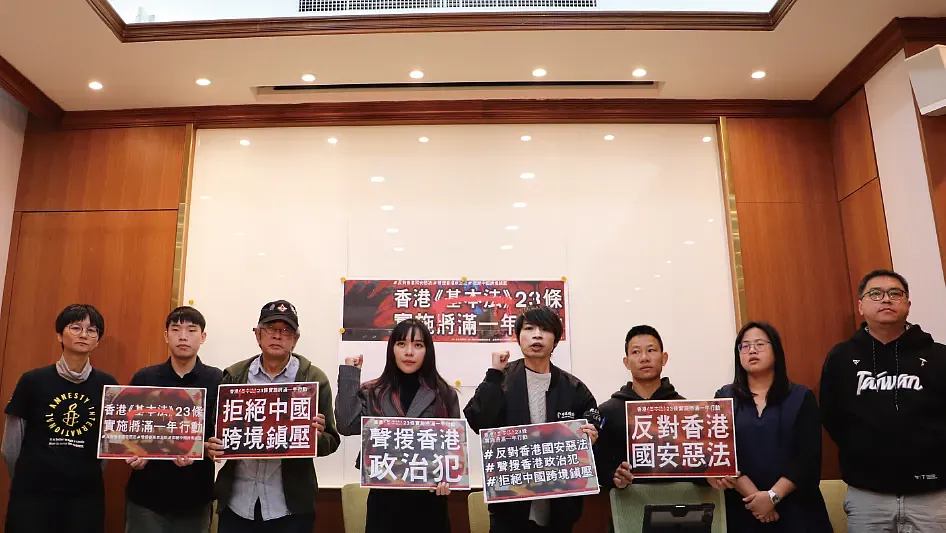
Press Conference | Press Conference on the Upcoming One-Year Anniversary of the Implementation of Hong Kong's Article 23
Last edited: 2026-07-27
On March 19, 2025, Hongkongers in Taiwan, together with several Taiwanese civil society organizations and the Legislative Yuan's Taiwan Parliamentary Hong Kong Friendly Caucus, held a press conference at the Legislative Yuan to examine the impact of the implementation of Hong Kong's Article 23 over the past year. The conference exposed how Hongkongers are subjected to China's transnational repression, how the Hong Kong government has expanded its suppression overseas, and called on Taiwan and the international community to take action to jointly safeguard freedom and human rights.
Serving as the moderator, Feng Chao-t'ien (Sky), Secretary-General of Hongkongers in Taiwan, mentioned in his opening remarks that although resistance still persists locally, it remains difficult to stop the various oppressive measures applied by the Chinese and Hong Kong governments. Furthermore, this pressure is no longer confined to Hong Kong; it has even extended overseas in a multitude of ways. Everyone present here consists of courageous protesters who have stood up to China for various reasons, including human rights, democracy, and freedom.
The first speaker, Huang Chieh, Chairperson of the Taiwan Parliamentary Hong Kong Friendly Caucus, reiterated that over the past few years, China has successively tightened its control over human rights in Hong Kong, with many cases involving the erosion of freedom of speech. For example, the "Sheep Village" picture books published by the Speech Therapists Union were accused of conspiracy to publish seditious publications; individuals who wrote phrases like "Liberate Hong Kong, revolution of our times" on the backs of chairs were also arrested. This demonstrates that as long as texts or drawings are suspected of endangering national security, their creators can be imprisoned, and mere possession can also lead to imprisonment. At the same time, seeking international solidarity is accused of "colluding with external forces," adding a crime to the charge. Facing China's authoritarian expansion, Kuomintang legislators last week downplayed the 77 cases of Taiwanese people going missing in China over the past two years, dismissively asking, "Is such a proportion really high?" Moreover, after a resolution to support Hong Kong was proposed last year, the opposition Kuomintang and Taiwan People's Party alternative proposal completely refrained from criticizing China, instead condemning the DPP government. We will continue to support Hong Kong, condemn evil laws, and stand with democracy and freedom.
Lin Jung-chi, manager of Causeway Bay Books, pointed out that the enactment of Hong Kong's Article 23 last year follows the Chinese government's 2002 attempt to pass the Basic Law and strengthen its rule over Hong Kong through annexes. Due to rule by man, the Chinese government's system suffers from severe deficiencies. In recent years, nearly all legislative measures have been invoked under harsh repression. In addition to those in Hong Kong who are punished for allegedly committing political crimes, even individuals abroad are hunted down by the Hong Kong government through long-arm jurisdiction. Finally, he offered parting advice to Hongkongers to protect themselves first, as the liberation of Hong Kong still has a long way to go.
Fu T'ang, a Hongkonger in Taiwan, pointed out that the number of people convicted in Hong Kong for "subversion" or "conspiracy to subvert state power" has already surpassed the figures within mainland China for the same period. Furthermore, the scope of the "sedition offense" has been expanded, legal tools have been abused, and freedom of speech has been severely restricted. Not only that, the Hong Kong government has also suppressed dissidents through personal data leaks, employer intimidation, and post-release supervision, and even subjected overseas Hongkongers to transnational surveillance, threatening their family members in Hong Kong. He called on the government to provide more asylum and residency options, and expressed hope that the international community will continue to pay attention to the human rights situation in Hong Kong, joining democratic nations in exerting pressure to safeguard the basic freedoms and rights of Hongkongers.
Chiu I-ling, Secretary-General of Amnesty International Taiwan, stated that the Hong Kong government repeatedly uses "national security" as a pretext to rationalize censorship, harassment, arrests, and prosecutions. According to cases collected by the organization, alongside Chinese and Hongkongers, Taiwanese individuals have also been affected by transnational repression measures, severely threatening the rights and civic space enjoyed by individuals and civil society groups in Taiwan. Finally, she reiterated her call for the Hong Kong and Chinese governments to immediately abolish Article 23 of the Basic Law, the National Security Law, and other legislation violating international human rights; governments that value human rights, including Taiwan, should actively protect the freedoms of Hongkongers within their borders.
Li Ming-ju, Deputy Executive Director of the Judicial Reform Foundation, noted that the Hong Kong Legislative Council further read and passed the Article 23 legislation in three readings, further suppressing democracy and freedom of speech in the name of "eliminating external forces." Only two months after its implementation, the police arrested eight people on charges of "inciting hatred" simply for posting information related to the June 4th Incident on Facebook, facing a maximum penalty of 10 years in imprisonment. At the same time, she called on the international and Taiwanese communities to continue paying attention to the current situation in Hong Kong, emphasizing that Barrister Chow Hang-tung chose to plead not guilty in her trial, defending herself in person and insisting on making her voice heard.
Shih I-hsiang, Senior Researcher at the Taiwan Association for Human Rights, called on the Taiwanese government to promptly establish a comprehensive refugee asylum system, rather than excluding the international human rights obligations that Taiwan should strive to fulfill in its bid to become a member of the international community simply due to hollow and abstract national security concerns—especially at a moment when China is continuously persecuting Chinese, Tibetan, and Hong Kong dissidents around the world through transnational repression. Shih I-hsiang stated, "Taiwan's democracy is also suffering massive attacks from internal conservative forces combined with external hostile forces. Therefore, by continuously building systems sufficient to consolidate democratic human rights—such as amending the Assembly and Parade Act to protect the people's right to peaceful assembly, reforming the police system to prevent police abuse of power, strengthening an independent judicial system, and safeguarding the constitutional democratic system—we can resist this."
Lin Szu-kai, Deputy Chairperson of the Taiwan Youth Generation Co-Prosperity Association, emphasized that Hong Kong and Taiwan are the frontline of the global fight against China's authoritarian expansion. The example of Hong Kong is bloody proof that once "One Country, Two Systems" is adopted and democracy and the rule of law are lost, no matter how unpopular or devoid of public support a government's policies may be, they can still be continuously pushed forward; even if one-third of the total population takes to the streets to protest, it remains impossible to turn around a regime that stubbornly goes its own way. Lin Szu-kai stated, "The Chinese government's continuously expanding transnational repression has not only dealt a heavy blow to Hong Kong, but has also sent a clear threat to the world—anyone, anywhere, as long as they are regarded as a 'dissident,' may become a target of China's suppression."
Finally, the press conference also previewed subsequent actions. On Sunday, March 23, a street action will be held at Taipei Fashion Square. Through interactive art creation and soapbox short speeches, the covered-up stories of Hong Kong will be presented, allowing the voice of freedom to continue to be heard. This is not only a witness to Hong Kong's past, but also an action of co-creation and dialogue. All friends who care about democracy and human rights are invited to participate together, fearlessly facing powerful authorities and joining hands to safeguard the value of freedom.
List of Speakers
Huang Chieh, Chairperson of the Taiwan Parliamentary Hong Kong Friendly Caucus and Legislator
Lin Jung-chi, Manager of Causeway Bay Books
Fu T'ang, Hongkonger in Taiwan
Chiu I-ling, Secretary-General of Amnesty International Taiwan
Li Ming-ju, Deputy Executive Director of the Judicial Reform Foundation
Shih I-hsiang, Senior Researcher at the Taiwan Association for Human Rights
Lin Szu-kai, Deputy Chairperson of the Taiwan Youth Generation Co-Prosperity Association
Participating Organizations
Hongkongers in Taiwan, Amnesty International Taiwan, Taiwan Youth Generation Co-Prosperity Association, Covenant Watch, Judicial Reform Foundation, Taiwan Association for Human Rights
This article is an AI-generated translation of the original Chinese text. In the event of any discrepancy, the Chinese version shall prevail.