
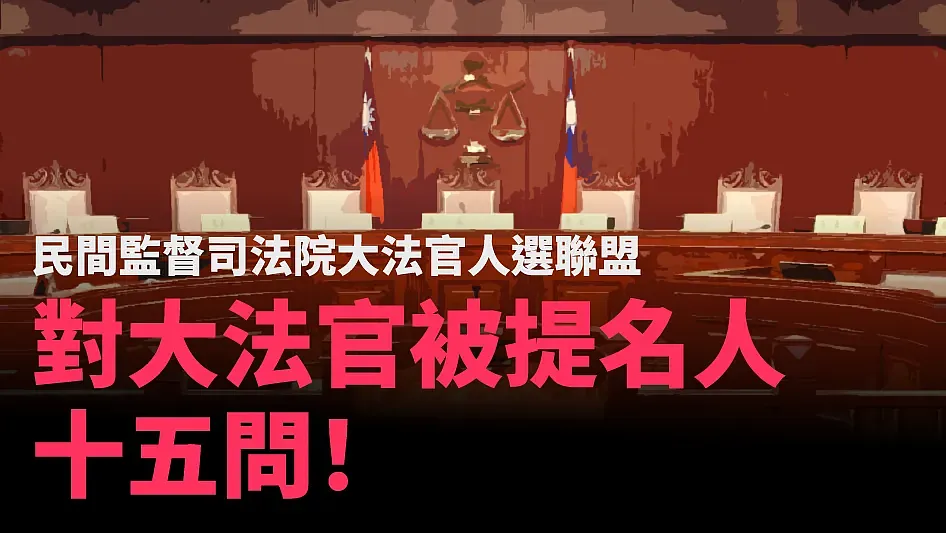
Statement | 15 Questions to Grand Justice Nominees by the Civil Alliance for Monitoring Judicial Yuan Grand Justice Nominees
Last edited: 2026-07-27
On March 21, the Office of the President announced the following seven Grand Justice nominees: Ch'en Ch'iu-ming, Su Su-o, Chan Chen-jung, Lin Li-ying, Hsiao Wen-sheng, Ch'en Tze-yang, and Cheng Ch'un-hui.
To review the suitability of the nominees and the exercise of the Legislative Yuan's consent power, 13 civil society organizations jointly formed the "Civil Alliance for Monitoring Judicial Yuan Grand Justice Nominees," calling on the Legislative Yuan to conduct a rigorous review and raising the following questions directed at the nominees for the President and Vice President of the Judicial Yuan, as well as the Grand Justice nominees:
I. The Legislative Yuan Should Rigorously Review Nominees' "Moral Integrity," "Constitutional and Human Rights Philosophy," and "Academic and Professional Competence"
This Alliance emphasizes that in determining whether nominees are fit to serve as Grand Justices, the Legislative Yuan should return to a rigorous review of their "moral integrity," "constitutional and human rights philosophy," and "academic and professional competence." Regarding the exercise of the personnel consent power for Grand Justices, this Alliance puts forward the following specific recommendations:
- Upon receiving the nominees' materials, each caucus in the Legislative Yuan should form a committee to gather opinions and first submit written questions or requests for supplementary materials to the nominees in writing. At the same time, each caucus's written questions should be made public upon submission so as to be subject to public scrutiny.
- Each caucus should promptly and appropriately arrange the schedule for review and the exercise of the consent power to avoid undue delays.
- Before convening the review meeting, the "Committee of the Whole House" should first hold a "public hearing" to broadly solicit opinions from all sectors of society; furthermore, the committee members and legislators wishing to question the nominees should participate throughout the entire process.
- The "Committee of the Whole House" should hold at least two review meetings. If a nominee's responses at the first review meeting are insufficient, they should supplement them at the second review meeting. Meanwhile, committee review is not a "recitation test"; this Alliance calls on legislators, when questioning on constitutional issues, not to meaninglessly quiz nominees on specific legal provisions or the content of Interpretation numbers, but rather to focus on clarifying the nominees' philosophies and perspectives.
- The spirit of exercising the consent power is that individual legislators can independently judge the suitability of the nominees to achieve the goal of recruiting talent for the country. Therefore, this Alliance calls upon various political parties to allow legislators to freely exercise their voting rights during the vote in the plenary session, rather than binding legislators through party discipline or other means.
It is particularly noteworthy that during the previous exercise of the Grand Justice consent power, although all three major parties submitted written questions to the nominees, only the Taiwan People's Party promptly facilitated public discussion; the written questions from the Democratic Progressive Party and the Kuomintang were only published after the fact in the Legislative Yuan Gazette and were not widely publicized, showing almost no discernible meaningful impact on the review process. In this regard, we call on all parties to ask questions in a public manner to foster scrutiny and discussion from all sectors regarding the Grand Justice nominees.
In summary, this Alliance calls on the Legislative Yuan to reference the above recommendations to prudently exercise its consent power—neither acting hastily nor maliciously boycotting. Through the personnel review procedure, public awareness of the functions of Grand Justices can be enhanced, and the suitability of each candidate can be subjected to broad public evaluation, which is the proper way to fulfill its constitutional responsibilities.
This Alliance also solemnly condemns acts of conducting reviews in a biased and arbitrary manner driven by intentional political confrontation, as such measures may not only lead to the constitutional crisis of substantially hollowing out the judicial power, but will also consequently damage public trust in the Grand Justices and the judiciary.
II. Nominees Are Cordially Requested to Reply to Public Questions and Foster Social Dialogue on Constitutional Issues
Grand Justices, hailed as the "guardians of the Constitution," must engage in continuous communication with society to avoid the perils of legislating in an ivory tower and to lead judicial progress.
To examine the nominees' constitutional and human rights philosophies, academic knowledge, and professionalism, and to prompt their dialogue with the general public, this Alliance will use a public questioning approach to ask the nominees about key constitutional issues concerning the exercise of Grand Justice powers, serving as a reference for the review.
Joint Questions to Grand Justice Nominees (15 Questions):
-
Focus on Human Rights and Constitutional Issues
- During your upcoming eight-year term, what do you consider to be the most emblematic (or your most-concerned) constitutional issue or basic human rights protection issue?
- What constitutional or human rights issues are there on which you hold a firm conviction in your mind regarding their constitutional stance, yet they diverge to a certain extent from the current stable mainstream views or legal order, or belong to issues where diverse and divergent opinions still exist in society? How do you view the relationship between the judgments and adjudication activities of the Constitutional Court and social values? To you, what is the impact on legal interpretations of engaging in current legal work (including as a scholar, judge, prosecutor, etc.) versus serving as a Grand Justice, and what additional contexts and factors need to be considered (or is there no impact)?
-
International Human Rights Covenants and Constitutional Review
- Paragraph 16 of the Concluding Observations of the 2022 international review committee for international human rights covenants states: "... In cases of conflict between existing or subsequently enacted regulations and the two Covenants, the status of the two Covenants must be further clarified. The review committee emphasizes that the two Covenants, as the two most important human rights covenants of the United Nations, should be given priority consideration." In your view, what is the hierarchy of domesticated international human rights covenants within our legal system? If domestic law conflicts with international human rights covenants, what is its impact when reflected in the constitutional review of that law? What is the relationship between the list of rights under international human rights covenants and the types and contents of basic rights in our country?
- Paragraph 3 of General Comment No. 6 on the Convention on the Rights of Persons with Disabilities, which has been domesticated in our country, further points out: "... denial of reasonable accommodation constitutes discrimination." In your view, does the content of this General Comment possess legal binding force? In constitutional review, what basic rights violations do you consider to be involved in laws or judgments that violate the "principle of reasonable accommodation"? What standard of review should be adopted?
-
Referendums and Constitutional Review
- Article 12 of the Additional Articles of the Constitution stipulates that amendments to our Constitution shall be subject to a procedure of proposal by the Legislative Yuan and ratification by citizens. The constitutional amendment ratification bill for the "18-Year-Old Citizen Rights" held in 2022 failed to pass because it did not reach the passage threshold. In your view, judging from the current constitutional amendment procedure and the practice of the aforementioned constitutional amendment ratification bill, are the current constitutional amendment procedure and threshold appropriate? How do you evaluate their impact on the operation of Taiwan's democracy? Does Article 12 of the Additional Articles of the Constitution raise any unconstitutionality concerns?
- Following the promulgation of Judicial Yuan Interpretation No. 748, certain groups opposing same-sex marriage submitted a referendum proposal to the Central Election Commission (CEC) in January 2018 (questioning whether same-sex marriage should be defined and protected under the Civil Code), and a referendum was held on November 24 of the same year. Regarding the administrative disposition by the CEC announcing the establishment of the referendum proposal, certain gay individuals, as interested parties and plaintiffs, filed an action for annulment with the Taipei High Administrative Court prior to the voting and applied for a suspension of the execution of the referendum procedure. The entire case was finalized on May 29, 2020, after the Supreme Administrative Court dismissed the plaintiffs' appeal in its 2020 Pan-Tzu Judgment No. 300, which held that the plaintiffs were not interested parties, possessed no subjective public rights, lacked standing to sue, and that the protection-norm theory did not apply, while incidentally noting that even if a referendum proposal violates the Indigenous Peoples Panchayet Act, it merely means the CEC has the power to refuse its proposal establishment, and under the law, prosecutors have standing to sue, whereas indigenous peoples themselves do not. What is your view on the aforementioned perspective that even if interested parties' rights are directly infringed, they still lack standing to sue? Regarding a referendum proposal with a high probability of unconstitutionality, do you believe the provisional injunction system stipulated in Article 43 of the Constitutional Court Procedure Act can be applied, and if so, how?
-
State Duty of Protection and Constitutional Review
- Currently, de facto spousal relationships of heterosexual or homosexual cohabiting partners still lack clear legal protection. In your view, what basic rights are involved in the current status of our legal system failing to explicitly protect them? Is this unconstitutional?
- Social assistance-related laws prioritize the prevention of abuses and incorporate virtual income and total household income calculation provisions that do not match the economic reality of impoverished people's lives, resulting in a severe underestimation of our country's impoverished population. Although there are exception conditions (Article 539 Clause), many citizens are still unable to apply for social assistance when facing difficulties in life. In your view, do the aforementioned issues concerning the social assistance system infringe upon people's right to subsistence and other basic rights? How should constitutional review be conducted?
- In legal issues involving climate and environmental changes, infringements upon people's rights and interests often stem not from the active deeds of public authority, but from the state's omissions or insufficient actions (such as carbon emission policies). In your view, does the state bear a duty of protection toward vulnerable groups whose rights are about to be infringed or are suffering infringement under extreme climate scenarios? Do you believe such groups or interested parties possess standing to sue, enabling them to demand that the state fulfill its duty of protection? If the system fails to provide appropriate remedial avenues, does this infringe upon people's right of access to court?
-
Gender Identity and Protection of Basic Rights
- Judicial Yuan Interpretation No. 748 points out that differential treatment based on "sexual orientation" as a classification standard falls within the scope of the right to equality regulated by Article 7 of the Constitution, and a stricter standard of review should apply. In your view, does our Constitution protect people's "gender identity"? What is the basis and extent of such protection? Regarding differential treatment based on "gender identity" as a classification standard, what standard of review do you think should be adopted? Do you believe that the people's "right to sexual autonomy" protected by the Constitution includes the "right to self-determination of gender"? What are your opinions on "gender-affirming recognition without surgery" (that completing gender reassignment surgery is not a necessary condition for applying to change gender registration)? If you favor gender-affirming recognition without surgery, do you believe that changing gender registration still requires other conditions (such as a psychiatric diagnosis certificate)? Or do you support "free change of gender registration"?
-
Land Expropriation and Protection of Basic Rights
- In recent years, land development for major national infrastructure projects has extensively adopted zone expropriation (such as the Taoyuan Aerotropolis, Taipei Shezidao development project, MRT development projects, and railways), causing infringements upon people's right to housing and property rights. In your view, is relying solely on grounds of "national economic development" sufficient to constitute the public interest purpose for the state to initiate expropriation? Is the "zone expropriation" adopted in our legal system unconstitutional? When disputes involve evicting residents living on state-owned land, do you think the state may purely stand in the position of a private party to assert its ownership without needing to consider the infringement of public authority upon residents' basic rights such as the right to housing?
- How do you think the scope of land that requires consultation and consent from indigenous peoples or tribes as stipulated in Paragraph 1, Article 21 of the Indigenous Peoples Panchayet Act should be interpreted, in accordance with Paragraph 11 and the first half of Paragraph 12 of Article 10 of the Additional Articles of the Constitution, as well as our country's historical interpretations and judgment intents concerning the rights of indigenous peoples and indigenous individuals? Is it unconstitutional to use public versus private land ownership as a distinguishing standard to exclude indigenous peoples or tribes from exercising the right to consultation and consent regarding the latter?
-
Protection of Penological Human Rights
- What are your opinions regarding the current status in our country where inmates are unable to vote due to the factual constraint of being incarcerated?
-
Judicial Review of National Security Issues and Construction of the Trial System
- Amid international warfare and volatile geopolitical situations, our country has recently seen many discussions regarding how the judicial system should respond and prepare during quasi-war/war situations. In your view, under the current political and social context, how would you define "(risk of) endangering national security"? How should judicial review be conducted on various regulatory measures implemented on the grounds of "endangering national security"?
- The government recently announced that it will propose reform bills regarding the military trial system. Past precedents, including Interpretation No. 436, have all served as important catalysts for changing the military trial system. What are your opinions on the reform of the military trial system?
[Civil Alliance for Monitoring Judicial Yuan Grand Justice Nominees]
Covenant Watch
Taiwan Alliance of Persons with Disabilities
Citizen's Congress Watch
Alliance for Constitutional Reform
Taiwan Association for Human Rights
Taiwan Criminal Defense Lawyers Association
Taiwan Alliance for Promotion of Civil Partnership Rights
Taiwan Association for Innocence
Taiwan Labor Front
Taiwan Alliance to End the Death Penalty
Judicial Reform Foundation
Awakening Foundation
Environmental Jurists Association
This article is an AI-generated translation of the original Chinese text. In the event of any discrepancy, the Chinese version shall prevail.