
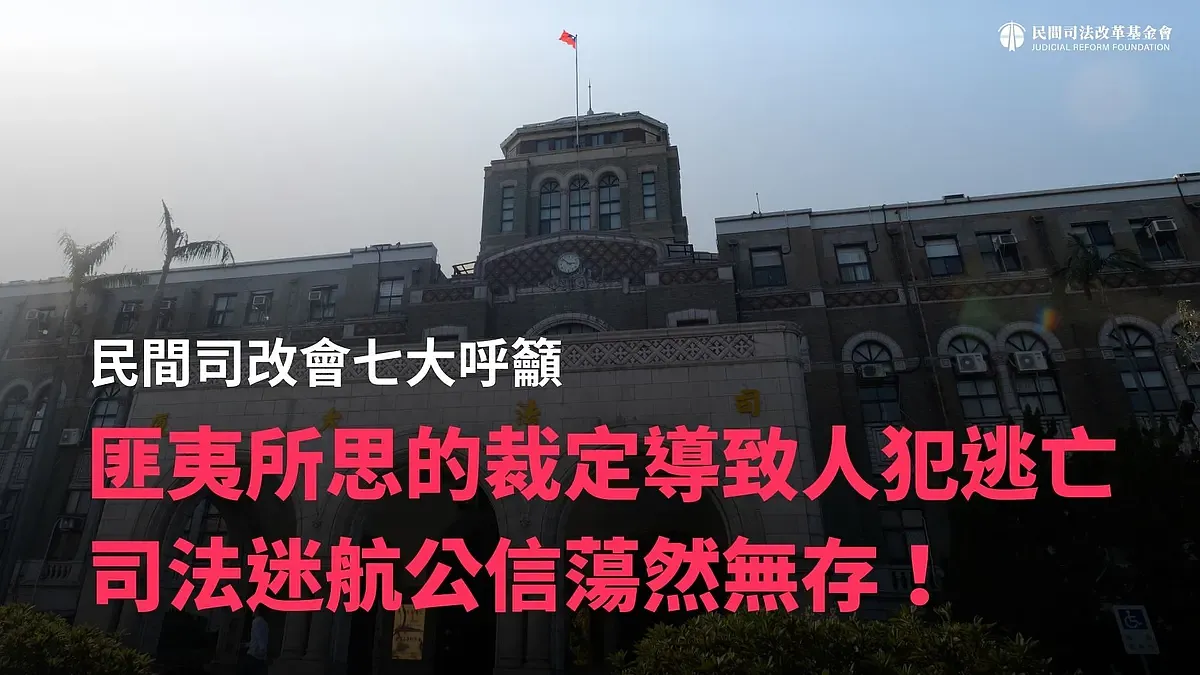
Statement | Inconceivable Ruling Leads to Defendant's Flight, Judicial Navigation Lost and Public Trust Bankrupt: Seven Calls from the JRF
Last edited: 2026-11-03
Recently, Taiwan High Court 110-Year-Su-Chung-Tzu No. 23 criminal case (the case of Chung Wen-chih violating the Securities and Exchange Act, etc.) has triggered high public concern due to the whereabouts of the bailed defendant being unknown and the controversy surrounding the bail ruling. The Judicial Yuan issued a statement on March 29, 2025 (hereinafter the same), admitting that the collegiate panel of the court did not pronounce in court to the parties concerned regarding whether to extend the technological monitoring applied to the defendant Chung Wen-chih, nor did it produce and announce a formal ruling to be served on the prosecutor. Instead, on October 14, 2024, it used a trial sheet in lieu of a ruling, unilaterally notified the defense counsel to handle the bail procedure, and delayed the retroactive production of the ruling until March 28 of this year, which clearly violates the provisions of the Code of Criminal Procedure concerning the pronouncement of judicial decisions and the production of written decisions.
In response to this major judicial error, this Foundation hereby states as follows:
I. Due Process is the Cornerstone of Impartial Justice; the Illegal Actions of the Collegiate Panel Severely Damage Public Trust in the Judiciary
Paragraph 3, Article 225 of the Code of Criminal Procedure explicitly stipulates that a ruling shall be announced on the day following its pronouncement, publicly posted, and notified to the parties concerned, enabling the parties to express their opinions through interlocutory appeal proceedings. According to media reports, the collegiate panel in this case only stated in court that it would notify the results by a written ruling, but subsequently only notified Chung Wen-chih's defense counsel by telephone without simultaneously notifying the prosecutor. Such actions violate the aforementioned provisions and give rise to the suspicion of favoring the defendant.
Even more regrettably, Ch'iu Chung-yi, the presiding judge of the collegiate panel, stated in another media interview on the 29th: "The Code of Criminal Procedure has no explicit provisions regarding the format of a 'ruling'. After the summary ruling by the collegiate panel, how the clerk of the presiding judge notifies or serves it is a matter of execution at the clerk's level." This shifted the responsibility onto the clerk, ignoring the provisions of Articles 50 and 51 of the Code of Criminal Procedure which require judges to produce the original text of a judicial decision before having the clerk produce the authenticated copy.
II. We Urge Relevant Authorities to Actively Hold Parties Accountable and Improve Systems to Rescue Public Confidence in the Judiciary
This case involves whether to extend technological monitoring applied to the defendant, which is critical to preventing the defendant from fleeing, profoundly affects judicial impartiality, and even more strictly requires adherence to legal procedures. The collegiate panel failed to publicly pronounce according to law, failed to notify the prosecutor, and failed to produce a formal ruling, severely violating procedural justice and causing the function of fair judicial trial to fail completely. Following the Shih Mu-ch'in case, this has once again heavily damaged public trust in the judiciary.
This Foundation hereby calls upon the relevant authorities to actively hold parties accountable in individual cases and swiftly initiate institutional reforms so that the people can regain confidence in the judiciary:
- The Taiwan High Court, as the authority to which the collegiate panel of this case belongs, should prudently investigate whether the collegiate panel falls under the circumstances of "violating obligations in office, omitting to execute official duties, or improper conduct in speech and behavior" pursuant to Subparagraph 2, Paragraph 2, Article 21 of the Judges Act, and request a judicial evaluation pursuant to Paragraph 1, Article 35 of the Judges Act.
- Pursuant to Paragraph 1, Article 35 of the Judges Act, subjects eligible to request an evaluation include three or more judges belonging to the same authority as the evaluated judge, the authority to which the evaluated judge belongs, the corresponding prosecutors office of the affiliated or higher-level court, or bar associations, etc. Furthermore, because the defendant's defense counsel in this case was formerly the presiding judge of Judge Ch'iu Chung-yi, it has also sparked speculations regarding improper interference or influence between the bench and the bar. The bench, the prosecution, and the bar should all attach importance to this major judicial disciplinary incident. Therefore, those with the power to request an evaluation in this case should face squarely the major damage caused by this case to judicial credibility and deliberate whether to initiate evaluation proceedings to respond to public expectations for judicial impartiality.
- Upon accepting the request for evaluation in this case, the Judges Evaluation Commission should as soon as possible make a resolution on whether disciplinary action is necessary, and report it to the Judicial Yuan for subsequent disposition pursuant to the provisions of Article 39 of the Judges Act.
- The Judicial Yuan, as the principal body of judicial administration, should proactively investigate whether the collegiate panel in this case has circumstances subject to disciplinary action, and transfer the case to the Control Yuan for investigation pursuant to Paragraph 2, Article 51 of the Judges Act.
- The Control Yuan, as an external supervisory body outside the judicial system, should proactively investigate whether it is necessary to impeach the collegiate panel in this case, and transfer it to the Disciplinary Court for trial pursuant to Paragraph 1, Article 51 of the Judges Act.
- Regarding the "summary ruling" which the collegiate panel claimed externally has been "practiced for many years," it has already caused confusion and questioning among the public regarding the practical operation of the judiciary. The Judicial Yuan should thoroughly investigate the application and impact of this "custom" and publicly explain it to the outside world to ensure that procedures are lawful and appropriate.
- Regarding "strengthening the anti-flight system," the Fifth Division of the National Judicial Reform Conference once made Resolution 64-1, stating that in response to insufficient alternatives to detention measures, defendants' rights, and anti-flight effects, alternatives to detention measures and their supporting packages should be researched and formulated. Although the legal amendment was completed in July 2019, malfunctions of the mechanism have continued to emerge. Civil society organizations concerned with judicial reform believe that a major reason why the resolutions of the National Judicial Reform Conference failed to be implemented is precisely the lack of a "regular supervisory mechanism," which resulted in responsible authorities such as the Judicial Yuan and the Ministry of Justice failing to actively shoulder responsibilities and effectively implement them when promoting reforms. Therefore, when President Lai Ching-te was running for election, it was petitioned that a standing "Judicial Reform Committee" incorporating citizen participation be established, and a promise was obtained. This Foundation once again calls upon President Lai Ching-te to fulfill his pre-election promise and establish a standing "Judicial Reform Committee" to reliably and actively promote reforms and bring about genuine change to the judiciary.
Press Contact
Chang Hua-che, Deputy Director of the Case Action Department, Judicial Reform Foundation
02-2523-1178#22
ven@jrf.org.tw
This article is an AI-generated translation of the original Chinese text. In the event of any discrepancy, the Chinese version shall prevail.