
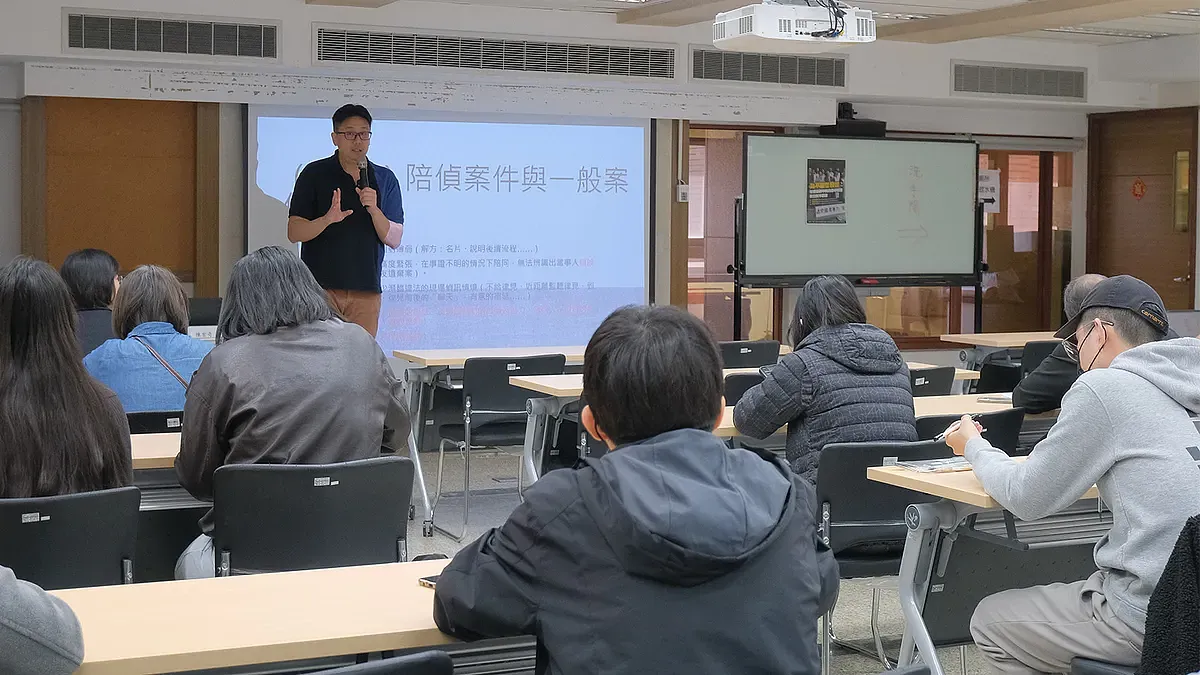
Sidelights | Seminar on "Speaking Up for Disobedience: Accompanying Defense in Social Movements and Civil Disobedience"
Last edited: 2026-11-04
Living in a democratic and free country, protests and social movements have always been ways for the public to express demands and fight for rights, typically speaking out against policies, social issues, or injustices. However, when protests and social movements involve acts of civil disobedience—especially when participants intend to use civil disobedience as a strategy—it often entangles them in legal disputes. What kind of role can lawyers play in such cases? What makes assisting clients different in these contexts? And if you are a participant, what should you watch out for?
This article features Attorney Ch'en Hung-ch'i guiding us through practical considerations for accompanying defense cases in social movements, and discussant Professor Wei Pei-hsuan explaining how to speak up for "civil disobedience."
The Peculiarities of Accompanying Defense in Social Movement Protests
Accompanying defense cases during social movement protests generally differ from standard retained cases. In ordinary retained cases, clients and lawyers usually have ample time to communicate and become acquainted. In contrast, during accompanying defense, a lawyer's first contact with the client may take place right at the police station. In the high-pressure, uncomfortable environment of a police station, maintaining good quality attorney-client interviews is often difficult. Furthermore, because clients may have just finished participating in a social movement, suffering from prolonged fatigue and stress, and experiencing a state of high excitement, the likelihood of an effective statement is reduced. Under such circumstances, how to build a relationship of trust within limited interview time is a major challenge. Here, Attorney Ch'en Hung-ch'i suggests that "carrying an adequate supply of name cards" is a great trick. This creates a sense of familiarity and connection between the client and the lawyer, preventing them from being total strangers to each other's names and backgrounds, which makes it easier to build trust and more conducive to the client fully expressing the facts of the case afterward.
In accompanying defense cases, lawyers should remind clients of the upcoming procedures and potential issues they will encounter so that clients do not feel ambushed. For example, after being apprehended and brought in, the process typically involves:
- The first police interrogation record
- Investigation by the investigative team of the respective precinct
- Transfer to the Prosecutors Office for secondary questioning
During the investigation by the investigative team, usually only identity verification takes place; however, under special circumstances, a second police interrogation record may occur. To prevent clients from being frightened or caught off guard by this, it is essential to warn clients beforehand of the possibility of a second police interrogation record, and to remember to ask for the lawyer's presence if this happens.
What to Do in Interrogation Scenarios That Violate the Law or Border on Violation?
In social movement protests, one may encounter a high degree of malice from police officers. There are many reasons why they might act this way—perhaps caused by prolonged duty stress, pressure from superiors, or hostile behavior from clients, etc. Consequently, police officers may adopt a harsh attitude or even attempt to provoke the lawyer. How should one conduct oneself in this situation? Attorney Ch'en Hung-ch'i breaks this down into several scenarios for us to discuss together!
Scenario 1
As a lawyer rushing to the police station, you receive a phone call from your client…
Police: "Hey, Counsel, we are really pressed for time here. If you haven't arrived yet, can we start questioning early?"
What to do in this situation?
Ans: Pursuant to Article 93-1, Paragraph 1, Subparagraph 5 of the Code of Criminal Procedure, a defendant or suspect who expresses the intent to retain defense counsel is entitled to "four hours" of waiting time for counsel to arrive!
Of course, clients may also exercise their right to remain silent before the lawyer arrives!
Scenario 2
As a lawyer rushing to the police station, but…
Police: "Counsel, we've waited for you for a long time. I think we should skip the attorney-client interview and start recording the statement directly, is that okay?"
What to do when the police demand proceeding with the statement without an attorney-client interview?
Ans: Article 34, Paragraph 2 of the Code of Criminal Procedure grants lawyers "one hour" and "one" opportunity for an attorney-client interview. Make sure to make good use of it and do not let the client's rights sleep!
Scenario 3
When you finally manage to conduct the attorney-client interview, police officers engage in close-range audio monitoring of the interview…. The client is under heavy psychological pressure and finds it difficult to articulate properly. What to do then?
Ans: Judicial Yuan Interpretation No. 654 establishes "visual monitoring without audio eavesdropping."
According to Judicial Yuan Interpretation No. 654, provisions in the Detention Act requiring monitoring and recording during a lawyer's visits with a detained defendant violate the proportionality principle of Article 23 of the Constitution and are thus unconstitutional. Therefore, current practice regarding visits between lawyers and detained defendants adopts a regulatory approach of "visual monitoring without audio eavesdropping," meaning "only visual surveillance" is permitted, and "audio eavesdropping or recording" is not.
Reading this, clever reader, you might wonder: Interpretation No. 654 targets "detained" defendants—does it also apply to ordinary apprehension and arrest situations?
Based on his practical experience, Attorney Ch'en Hung-ch'i believes that under the legal principle of "the greater includes the lesser," rights that detained defendants can enjoy should certainly be enjoyed by non-detained defendants as well! Therefore, the intent of Interpretation No. 654 can still be applied by analogy. Although Attorney Ch'en noted that police did not adopt this argument during previous advocacy efforts, it remains a method we can learn from and strive for.
The Nuclear-Grade Weapon: The Right to Remain Silent
Reviewing the three scenarios above, one can see that accompanying defense takes many forms, and navigating it is a highly complex issue. Here, Attorney Ch'en Hung-ch'i specifically points out that the client's "right to remain silent" is a crucial right. Pursuant to Article 95, Paragraph 1, Subparagraph 2 of the Code of Criminal Procedure, a defendant may remain silent. "Remaining silent" may sound insignificant; however, for the police, a client remaining silent can be quite troublesome. Police may feel pressured and dislike having an empty record; thus, making good use of the right to remain silent is a vital trick!
Under what circumstances should this nuclear weapon (the right to remain silent) be invoked forcefully? There is actually no fixed standard. If police attitude is hostile and inducement borders on malice, one can certainly remind the client at the appropriate moment and exercise the right to remain silent somewhat firmly. Afterward, one can explain to the prosecutor that improper police interrogation conditions led to the exercise of this right.
Finally, Attorney Ch'en Hung-ch'i emphasized that when fighting for clients' rights, lawyers should "try to maintain taste and dignity without always having to assert things aggressively." In other words, avoid becoming the target of conflict with the police unless strictly necessary, so as to prevent "innocent bystanders from getting dragged into the dispute"!
The Importance of "Immediate Application for Habeas Corpus" and "Retroactive Accountability"
Sharing his personal experience, Attorney Ch'en Hung-ch'i noted that in the prominent Korean workers' case, client Lee Sang-eun was unlawfully arrested. Through previous similar incidents and the legal team's repeated trials and efforts, they realized: if apprehension procedures are found to be illegal, there is no need to cling to accompanying the client on-site; one should immediately apply for habeas corpus! In that case, the legal team secured the release of client Lee Sang-eun precisely by applying for habeas corpus immediately.
In addition, Attorney Ch'en Hung-ch'i shared that if one wishes to hold police officers retroactively accountable following improper interrogations, official letters can be dispatched to the "Inspectorate Office," with copies sent to multiple different units and administrative agencies to urge their attention.
"Civil disobedience can be said to be a right of resistance. People achieve illegal outcomes through rights conferred by the Constitution. Through small-scale resistance, we pull a constitutional system nearing out-of-control back onto the right track—much like sneezing or coughing to remind the body that something is wrong."

During the discussion, Professor Wei Pei-hsuan stated that whether it is assembly and procession or civil disobedience, both require courage, involve huge stakes, necessitate stepping forward directly, expose individuals to the public's bare scrutiny, and even require confronting the front lines of the state.
Professor Wei Pei-hsuan noted that in Taiwan, it is difficult to evaluate civil disobedience as legal; it can only be described as "sympathetic illegality." For example, in the case of the famous Rice Bomber—Yang Ju-men—Taiwanese judiciary could only assist in sentencing or rely on presidential pardons, but fundamentally it is difficult to deliver an acquittal.
So how should we help defend clients when exercising this right of resistance known as civil disobedience? Professor Wei Pei-hsuan stated that defense focuses are unlikely to be placed on "justification grounds" (grounds for blocking illegality). Instead, one should be pragmatic and fight for the client through "statutory elements" and "culpability." For instance, if a client with physical or mental disabilities refuses police inspection and is accused of "obstructing official duties," our defense direction might be that "the police were not exercising official duties at all," meaning the client did not obstruct official duties!
Finally, Professor Wei Pei-hsuan pointed out that whether in civil disobedience or assembly and procession, situations frequently arise where police officers are fully aware that certain actions are illegal yet still carry out unlawful enforcement. Such situations may occur due to instructions from superiors or power dynamics that require the immediate suppression of public voices. They also do not fear administrative disciplinary action because they are doing what their superiors like, ensuring that someone will continue to "protect them" in the future.
How should we respond then? What we can do is to "hold them accountable to the end," "maintain continuous attention," and "keep speaking out" so they know that someone is always watching these actions and putting pressure on superiors; we must also let them know that they cannot evade responsibility every single time. Only in this way can we ensure that the government cannot use illegal means to maintain the stability of its power! Only thus can we protect the functioning of democracy and ensure that the people's voices are never ignored.
This article is an AI-generated translation of the original Chinese text. In the event of any discrepancy, the Chinese version shall prevail.