
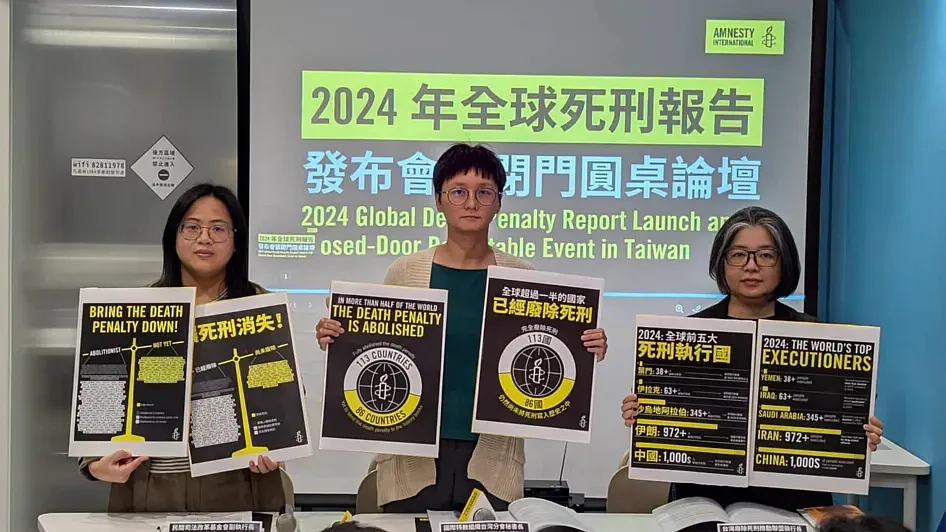
Statement by Attorney Li Ming-ju | 2024 Global Death Penalty Report
Last edited: 2026-11-03

Although civil society organizations were inevitably disappointed by Constitutional Court Judgment No. 8 of 2024, discussions on legislative amendments began swiftly. While the Judicial Yuan has convened three consultative meetings, no public updates have been released by the Ministry of Justice.
The legislative amendments implicated by this judgment involve mandatory defense during investigation, mandatory defense and oral argument in the third instance, the requirement of a unanimous verdict for the death penalty, and the prohibition of sentencing individuals with mental disabilities to death. The Constitutional Court's judgment clearly points toward stricter due process. However, during the legislative amendment process, a lack of oversight can easily lead to amendments that prioritize 'minimal changes' rather than 'strict adherence to due process.'
For instance, regarding defense during investigations, the Judicial Yuan's draft limits the requirement to cases of 'intentional homicide where the maximum statutory punishment is the death penalty.' Civil society organizations argue that in practice, a death result may arise later, or an investigation may initially proceed under negligent homicide—both of which would fall outside the scope currently delineated by the Judicial Yuan and fail to trigger mandatory defense. In short, civil society organizations will continue their efforts in monitoring these legislative amendments.
Furthermore, the Constitutional Court's determination of the subjective intent required to sentence someone to death is also highly problematic. According to the past jurisprudence developed by the Supreme Court in accordance with the two Covenants, death penalty sentences have been restricted to 'direct intent.' Yet, in the reasoning of its judgment, the Constitutional Court mentioned categories such as 'general intent' (dolus generalis) and 'alternative intent' (dolus alternativus), which fails to apply the strictest interpretation. Many scholars have already written critiques on this matter, and civil society organizations will be holding a symposium to call the legal practice community's attention to it.
However, what concerns us most is that beyond the amendments directly responding to the holding of the judgment, Constitutional Court Judgment No. 8 of 2024 will also impact death penalty execution regulations scattered across various laws, orders, and rules, such as the Code of Criminal Procedure, the Prison Act, and the Regulations Governing the Execution of Capital Punishment. Regarding the latter, the Ministry of Justice published a new draft on the Join platform on March 24, seeking to relax obstacles to the execution of capital punishment. Although civil society organizations have jointly protested this procedurally, the impact has been very limited. Amid Taiwan's chaotic domestic political climate, international attention is exceptionally vital to join forces in halting such political will.
In particular, at the press conference for the release of the global death penalty report last year, my main remark was an expression of hope that the Constitutional Court could serve as the ultimate line of defense for human rights. Yet a year later, Taiwan's Constitutional Court remains paralyzed. The grand justices nominated late last year were all rejected, and last month President Lai re-nominated seven grand justices. Notably, the grand justice nominated as the President of the Judicial Yuan even comes from a prosecutorial background. The judicial and prosecutorial systems in Taiwan have always held divergent views on legal bills, with a significant gap particularly regarding human rights performance. Prosecutors originate from a system characterized by strong administrative nature and monolithic will; we are deeply concerned about how such an individual can be fit for the role of President of the Judicial Yuan. Especially at this critical juncture for legislative amendments following Judgment No. 8, we need the international community and Taiwan's civil society organizations to stand firm together in protecting human rights and to maintain ongoing vigilance. Thank you.
Further Reading
Amnesty International Press Release | 2024 Global Report: Death Sentences Reach Highest Level Since 2015
2024 Global Death Penalty Report
This article is an AI-generated translation of the original Chinese text. In the event of any discrepancy, the Chinese version shall prevail.