
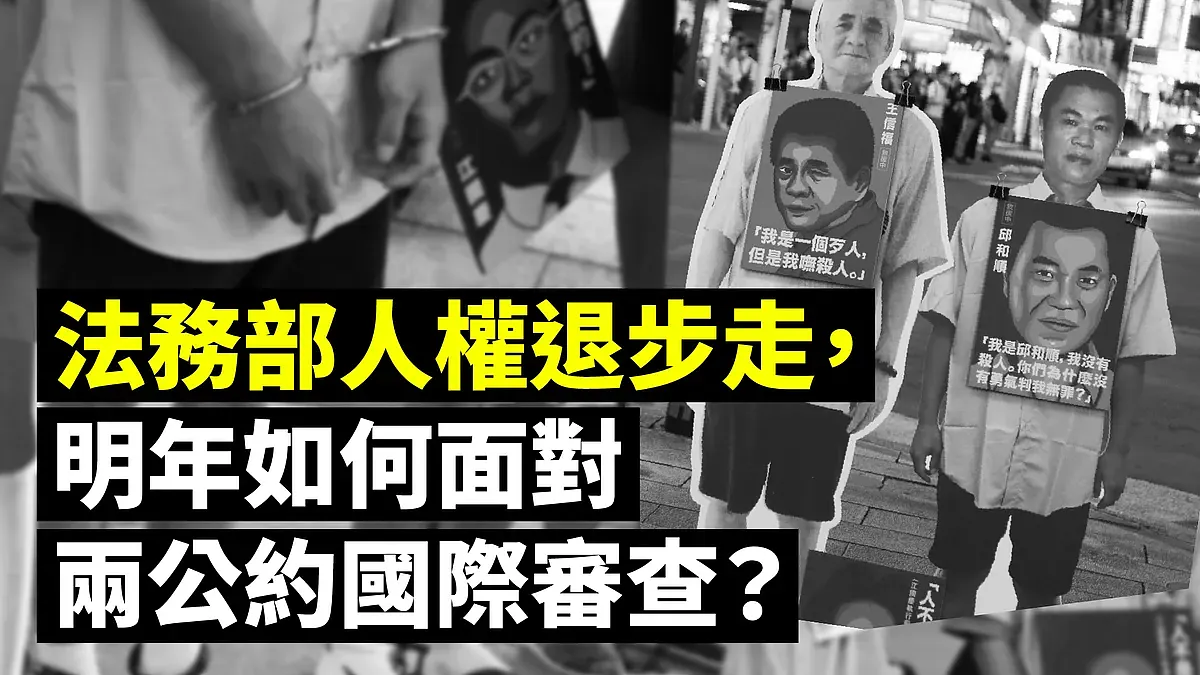
Joint Statement|The Ministry of Justice's Human Rights Retrogression: How Will It Face the International Review of the Two Covenants Next Year?
Last edited: 2026-07-27
On March 24, 2025, the DPP government announced a draft of the Regulations on the Execution of the Death Penalty, significantly relaxing restrictions on carrying out executions. The regulations were promulgated yesterday evening (April 16) and will take effect at lightning speed this Friday (April 18). Under these regulations, while a defendant is seeking relief and the retrial court or the Constitutional Court is deliberating, the Ministry of Justice can execute death row inmates by firing squad as long as no ruling to suspend execution is issued.
Compared to the Kuomintang's proposed "anti-abolition of the death penalty referendum," the DPP government seems intent on competing by resorting to "speedy trials and speedy executions." In response, civil society organizations have jointly issued the following statement:
Resurrecting the History of Speedy Trials and Speedy Executions, Disregarding the Due Process Requirements of Constitutional Judgments
rThe emergence of the Regulations on the Execution of the Death Penalty was secured by the "Chou Hsun-shan incident" in 1999. Had these regulations not imposed strict restrictions over the past thirty years—requiring a suspension of execution upon filing for a retrial, constitutional litigation, or extraordinary appeal—innocent individuals whose death row convictions have since been overturned, such as Hsu Tzu-chiang, Hsieh Chih-hung, and Cheng Hsing-tse, would never have survived to see their exonerations.
Before extraordinary remedies are granted, wrongful convictions require years of effort, multiple requests, and immense perseverance to overturn. Amending the rules to allow executions before extraordinary remedies are granted is tantamount to returning to an era without the Regulations on the Execution of the Death Penalty; it is an abolition in practice under the guise of amendment. Today, wrongful conviction cases still being rescued by civil society groups, such as Chiou Ho-shun and Wang Hsin-fu, involve living human beings confined in prison. The government refuses to recognize the torture that prolonged detention inflicts on their bodies and minds, and is now attempting through this political will to signal an eager intent to cut off their paths to survival—an act that is utterly cruel and inhumane.
Furthermore, we must ask the Ministry of Justice: after the Constitutional Court established preliminary standards for "execution capacity for death row inmates" in Judgment No. 8 of the 2024 (113) Constitutional Court, has the Ministry of Justice reviewed this matter? Why was it not reflected in this amendment? Does the DPP government intend to execute the death penalty prudently, or does it want to rush executions? The intent of Judgment No. 8 of 113 (2024) is to demand greater prudence, not greater haste, in the application of the death penalty. The Ministry of Justice's amendments aimed at swift execution distort and violate the intent of that Constitutional Court judgment.
Which International System Is the DPP's Current Political Will Aligning With?
According to the 2024 global death penalty report just released by Amnesty International, even though 113 countries worldwide have completely abolished the death penalty, and a total of 145 countries have abolished it in law or practice, China remains the world's leading executioner; countries such as North Korea and Vietnam are also believed to make extensive use of the death penalty. These leaders weaponize the death penalty on false pretexts, claiming it improves public safety, or use it to instill fear among the public.
Next year will mark the international review of the "Two Covenants" (the International Covenant on Civil and Political Rights and the International Covenant on Economic, Social and Cultural Rights). When our country domesticated the Two Covenants in 2009, it was precisely to elevate human rights protections in Taiwan and thereby align with the international human rights system. The Ministry of Justice even established the "Steps to Human Rights" website to handle matters related to these covenants.
However, the DPP government's political will at this moment to rush trials and executions clearly goes against the majority of countries worldwide that support human rights, disregarding human rights values for political gain. We must ask: which countries constitute the international system in the minds of the DPP government? How will the DPP government and the Ministry of Justice face the international review of the Two Covenants next year? How can they claim to still be qualified as the competent authority for the Two Covenants affairs under the banner of "Steps to Human Rights"?
Civil society organizations solemnly condemn the DPP government's amendment of these regulations and strongly urge the Ministry of Justice to step back from the brink and revise the rules back. They must not follow the lead of the opposition parties, coveting short-term political and public opinion dividends while recklessly dismissing the possibility of long-term international political losses.
Issuing Organizations
Taiwan Association to End the Death Penalty
Taiwan Association for Human Rights
Taiwan Labour Front
Taiwan Association for Innocence
Judicial Reform Foundation
Covenant Watch
This article is an AI-generated translation of the original Chinese text. In the event of any discrepancy, the Chinese version shall prevail.