
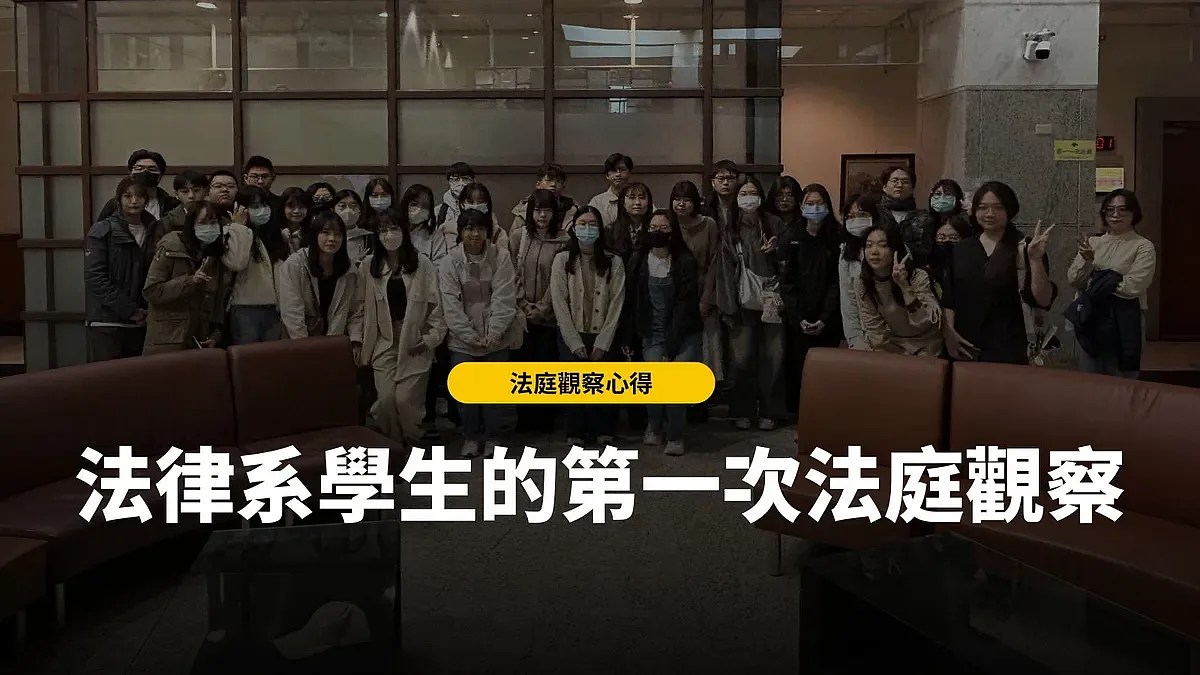
Court Observation Insights: A Law Student’s First Court Observation
Last edited: 2026-08-22
Thoughts on Observing the Court in Person
This was my first time attending a court hearing after starting law school. I had observed a hearing once before when attending a high school legal camp, but back then, having zero legal expertise and starting from a blank slate—coupled with the case being about environmental law, which was relatively dry and tedious—I understood nothing and came away with no particular impressions. Having studied law for nearly three years now, equipped with some foundational legal knowledge, today's experience and impressions were entirely different. Observing court proceedings firsthand helps me learn how legal practice operates in reality and fills me with greater aspirations for my future in law.
Taiwan Chiayi District Court is newer, larger, and much more magnificent than I had imagined. It crossed my mind that it would be wonderful to practice law in such a place.
Case Contested Points
This was my first time attending a court hearing after starting law school. I had observed a hearing once before when attending a high school legal camp, but back then, having zero legal expertise and starting from a blank slate—coupled with the case being about environmental law, which was relatively dry and tedious—I understood nothing and came away with no particular impressions. Having studied law for nearly three years now, equipped with some foundational legal knowledge, today's experience and impressions were entirely different. Observing court proceedings firsthand helps me learn how legal practice operates in reality and fills me with greater aspirations for my future in law.
Entering the Trial Courtroom
Practical Impressions of Each Role
Inside the courtroom, the judge, lawyer, prosecutor, court clerk, and interpreter were all in their respective positions. Later, the defendant was brought in by two bailiffs, wearing handcuffs. To be honest, if their roles were swapped around, they weren't wearing robes, and they were seated at random, I wouldn't have been able to guess their respective identities. Everyone looked like ordinary people with no distinct differences—just like us.
Looking at the defendant, it was hard to imagine that this person had already been serving a prison sentence for 14 years. He looked like an ordinary, honest, and amiable uncle who was great at chatting. His gaze was bright and alert, and his answers, though slightly nervous, were very firm, carrying a longing to return to society. Neither the lawyers, judges, nor prosecutors were like those in TV dramas; they lacked the imagined overpowering aura, sternness, and intense severity. They spoke just like normal people, without any particular harshness or forceful imposing tone—as calm as ordinary conversations we have with friends.
Trial Procedure and Reflection
The trial procedure began, and the hearing followed proper rules step by step: identity and document verification, the defense counsel's arguments, presentation of evidence, factual and legal debates, and finally concluding the proceedings with the verdict to be rendered on another date. Notably, the judge asked about the defendant's educational background, work experience, and family background. What left the deepest impression on me was when he stated he had already served 14 years in prison, has a minor daughter studying in mainland China, previously worked as a taxi driver, has a retired mother, and a father currently serving a prison sentence, with family members rarely visiting him in prison. Under such circumstances, his starting point is vastly different from ours. He has to exert much greater effort than an ordinary person just to live the same "normal" life, which explains why the General Provisions of the Criminal Code of the Republic of China feature provisions for "discretionary reduction of punishment."
During the trial, other things that left a deep impression on me were the arguments made by the defendant's counsel. The counsel argued that the defendant's statements against his own interest made during the investigation lacked admissibility as evidence, and because he was unrepresented by counsel at the time, there were procedural flaws. Furthermore, at the time, the defendant no longer held the status of a reservist. Since the law cannot be applied retroactively and this was an internal administrative issue of the administrative agency, this disadvantage should not be shifted onto the defendant. Moreover, the defendant stated right at the beginning of the investigation that he had no knowledge of the military service recall or related notifications; therefore, he lacked subjective intent and should not be guilty of the offenses against military service obligations. The judge also asked the defendant whether he had been subjected to duress, threats, or torture. The defendant replied that the interrogator during the investigation was relatively harsh, but it did not reach the level of improper methods or inducement. Through the dialogue between the counsel and the judge, the importance of evidentiary admissibility in the Code of Criminal Procedure became evident. Just like what we study in school, the Code of Criminal Procedure was operating right before our eyes in the courtroom. Furthermore, throughout this process, there was none of the intense, fierce verbal sparring seen in TV dramas. Everyone spoke at a relatively slow pace to clearly present their opinions in a peaceful atmosphere.
Finally, during the factual and legal statements, the judge asked if the defendant had anything to add. The defendant stated that he had never met anyone else in prison who was doing time for a drug offense while also being subjected to a military service recall, because they all automatically received notices of suspension of military service, whereas he was the only one who didn't. As we study law, we become increasingly capable of rationally analyzing facts and subsuming them under legal provisions, but we might forget the most fundamental fact: the subjective perspective of the defendant. While we frantically and desperately delve into the statutory provisions, legal principles and their applicability, administrative and procedural issues, and timelines, the defendant's subjective thoughts end up being the very last thing we consider. Isn't this examining the defendant from a "God's-eye view"?
Disadvantages of the Litigation System for Incarcerated Defendants
Once the proceedings concluded, the overall hearing time was actually very short—less than an hour. The legal staff explained that the evidence and other materials had likely already been investigated and debated during previous trials, leaving little else to contest in this particular judgment. Although it lasted less than an hour, I learned a great deal, witnessed the operation of judicial practice, and gained a slight understanding of the dilemmas faced by inmates. Appearing in court is like a gamble for them. While acquittal is obviously the best outcome, attending court means they lose out on labor points in prison for that day, which affects their subsequent eligibility for parole or the meager wages they can earn that month.
When the defendant answered the judge's question of "whether he had been tortured," both the defense counsel and the defendant quickly responded "No." This is actually tied to litigation strategy and the defendant's best interests, because answering "Yes" might necessitate reopening the trial, which would ultimately work to the defendant's disadvantage. Perhaps the prison system still has its shortcomings.
The defendant had already served 14 years in prison. If the offense of obstructing military service were added in this judgment, it would jeopardize his chances of parole and seriously infringe upon his rights. The judgment has now been delivered. After multiple rounds of legal maneuvering and push-and-pull, the judiciary successfully and commendably returned innocence to the defendant, delivering a legally sound judgment that preserves humaneness. It is also hoped that the defendant can reform himself and successfully reintegrate into society in the future.
This article is an AI-generated translation of the original Chinese text. In the event of any discrepancy, the Chinese version shall prevail.