
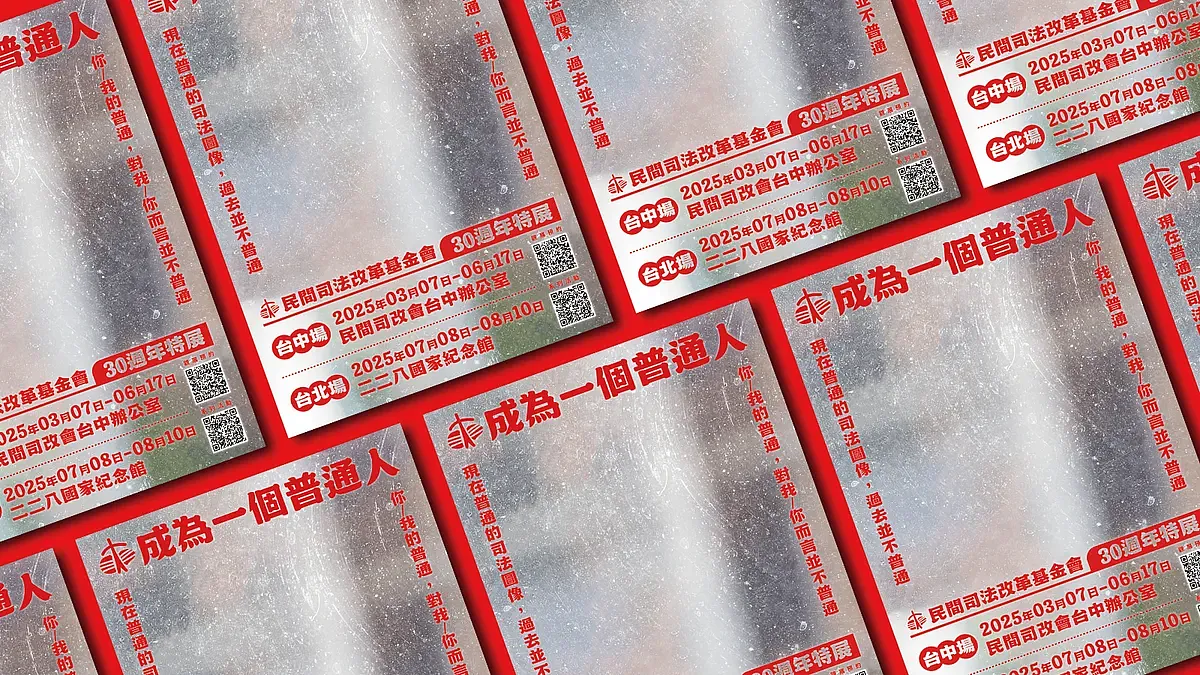
Becoming an Ordinary Person|30th Anniversary Special Exhibition of the Judicial Reform Foundation|Taipei Venue
Last edited: 2026-08-22
Have you ever imagined what kind of person you would want to be at the age of 30?
Through retrospection and outlook, "Becoming an Ordinary Person: 30th Anniversary Special Exhibition of the Judicial Reform Foundation" invites the audience to witness Taiwan's thirty-year journey of judicial reform—how it brought about change, turned many essential rights into the daily reality of every "ordinary person," and highlighted the footprints left along the way by those who struggled, inspiring followers to press on and forge future paths of change.
This exhibition is both a tribute to the past and a collective vision for the future of judicial reform.
*
Never would I have thought that becoming an ordinary person could be such a difficult task.
Su Chien-ho, Taiwan's first exonerated defendant in a death penalty miscarriage of justice case, once said, "I hope that during my lifetime, I will no longer need to explain who I am."
The Su Chien-ho case involving three defendants became a catalyst for Taiwan’s first wave of criminal procedure reform. It became teaching material in the high school curriculum, the first wrongful conviction case that many law students learned about, and the case most frequently discussed in the Judicial Reform Foundation’s campus lectures. They were extraordinary in this sense. But no one wants to remain “extraordinary” for so long.
“When I was tortured during interrogation, my younger brother was not even married yet. Now he is already a grandfather, while I can only remain stuck here in the same place. Of course I know that the judicial system today is completely different from what it was back then, but please do not treat me as if I were invisible. The fact is that I am still fighting my case in court. I keep a low profile, but I am still working hard. I ask everyone to work together.”
*
Extraordinary forces for change make possible the ordinary happiness of everyday life.
Over the past 30 years, the Judicial Reform Foundation has brought together the efforts of many people from the bottom up, transforming what was once an extraordinary and abnormal picture of the judicial system into what is now ordinary and normal. It continues to monitor whether rights that most people have already come to regard as ordinary are also universally protected for vulnerable groups.
Though there is still unfinished work, we have never stopped. We will continue to uphold our commitment and move toward the future.
Exhibition Period and Venue
Exhibition period: July 8, 2025 (Tuesday) to August 10, 2025 (Sunday)
-
Opening hours: Tuesday to Sunday, 10:00 a.m.–5:00 p.m.
- Closed: Mondays. If a Monday falls on a national holiday, the museum will remain open and close on the following day instead. The museum will also be closed on days when the government announces suspension of work due to natural disasters.
Venue: National 228 Memorial Museum, 3F Exhibition Area, No. 54, Nanhai Road, Zhongzheng District, Taipei City
Visitor Information
-
No reservation is required for the Taipei exhibition. Exhibition guides will be available in the exhibition area at all times
-
Smoking, eating, drinking, chewing betel nuts, and chewing gum are prohibited throughout the museum
-
Pets are not allowed, except guide dogs. Dangerous items and flammable materials are also prohibited
-
Please do not bring umbrellas into the exhibition area. Folding umbrellas should be placed inside your personal bag
-
Large personal belongings and backpacks should be stored in the lockers or left at the service counter.
-
Wheelchairs are available in the museum. Please contact the service counter if you need one.
-
Accessible elevators and ramps are available in the museum. Please contact the service counter if assistance is needed.
Contact Information
-
Tel: (04) 2523-1178, ext. 23, Staff Member Che
-
E-mail: ytc@jrf.org.tw
Organizer
Judicial Reform Foundation
Co-organizer
Memorial Foundation of 228
Curatorial Team
Chief Curator | Lee Ming-ju
Curatorial Coordination | Hsieh Jen-chun, Wang Chen Yun
Exhibition Design | Lee Ming-ju, Hsieh Chia-chen, Tsai Meng-chu, Lee Chao-yen, Chen Yin-ting
Visual Design | Tsai Meng-chu
Layout Design | Tsai Meng-chu
Video Editing | Lee Chao-yen
Sound Editing | Lee Chao-yen
Text Editing | Tsai Shang-heng, Lee Ming-ju
Exhibition Production | Hsieh Chia-chen, Tsai Meng-chu, Lee Chao-yen, Chen Yin-ting, Hsu Tzu-chiang
This article is an AI-generated translation of the original Chinese text. In the event of any discrepancy, the Chinese version shall prevail.