
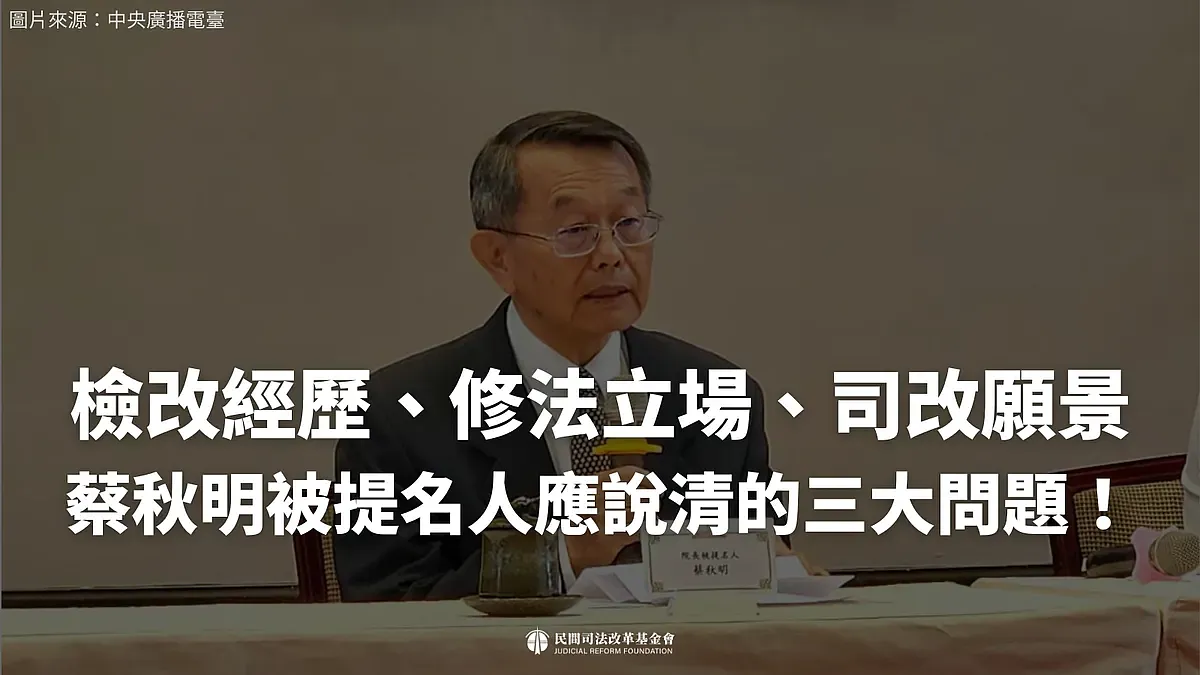
Press Conference | Prosecutor Reform Background, Legislative Stances, and Judicial Reform Vision: Three Key Questions That Nominee Tsai Chiu-ming Must Clarify!
Last edited: 2026-08-22
On March 21 of this year, President William Lai nominated Tsai Chiu-ming, Su Su-e, Hsiao Wen-sheng, Cheng Chun-hui, Lin Li-ying, Chen Tzu-yang, and Chan Chen-jung as Grand Justice nominees. Among them, Tsai Chiu-ming was also nominated as the President of the Judicial Yuan, while Su Su-e was nominated as the Vice President.
However, at a time when the Constitutional Court is already facing an operational crisis due to the "amendments to the Constitutional Court Procedure Act," the majority coalition in the Legislative Yuan led by the Kuomintang (KMT) and the Taiwan People's Party (TPP) has still failed to actively review this crucial personnel appointment case. This fact clearly demonstrates that the Blue-White coalition disregards the operational difficulties of constitutional organs and ignores the constitutional duty of institutional loyalty.
Apart from calling on the Legislative Yuan to swiftly schedule the review of the Grand Justice nominees, we believe that nominee Tsai Chiu-ming still needs to explain numerous issues to the public. Accordingly, our Foundation poses 3 major questions to nominee Tsai Chiu-ming concerning his "prosecutorial reform background," "legislative stances," and "judicial reform vision":
1. Drawing lessons from the past to understand the future: What are nominee Tsai Chiu-ming's participation experience and views regarding "prosecutorial reform"?
2. How does nominee Tsai Chiu-ming view the differing opinions on legislative amendments between the Judicial Yuan and the Executive Yuan's Ministry of Justice?
3. Where should judicial reform head, nominee Tsai Chiu-ming?
1. Drawing lessons from the past to understand the future: What are nominee Tsai Chiu-ming's participation experience and views regarding "prosecutorial reform"?
In the current nomination case for Justices of the Judicial Yuan, President William Lai has nominated Mr. Tsai Chiu-ming to also serve as the President of the Judicial Yuan. However, in the constitutional history of our country, there is no precedent for a president nominating a candidate with a prosecutorial background to serve as the President of the Judicial Yuan.
Furthermore, as an investigative organ, the prosecutorial system possesses a closely knit organizational culture that emphasizes "prosecutorial solidarity" and "subordination to superiors." Consequently, outside observers have repeatedly expressed concerns about the suitability of a prosecutor assuming the presidency of the Judicial Yuan and leading the body of judges.
To address these concerns, we believe that the Office of the President and nominee Tsai Chiu-ming should place greater emphasis on explaining to the public his views and experiences regarding judicial reform. Specifically, having served as a prosecutor for a long time, which reform proposals did nominee Tsai Chiu-ming participate in or support during the surge of "prosecutorial reform" (such as the rotational system for prosecutors of the first and second instances, prosecutor evaluations, and the system for electing chief prosecutors)? During his tenure as a prosecutor, did he ever encounter improper external interference in case handling, and how did he respond?
Although the aforementioned issues do not fall within the official authority of the President of the Judicial Yuan, we believe that by examining the past we can understand the future; Prosecutor Tsai should possess extensive participatory experience in prosecutorial issues with which he is familiar in order to convince people that he can further promote judicial reform after assuming the presidency. At the same time, we also believe that President William Lai's willingness to nominate Prosecutor Tsai Chiu-ming as the President of the Judicial Yuan must stem from an understanding of nominee Tsai Chiu-ming's past experiences participating in prosecutorial reform.
However, neither the press conference of the Office of the President nor the autobiography of nominee Tsai Chiu-ming touches upon this matter. Therefore, we earnestly request the Office of the President and nominee Tsai Chiu-ming to explain his participation experience and opinions regarding "prosecutorial reform" or "judicial reform."
2. How does nominee Tsai Chiu-ming view the differing opinions on legislative amendments between the Judicial Yuan and the Executive Yuan's Ministry of Justice?
As the highest head of the judicial system, the President of the Judicial Yuan also holds a pivotal and critical position regarding relevant legislative proposals. What is worth noting in recent years is that the Judicial Yuan and the Executive Yuan's Ministry of Justice, as the competent authorities for laws related to the judiciary and legal system, frequently hold differing amendment opinions on various issues. Based on the characteristic that its decision-making system is predominantly led by prosecutors, the Ministry of Justice often approaches legislative amendments from the perspective of a "prosecutor," emphasizing "severe punishment" and "zero tolerance for crime." In contrast, the Judicial Yuan leans closer to the perspective of an "adjudicator," focusing on the "principle of legal certainty" and "equity."
For example, the legislative amendments proposed by the Ministry of Justice in 2022 under the banner of "zero tolerance for driving under the influence of drugs (drug driving)" advocated that a primary "positive urine test" constituted "drug driving." In comparison, the Judicial Yuan considered this part to raise concerns regarding violations of the principle of legality (nullum crimen, nulla poena sine lege) and the principle of legal certainty, as well as a lack of scientific evidence. Ultimately, the articles passed through the third reading referenced the opinions of the Judicial Yuan, adopting penalty methods comparable to those for "drunk driving." In addition, the table below lists 15 legislative bills from recent amendments where the Judicial Yuan and the Executive Yuan's Ministry of Justice submitted differing opinions:
| # | Amendment Subject | Articles with Differing Opinions Between the Two Yuans | Proposal Date | Main Proposing Organ |
| 1 | Expanding the scope of cases eligible for appeal to the third instance | Article 376 of the Code of Criminal Procedure | January 5, 2021 | Judicial Yuan (Executive Yuan held differing opinions) |
| 2 | Amendment to the scope of appeal | Article 348 of the Code of Criminal Procedure | January 5, 2021 | Judicial Yuan (Executive Yuan held differing opinions) |
| 3 | Scope for aggravated punishment of recidivism | Article 47 of the Criminal Code | February 9, 2021 | Executive Yuan (Judicial Yuan held differing perspectives) |
| 4 | Addition of the emergency custody system | Articles 121-1, 121-5, and 301-1 of the Code of Criminal Procedure | March 23, 2021 | Judicial Yuan (Executive Yuan held differing opinions) |
| 5 | Clarification of the definition of hit-and-run offenses and rationalization of penalties | Article 185-4 of the Criminal Code | April 27, 2021 | Executive Yuan (Judicial Yuan held differing perspectives) |
| 6 | Extension of custodial disposition | Article 87 of the Criminal Code | April 27, 2021 | Executive Yuan (Judicial Yuan held differing perspectives) |
| 7 | Increasing penalties for major transportation accident crimes and negligent homicide | Articles 183 and 276 of the Criminal Code | May 19, 2021 | Executive Yuan (Judicial Yuan held differing perspectives) |
| 8 | Reform of the criminal forensic appraisal system | Articles 160-1, 198-1, 206, 208, and 211-1 of the Code of Criminal Procedure | August 13, 2021 | Judicial Yuan (Executive Yuan held differing opinions) |
| 9 | Strengthening the protection of rights for persons with disabilities | Articles 31, 93-1, and 186 of the Code of Criminal Procedure | August 13, 2021 | Judicial Yuan (Executive Yuan held differing opinions) |
| 10 | Reform of criminal third-instance proceedings | Articles 253, 284-1, 375-2, 378-1, 379-2, 392, and 415-1 of the Code of Criminal Procedure | April 11, 2022 | Judicial Yuan (Executive Yuan held differing opinions) |
| 11 | Reform of criminal second-instance proceedings | Articles 273, 273-3, 366-1, 369, and 455-1 of the Code of Criminal Procedure | May 25, 2022 | Judicial Yuan (Executive Yuan held differing opinions) |
| 12 | Addition of the "Chapter on Intimate and False Sexual Images" | Article 10, Article 91, and Chapter 28-1 of the Criminal Code | May 2, 2022 | Executive Yuan (Judicial Yuan held differing perspectives) |
| 13 | Perfecting penal provisions for "drug driving" | Article 185-3 of the Criminal Code | August 25, 2022 | Executive Yuan (Judicial Yuan held differing perspectives) |
| 14 | Due process of law for compulsory urine collection | Articles 70-1, 205-2, 205-3, and 205-4 of the Code of Criminal Procedure | December 6, 2024 | Judicial Yuan (Executive Yuan held differing opinions) |
| 15 | Protection of defense counsel's right to take notes during investigation | Articles 70-1, 245, and 245-1 of the Code of Criminal Procedure | March 11, 2024 | Judicial Yuan (Executive Yuan held differing opinions) |
The aforementioned 15 bills with differing opinions between the two Yuans are limited to those for which formal written opinions were submitted. In practice, legislative amendments with divergent views during the legislative process extend far beyond the items listed above (such as the legislative process for the special chapter on technological investigation in the Code of Criminal Procedure).
In this regard, we earnestly ask nominee Tsai Chiu-ming: among the legislative amendment examples above, do you tend to support the Judicial Yuan or the Ministry of Justice?
What we worry about is that a President of the Judicial Yuan with a background in the prosecutorial system might lean toward the opinions of the Ministry of Justice, causing criminal policy views to tilt severely and hindering the establishment of a fair judicial system that values human rights protection. Given this, based on past legislative amendment experiences, we hope that nominee Tsai Chiu-ming can concretely express his views and declare how he, as the President of the Judicial Yuan, will view and handle the issue of differing legislative amendment opinions between the two Yuans.
3. Where should judicial reform head, nominee Tsai Chiu-ming?
In his autobiography, apart from "reducing the judicial burden," nominee Tsai Chiu-ming also raised the following 3 issues:
- Many cases bounce back and forth between higher and lower court instances, leaving both parties and adjudicating personnel exhausted and powerless.
- A legal regulatory system that heavily penalizes inappropriate behaviors.
- The judicial cultural myth of sparing no cost and exhausting all possible avenues of verification.
Furthermore, we would like to invite nominee Tsai Chiu-ming to clearly describe the above 3 issues and propose preliminary thoughts on his solutions.
At the same time, on March 29 of this year, our Foundation also raised 7 major questions directed at the future president regarding the direction of judicial reform as follows:
- Regarding the phenomenon of the general public's low trust in the judiciary, what do you think are the causes, and what concrete improvement measures do you have?
- How can we foster dialogue and communication among citizens, judges, civic groups, the Ministry of Justice, and other organs to resolve internal disagreements within the judicial system?
- Is the current government's resource allocation for judicial trials sufficient? What are your views and concrete measures regarding the planning or augmentation of the judicial budget?
- When proposing major draft amendments in the future, will the Judicial Yuan commit to simultaneously conducting "policy and human rights impact assessments" so that all sectors of society can fully understand the impact of the reforms?
- Under the premise of safeguarding people's rights and interests, how can the judicial burden be reasonably reduced? What concrete solutions do you have for the phenomenon of overextended judges and an excessive caseload?
- What are your views on the current implementation status of the "Citizen Judges system"? Do you support further promoting reforms to the criminal procedure system, such as the system of non-transfer of case files and evidence (dossier separation)?
- What are your views on the "reform of the military judicial system"? Is there a concrete direction for reform?
We invite nominee Tsai Chiu-ming to answer the aforementioned questions to help the public and judges across Taiwan understand how the future President of the Judicial Yuan views the challenges currently facing our judiciary.
Press Conference Time
June 2, 2025 (Monday) 10:00
Press Conference Location
Room 102, Legislative Yuan Research Building (Chung-Hsing Building), No. 3-1, Sec. 1, Chinan Rd., Zhongzheng Dist., Taipei City
Attendees
- Huang Hsu-tien | Chairperson, Judicial Reform Foundation
- Lin Yung-sung | Standing Board Director, Judicial Reform Foundation
- Lee Ming-ju | Deputy Executive Director, Judicial Reform Foundation
- Chang Che-cheng | R&D Specialist, Disabled People's Rights Alliance, R.O.C.
Press Contact
Elvin Lu, Attorney-at-Law, Director of the Legal Policy Department, Judicial Reform Foundation
Phone: 02-2523-1178#37
Email: elvin@jrf.org.tw
This article is an AI-generated translation of the original Chinese text. In the event of any discrepancy, the Chinese version shall prevail.