
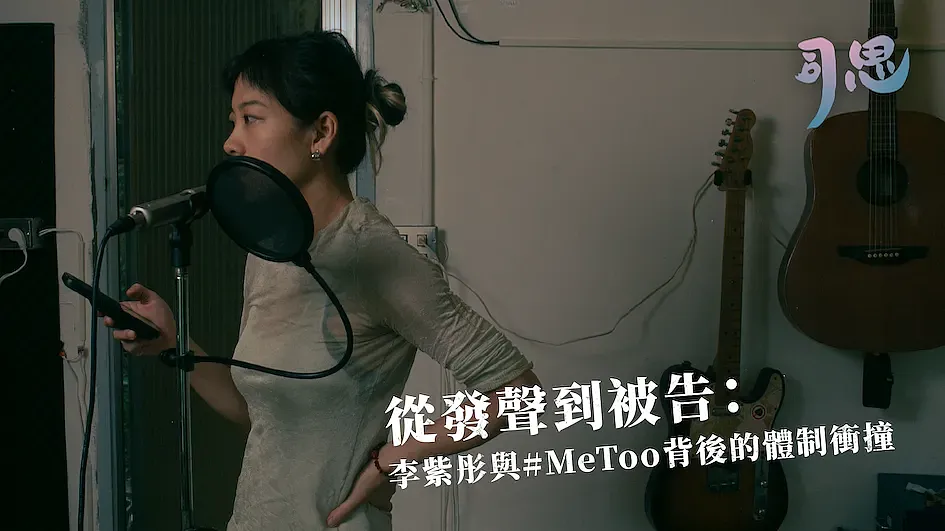
From Speaking Out to Defendant: Lee Tzu-tung and the Institutional Clash Behind #MeToo
Last edited: 2026-08-22
The incident took place at a post-event dinner for an advocacy activity. A made inappropriate physical contact with a staff member of the event. Lee Tzu-tung (hereinafter referred to as Tzu-tung) was not the direct party involved; she just happened to go pour some water and witnessed the whole thing upon turning around.
The day after the incident, Tzu-tung wrote about it on her social media page in a fictionalized and non-public manner. A year later, when the #MeToo movement erupted, Tzu-tung believed that some time had passed and public opinion at the time was more capable of understanding the context of such incidents, so she changed the post to public and wrote A's name at the very end. However, because the other party is a prominent literary figure whose status is tied to ethnic and social structures, many people were unwilling to step forward to accuse him or, conversely, blamed the victim instead.
Stepping Forward to Speak Out, Yet Treated as "Keyboard Warriors": An Investigative Experience
At the time she spoke out, Tzu-tung actually did not expect the other party to file a lawsuit. It was only later, after researching foreign #MeToo experiences, that she realized this is a common strategy in Strategic Lawsuits Against Public Participation (SLAPP) cases. She expressed with helplessness that when she first received the subpoena, she contacted a lawyer beforehand, but not all lawyers possess gender consciousness. Even when understanding the details of the incident, some lawyers still urged Tzu-tung to settle. However, Tzu-tung believed that the act of speaking out itself encapsulates the concept of the #MeToo movement; as a form of protest, it cannot simply be resolved through a settlement.
Upon arriving at the prosecutor's office for the investigation hearing, Tzu-tung and the other defendants were instead met with pressing and rigorous questioning. Tzu-tung mentioned that she felt extremely nervous when being questioned at the time, and coupled with the presiding prosecutor's demand for very specific and detailed accounts of how the incident occurred, it made her even more flustered and uncomfortable. She gave examples such as, "Did you see him touch with his left hand or right hand?" and "Where did he touch and how many times did he touch?", all of which were questions she had been asked. Although Tzu-tung later learned that this type of questioning might be aimed at obtaining clear evidence, she believed that simply as a witness, she had previously referred to the incident broadly as "groping" when recounting it and found it difficult to describe details—let alone if it were the direct victim having to face this style of questioning.
Furthermore, during the process, Tzu-tung and other defendants were accused of being "you young people are just keyboard warriors," and were further pressed by the prosecutor: "The other party is a master; do you know that? Is it appropriate for you to do this?" Tzu-tung felt that this questioning style was akin to using subjective consciousness to question their actions, and she remarked, wouldn't people in power and with influence still do such things? If prosecutors are unclear about this concept of power asymmetry, might other cases suffer from the same questioning?
Following her experience at the investigation hearing, Tzu-tung, after discussing with her lawyer, decided to apply for a transfer of jurisdiction to the Taipei District Prosecutors Office. She laughed and said, "I thought to myself, at the end of the interrogation, I must summon the courage to tell the prosecutor that I want a transfer of jurisdiction." With the prosecutor she encountered after the jurisdiction was transferred, Tzu-tung distinctly felt that he knew this was a #MeToo case; during the questioning, he not only comprehensively understood the process of the event, but also did not delve excessively into the minutiae of the incident, allowing the party involved to fully narrate the sequence of events. Unlike the authoritative questioning of the previous prosecutor—which could easily cause ordinary citizens unfamiliar with the law to feel defeated and overwhelmed in court—the prosecutor Tzu-tung encountered after the transfer of jurisdiction was perhaps the choice in #MeToo cases that could balance investigation while minimizing secondary victimization of the involved parties.
"Most people, just waiting to receive a disposition of non-prosecution, already don't want to continue any further."
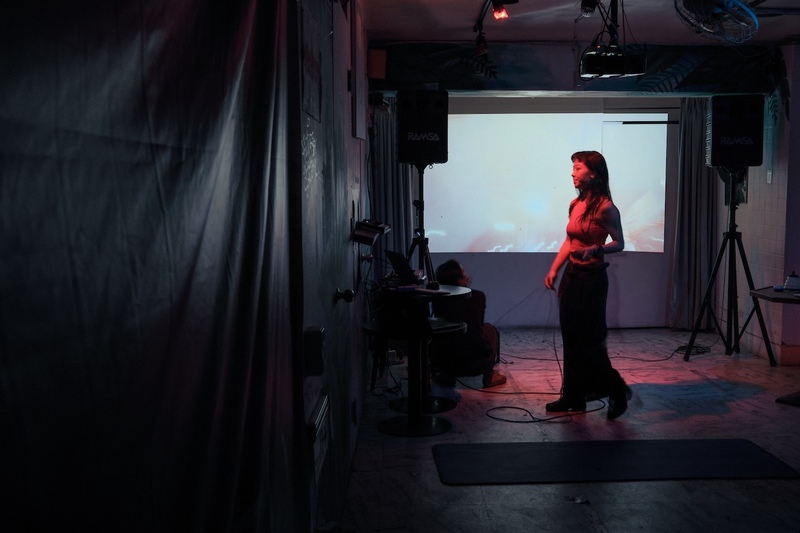
Photo / Rehearsal before the performance. As an artist, Lee Tzu-tung expresses her resistance against the establishment through songwriting. (Photography / Li Chao-yen)
Going back to the moment she was sued, Tzu-tung was very nervous about A filing a lawsuit against 7 people all at once. Because the 7 defendants made different statements regarding the case, if any of them contained overly aggressive remarks, there was a possibility that defamation could be established. Consequently, even if A truly engaged in inappropriate physical contact, he could exploit the public's lack of clarity regarding the context and use "the establishment of defamation" as an excuse to clear himself of the sexual harassment allegations. Tzu-tung desperately hoped to find a prosecutor who understood the other party's strategy, but unfortunately encountered the aforementioned situation. Therefore, upon learning of the prosecutor's attitude, Tzu-tung decided to seek other avenues of remedy.
Initially, Tzu-tung merely wanted to seek help driven by the thought that "this prosecutor is problematic," but because she was unfamiliar with the judiciary, she did not even know that she could file a complaint with the Prosecutor Evaluation Commission (hereinafter referred to as the PEC). It was only because she knew from past participation in social movements that the Judicial Reform Foundation (JRF) could assist with such matters that she made contact with the JRF and initiated subsequent actions (press release). Tzu-tung stated that if ordinary people have no exposure to relevant groups or information, they might not even know whom or how to ask for help. Moreover, litigation processes are lengthy, and filing a complaint with the PEC requires waiting until a disposition of non-prosecution is rendered before it can be submitted. Most people might have already expended a great deal of energy just waiting for the lawsuit to reach a temporary close, let alone continuing with subsequent actions.
Tzu-tung concluded by noting that she had doubts throughout the process because the victim was adamantly unwilling to step forward, raising the question: where should the boundary of speaking out be drawn? Their ultimate approach was to resolutely withhold any information related to the victim to prevent her from being forced to come forward. The various challenges faced during the litigation process also reflect that Taiwan still has much unfinished business following the #MeToo movement. Not only are there currently no countermeasures against SLAPP suits—forcing speakers to face the pressure brought by such litigation—but Tzu-tung's case also readily reveals uneven levels of gender consciousness among judicial personnel. How to strengthen judicial personnel's sensitivity toward #MeToo cases and prevent secondary victimization of survivors remains an issue that must be reflected upon in the wake of the #MeToo movement.
This article is an AI-generated translation of the original Chinese text. In the event of any discrepancy, the Chinese version shall prevail.