
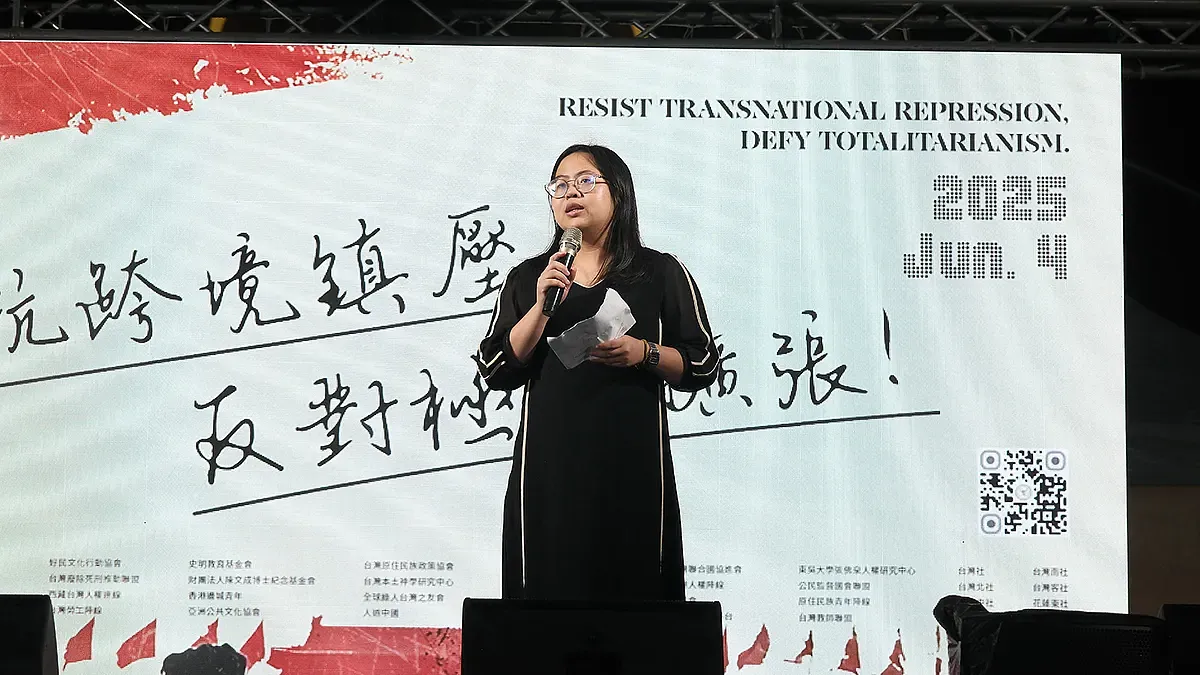
Statement by Lee Ming-ju | The 36th Anniversary of June Fourth and the 10th Anniversary of the 709 Crackdown on Lawyers
Last edited: 2026-08-22
Hello everyone, I am Lee Ming-ju, Deputy Executive Director of the Judicial Reform Foundation.
This year marks the 36th anniversary of China's June Fourth Incident. Although the armed suppression and authoritarian rule by the CCP authorities continue to expand in various places, the spirit of pursuing democracy and freedom shown by our predecessors in Tiananmen Square in 1989 has never vanished.
This year also marks the 10th anniversary of China's 709 crackdown on lawyers.
Ten years ago, in the early morning of July 9, 2015, the "709 Crackdown on Chinese Human Rights Lawyers" took place—an event that shocked the international community regarding the mass arrest of human rights lawyers and citizens. Chinese public security and state security personnel suddenly carried out arrests targeting attorney Wang Yu of Beijing Fengrui Law Firm, her husband, attorney Bao Long-jun, and their son, Bao Zhuo-xuan (Bao Meng-meng).
A total of 316 Chinese human rights lawyers, law firm staff members, human rights defenders, and their family members were summoned, forcibly interviewed, restricted from leaving the country, placed under residential surveillance, criminally detained, or subjected to enforced disappearance and arrest. Among them, 36 individuals were detained or subjected to enforced disappearance.
We understand that a decade has passed, and the professional practice space for human rights lawyers in China has not improved; instead, it has worsened further—including restrictions on personal freedom, revocation of law licenses, exit bans, and harassment of lawyers' families. In addition to daily stalking and harassment, they are frequently forced to move repeatedly because local governments do not want them to stay in the area. Methods such as compelling landlords to terminate leases and forcing children to transfer schools are used to compel them to return to their original household registration locations.
In recent years, the Chinese government's oppression of human rights defenders has even extended overseas, carrying out various forms of transnational repression abroad. Freedom House released its latest report this February, showing that 160 transnational repression incidents occurred globally in 2024, and the Chinese government continues to be one of the primary countries executing transnational repression, posing a severe threat to global democracy, human rights, and security. Aside from directly using methods such as kidnapping or attacks, the Chinese government also utilizes diplomatic and economic means to pressure other countries, demanding the repatriation of exiles. Freedom House pointed out that the Chinese government has promoted illegal extraditions or forced returns in multiple countries, with nations in Southeast Asia and Central Asia often becoming primary targets.
Nevertheless, to this day, numerous Chinese human rights lawyers and human rights defenders both at home and abroad remain willing to bravely step forward, expose the truth, raise a voice of justice against government oppression, and seek the attention and support of the international community. Such courage appears all the more precious in this dark and uncertain era!
Today, as we gather here, I believe everyone deeply cares about the progress of human rights in China and refuses to give up exploring possibilities. I hope everyone will not forget this group of hardworking people. The Judicial Reform Foundation will also continue to monitor the situation, support the rule of law, and defend democracy. Thank you, everyone!
This article is an AI-generated translation of the original Chinese text. In the event of any discrepancy, the Chinese version shall prevail.