
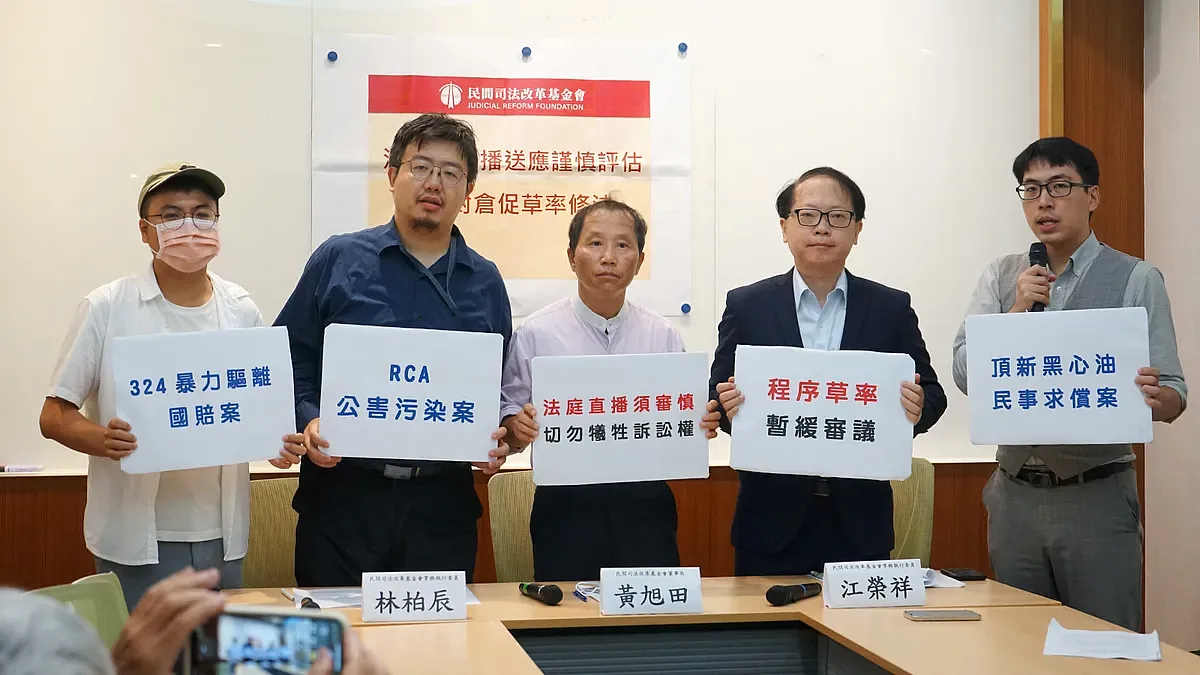
Press Conference | "Courtroom Public Broadcasting Requires Careful Assessment; Oppose Hasty and Reckless Legislative Amendments" Joint Statement by Civil Society Groups Calling to Halt Deliberations
Last edited: 2026-08-22
Update: June 9, 2025, 1:00 PM – Added links to statements of opposition from groups including the Taiwan Law Society, the Taiwanese Society of Psychiatry and Law, and the Taiwan Prosecutors Association.
On May 23 of this year, the Taiwan People's Party's amendment to the Court Organization Act was confirmed to be sent directly to the second reading, under the banner of implementing the "2017 Presidential Office National Judicial Reform Conference," demanding that criminal, civil, and administrative cases in fact-finding trials may be publicly broadcast on a case-by-case basis.
However, the legislative process for the aforementioned amendment draft was crude and aggressive, and lacked sufficient discussion, triggering backlash from some judges, prosecutors, and lawyer groups. Currently, the Taiwan Judges Association, Taiwan Women Judges Association, Taiwan Prosecutors Association, Prosecutor Reform Association, Taipei Bar Association, Taiwan Criminal Defense Lawyers Association, Taiwan Law Society, Taiwan Criminal Law Association, Taiwanese Society of Psychiatry and Law, Taiwan Academy of Forensic Sciences and the National Association of Coroners, R.O.C. have respectively issued statements opposing the reckless legislative amendments, demanding that institutional reforms opening courtrooms to public broadcasting be subject to careful assessment and thorough communication with all sectors to build consensus, so as to prevent fact-finding courts from degenerating into a traffic-driven circus.
In response, our Foundation, together with 17 other groups including the Covenants Watch, Awakening Foundation (independent statement), Garden of Hope Foundation, Culture and Environment Association, Citizen Congress Watch, Disabled People's Federation R.O.C., Asian Public Culture Association, Taiwan Association of Professors, Taiwan Alliance for Advancement of Youth Rights and Welfare, Taiwan Association for Human Rights, Taiwan Labor Front, Taiwan Equality Campaign, Taiwan Alliance to End the Death Penalty, National Alliance of Taiwan Women's Associations, Taiwan Innocence Project, and Taiwan Indigenous Youth Public Participation Association, have jointly issued a statement. We believe that from the perspective of safeguarding the people's right to litigation and the constitutional right of defendants to a fair trial, the draft promoted by the Taiwan People's Party this time has major flaws in both procedure and content. To carefully promote "fact-finding courtroom public broadcasting" without affecting the rights and interests of the parties involved, to narrow the distance between the public and judicial activities, and to enhance public understanding and trust in the judiciary, our Foundation proposes the following 3 demands, urging the Legislative Yuan to treat this legislative amendment seriously and not to force through a bill that has not been thoroughly discussed:
1. While courtroom public broadcasting inherently helps strengthen the openness and transparency of the judiciary, its legalization must still be properly deliberated upon the premise of sufficiently ensuring that case parties receive a fair trial.
2. Foreign legal practices and experiences vary, and their effectiveness remains to be evaluated; our country's initial promotion of courtroom public broadcasting should be handled with caution. In particular, the public broadcasting of individual fact-finding court cases involves different types of litigation, and incorporating them comprehensively has profound and far-reaching impacts. It should be fully discussed, and legislative amendments should not be rushed.
3. The legislative amendment process spearheaded by the Taiwan People's Party this time was hasty, and the legislative quality is inadequate; we strongly urge that deliberations be suspended.
1. While courtroom public broadcasting inherently helps strengthen the openness and transparency of the judiciary, its legalization must still be properly deliberated upon the premise of sufficiently ensuring that case parties receive a fair trial
Article 86 of the Court Organization Act stipulates: "Arguments in litigation and the pronouncement of judgments shall be conducted in open court." This is an explicit statutory provision for our country's principle of public trial. Except where the law provides otherwise (such as sexual assault cases and juvenile cases), courts shall conduct case trials openly, and "failing to make public what should be made public" will constitute a judgment violating the law. Currently, judicial practice has already implemented the "courtroom openness" required by the principle of public trial.
However, constrained by the time and spatial costs of courtroom attendance, even for cases with a significant impact on society and the public interest, only a very few people are able to hear the trial process. In this regard, the benefit of courtroom public broadcasting is that it can eliminate the aforementioned limitations, allowing the public to directly understand the process of courtroom activities and promoting public discussion and attention regarding important social or public issues. At the same time, this may help the public understand the judiciary and demystify it, achieving the effects of strengthening judicial credibility and promoting social communication. This spirit was also reached as a consensus at the "2017 Presidential Office Judicial Reform National Conference." Subsequently, although the Grand Chambers of the Supreme Court and the Constitutional Court have successively carried out routine courtroom public broadcasting, further opening up "fact-finding courtroom public broadcasting" has not yet been pursued.
Information dissemination in the digital age possesses the characteristics of being rapid, widespread, and difficult to reverse, and all video dissemination faces multiple challenges such as discerning the truth or falsehood of information and protecting privacy. At the same time, "fact-finding courtroom public broadcasting" may also bring about contrary effects such as "witnesses fearing to testify," "strengthening trial by public opinion and stigmatization," and "fragmented video footage causing the public to misunderstand judicial procedures." Furthermore, the defendant's right to a fair trial is precisely the core of litigation rights protection expounded by Grand Justices in multiple interpretations. Therefore, we believe that the premise for promoting "fact-finding courtroom public broadcasting" is that it must not affect the parties' right to a fair trial; if it instead harms the rights and interests of the parties, it is putting the cart before the horse.
2. Foreign legal practices and experiences vary, and their effectiveness remains to be evaluated; our country's initial promotion of courtroom public broadcasting should be handled with caution. In particular, the public broadcasting of individual fact-finding court cases involves different types of litigation, and incorporating them comprehensively has profound and far-reaching impacts. It should be fully discussed, and legislative amendments should not be rushed
First, the Constitutional Court and the Supreme Court Grand Chamber already have routine courtroom public broadcasting. The parts involved here all concern legal issue debates; because their legal interpretations have a very wide impact and possess significant public interest, the negative effects brought by public broadcasting are also relatively small. Comparatively speaking, courtroom public broadcasting in foreign countries also mostly starts from the highest appellate levels, free from fact presentation and evidence investigation procedures. Therefore, we believe that all parties seem to have a higher consensus regarding public broadcasting for legal trials. For the same reason, we also believe that debates conducted by the Supreme Administrative Court Grand Chamber likewise possess the benefits of opening up courtroom public broadcasting.
As for fact-finding courts, based on the potential negative effects that public broadcasting may bring, different institutional norms can be seen in comparative law. Taking Germany and Japan as examples, current judicial practice does not open up the trial process to public broadcasting.
Taking the United States, which is frequently cited as a reference, Rule 53 of the Federal Rules of Criminal Procedure actually comprehensively prohibits federal courts from taking photographs or broadcasting proceedings during criminal court trials; however, its attitude toward public broadcasting in civil cases is relatively relaxed. At the state court level, discretion is granted to fact-finding courts to decide whether to conduct public broadcasting on a case-by-case basis.
Although British legal policy is relatively open toward courtroom public broadcasting, it also imposes strict restrictions on the targets and scope of recording. For example, British criminal courts (courts of first instance) handle fact-finding and evidence investigation; out of concern that recording would affect the rights and courtroom performance of defendants, witnesses, victims, legal representatives, and jurors, the subjects of recording are limited solely to the judge, and the scope of recording is limited strictly to the sentencing reasons pronounced by the judge, with deferred broadcasting adopted during public broadcasting.
In addition to the aforementioned Germany, Japan, the United States, and the United Kingdom, countries such as Canada, Australia, Israel, Italy, the Netherlands, Norway, Spain, Scotland, and Ireland have also conducted various experiments to explore the possibility of courtroom public broadcasting. Viewed in this light, taking the institutional practices of other democratic countries as a reference will also vary due to differences in each country's judicial culture, historical experience, and social conditions. Therefore, it is difficult to use "whose grass is greener" as the basis for whether our country should open up courtroom public broadcasting; yet it should not be viewed as an unfeasible flood or ferocious beast either. Instead, feasible solutions should be found to cautiously narrow the distance between the people and judicial activities in the digital age, thereby enhancing public understanding and trust in the judicial system.
(1) Civil and administrative cases involving major public interest should prudently pilot courtroom public broadcasting in specific individual cases
Referring to foreign systems and the objectives of promoting courtroom public broadcasting, we believe that taking the first step of "fact-finding court public broadcasting" should comply with the following principles and be cautiously pilot-tested:
- Limited to civil and administrative cases involving "major public interest" and conducted under open trial procedures, with judges ruling on whether to publicly broadcast based on the application of the parties.
- To reduce the impact on witnesses and expert witnesses and the exposure of parties' privacy, the scope of public broadcasting shall be limited solely to oral arguments and shall not include evidence investigation or witness cross-examination procedures.
- The arrangement of camera angles for public broadcasting shall be directed by the judge and shall be based on the principle of "minimizing the impact on the parties' litigation activities."
- During the pilot period, to reduce infringements on parties' privacy, except for cases where state organs or similar groups are parties, courtroom public broadcasting shall be limited to circumstances where both the litigants and participating parties agree.
- During the pilot period, the Judicial Yuan shall conduct empirical research on the impact of courtroom public broadcasting to review and amend related systems.
So-called civil and administrative cases involving "major public interest" are not to be judged by the "degree of social attention," but must be comprehensively judged by the judge in individual cases based on factors such as "involving important institutional issues or legal disputes," "impact and influence on the social activities of the general public," "supervision and accountability of public power," and "number of people involved." Conversely, cases that merely attract social attention may simply be driven by media reporting on celebrities that arouser public curiosity or the desire to pry into privacy, and may not necessarily possess public interest. Furthermore, viewed from the objective of public broadcasting, whether during the pilot phase or formal implementation, the system lacks the justification and necessity for large-scale, case-by-case broadcasting.
For example, the "Plant Shutdown Workers Case" involved the rights of thousands of disadvantaged workers and affected the "reform of the national employment insurance legal system" and the enactment of the Act for Worker Protection of Mass Redundancy; the "RCA Pollution Case in Taiwan," besides handling relief and compensation liabilities for health damages suffered by a majority of victims, also drove the state and civil society to reflect on corporate responsibilities for human rights violations and environmental protection; although the "Siraya Indigenous Identity Recognition Case in Pingpu" only involved specific individuals fighting for statutory indigenous status, it concurrently affected the rights and interests of all clan members fighting for "indigenous status" and prompted the state to face how the amendment to the Status Act for Indigenous Peoples should respond to the collective demands of Pingpu indigenous groups to restore their status. Aside from the aforementioned cases, very many cases such as the "March 24 Violent Eviction State Compensation Case," "Beauty Bay Development Case," "Ting Hsin Oil Products Claim Case," and "Typhoon Morakot Xiaolin Village Annihilation State Compensation Case" all share characteristics of having a broad impact and high public interest, and possess the value of being publicly broadcast to the public. Conversely, cases that are in principle not to be tried openly will not be included in the scope of public broadcasting.
Regarding the method of public broadcasting, considering that witnesses and expert witnesses may become unwilling to testify due to facing pressure, or that testimonies may be distorted (exaggerated or underestimated) because of cameras, the scope of public broadcasting should exclude procedures for cross-examining human witnesses. Regarding the investigation of physical evidence, images, and audio recordings, considering that the contents might unnecessarily and excessively expose case details, this part shall likewise not be broadcast. In other words, the scope of broadcasting during the pilot period should be limited to the "oral argument" procedure. As for the broadcasting method, it should also be directed by the judge based on the principle of "minimizing the impact on the parties' litigation activities," and it is not necessarily required to video-record judges, parties, legal representatives, and other persons participating in the litigation throughout the entire process.
As for whether a case possesses the major public interest required for public broadcasting, the system should have judges appropriately decide after synthesizing the opinions of parties and participating parties. However, during the pilot period, it may be appropriate to require the unanimous consent of all parties and participating parties to reduce the privacy impact on individuals involved in the case. Nevertheless, state organs acting as defendants and government-endowed foundations belong to objects under public supervision, and in principle have no reason to veto a plaintiff's application for public broadcasting; as for circumstances where one party is a publicly listed company and involves major public interest, whether its consent is necessary is also a matter open for discussion in the system.
(2) Courtroom public broadcasting in criminal cases should be further deliberated upon based on localized practical experience
Our Foundation has long rescued miscarriage-of-justice cases, and believes that criminal miscarriage cases such as the "Hsu Tzu-chiang Case," "Su Chien-ho Case," and "Chiang Kuo-ching Case" also possess high public interest in reflecting upon the judicial system. Aside from miscarriage cases, criminal cases such as the "Wang Kuang-lu Hunting Rifle Case," "Smangus Windblown Zelkova Case," and "Retaliatory Defamation Case against MeToo Whistleblowers" also involve major public interests in respecting indigenous traditional culture and gender equality. In this regard, the trial process of certain criminal cases also possesses the public interest required to conduct public broadcasting.
However, under current conditions where criminal cases lack courtroom public broadcasting, they have already been heavily reported on by the media, or criminal suspects have been "convicted" with witch-hunt-style labels, causing criminal defendants to face "trial by public opinion" before even entering the judicial system; particularly in lay judge cases, the effect of related reports in polluting lay judges' mental impressions may endanger the realization of the "presumption of innocence principle." In addition, some studies point out that the negative impact of public broadcasting on lay judges also exists in foreign judicial practice.
As mentioned previously, US federal courts still comprehensively prohibit courtroom public broadcasting in criminal cases today. Considering that the penal sanctions accompanying criminal trials will directly deprive defendants of property, freedom, and even life, criminal proceedings possess the most rigorous procedures, making the challenge of bringing cameras directly into fact-finding trials of criminal cases even greater. Opening up courtroom public broadcasting for criminal cases in the absence of localized practical experience, we worry, will impair defendants' right to a fair trial.
In summary, our Foundation believes that from Taiwan's localized experience and comparative law observations, one can see that fact-finding courtroom public broadcasting brings a greater impact to criminal cases. Therefore, at the outset of piloting "fact-finding courtroom public broadcasting," we believe that the handling of criminal cases should be even more cautious, and could perhaps await the accumulation of a certain degree of courtroom public broadcasting experience from major public interest civil and administrative cases before further deliberation.
3. The amendment process spearheaded by the Taiwan People's Party this time is hasty, and the legislative quality is inadequate; we strongly urge suspending deliberations
We reiterate once again that for the promotion of courtroom public broadcasting, our Foundation believes it should be premised upon not infringing upon the parties' "right to a fair trial."
At the same time, courtroom public broadcasting also involves numerous practical operational difficulties. Specifically, should courtroom public broadcasting adopt live-streaming or recorded broadcasting? How should filming be conducted? Should cameras directly film courtroom participants such as judges, lawyers, prosecutors, defendants, expert witnesses, witnesses, and victims (e.g., current public broadcasting by the Supreme Court Grand Chamber only features presentation slides and audio)? Is the use of footage limited to specific purposes? How does the court control its use and prevent and prohibit acts of forgery and alteration? The above issues should also be reviewed and planned concurrently while amending the Court Organization Act and related regulations.
Our Foundation previously proposed and studied the trial of a courtroom public broadcasting system during the "2017 Presidential Office Judicial Reform National Conference," carefully considering the profound impact of courtroom public broadcasting to avoid exposing parties to undue pressure. Coincidentally, prior to considering whether to promote courtroom public broadcasting, many democratic countries also understood the potential impact of courtroom public broadcasting on a fair trial through pilot-testing and experimentation, in order to evaluate the possibility of publicly broadcasting courtroom activities. Methodologically, the Judicial Yuan could perhaps refer to the pilot approach of the Citizen Judges Act, conducting an overall evaluation during the trial stage through "performance evaluation periods" and the "operation of a performance evaluation committee," serving as a reference for future legislative amendments and related complementary measures.
Returning to this legislative amendment, our Foundation believes that the amendment to the Court Organization Act promoting courtroom public broadcasting, spearheaded by the Taiwan People's Party, has the following 2 major problems:
(1) Hasty procedure, ignoring professional opinions
After the draft proposed by the Taiwan People's Party passed its first reading and was referred to committee on April 18 this year, it underwent no discussion whatsoever, nor were any public hearings or seminars held to collect opinions from all sectors. On the contrary, supported by the opposition alliance, this case suddenly proposed sending it directly to the second reading on May 9, and the Democratic Progressive Party caucus's motion for reconsideration was voted down on May 23, hollowing out substantive discussion in the committee. The crudeness of this legislative procedure is identical to the way controversial bills have been handled by the new parliament thus far, blocking channels of speech and clearly violating the spirit of open discussion and democratic debate in parliament.
(2) Inadequate legislative quality
Because the Taiwan People's Party version of the draft lacked scrutiny and debate through the aforementioned due legislative procedures, errors and controversies in its content lacked examination. Its core provision promoting fact-finding public broadcasting is Paragraph 3, Article 90 of the draft Court Organization Act: "Where the High Court and District Courts try cases involving major public interest or capturing social attention, audio and video recordings made during the public conduct of oral arguments and pronouncement of judgments may, after comprehensively considering all circumstances such as the relationship with public interest, the fairness of trial procedures, and the balanced protection of the rights and interests of procedural participants and others, be implemented for public broadcasting in appropriate ways by ruling upon application by the defendant or ex officio." This regulatory method has at least the following improprieties:
- Because its provisions stipulate that only defendants can apply for courtroom public broadcasting, it leads to the unfair phenomenon in civil cases where only one side can apply. In particular, after Article 47 of the Administrative Court Organization Act mutatis mutandis applies this provision, it will lead to the absurd phenomenon in administrative litigation of "citizens suing the government" where only the state organ defendant—which is the object of supervision—can apply to conduct courtroom public broadcasting.
- It lacks complementary measures for situations where courtroom audiovisual recordings are forged, altered, or improperly utilized.
- As mentioned previously, the definition of cases capturing social attention is unclear and overly broad, potentially including cases that receive news reporting or social media attention but lack public interest, which is likely to be detrimental to judicial practice in judging "which cases possess the value of being publicly broadcast."
In summary, our Foundation urges the Legislative Yuan to treat this legislative amendment seriously, and to advance the courtroom public broadcasting system step-by-step and in stages only after thorough communication with all sectors, so as to avoid damaging Taiwan's hard-won fair trial and judicial independence.
Joint Statement Organizations
Judicial Reform Foundation
Covenants Watch
Awakening Foundation
Garden of Hope Foundation
Culture and Environment Association
Citizen Congress Watch
Disabled People's Federation R.O.C.
Asian Public Culture Association
Taiwan Association of Professors
Taiwan Alliance for Advancement of Youth Rights and Welfare
Taiwan Association for Human Rights
Taiwan Labor Front
Taiwan Equality Campaign
Taiwan Alliance to End the Death Penalty
National Alliance of Taiwan Women's Associations
Taiwan Innocence Project
Taiwan Social Welfare League
Taiwan Indigenous Youth Public Participation Association
National Association of Parents of Mentally Retarded, R.O.C.
Press Contacts
Lu Cheng-yen, Attorney, Director of Legal Policy Department, Judicial Reform Foundation
Telephone: 02-2523-1178#37
Email: elvin@jrf.org.tw
Lin Cheng-Ching, Assistant Bill Researcher, Legal Policy Department, Judicial Reform Foundation
Telephone: 02-2523-1178#14
Email: kacan@jrf.org.tw
This article is an AI-generated translation of the original Chinese text. In the event of any discrepancy, the Chinese version shall prevail.