
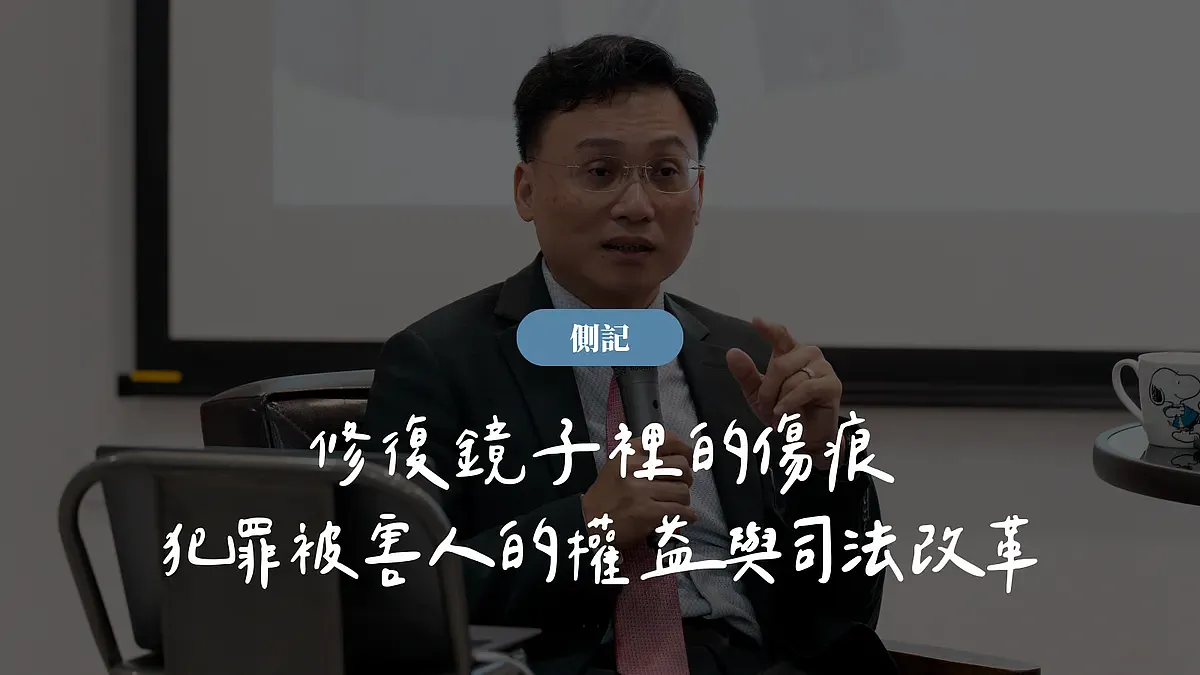
Sidelights | Part 1 | Repairing the Scars in the Mirror: Rights of Crime Victims and Judicial Reform
Last edited: 2026-08-22
When we talk about judicial reform, the focus of discussion is often concentrated on the protection of defendants' rights, procedural justice, and fair trials. But what about those who have suffered from crimes and whose lives have been torn apart? Do they also possess the possibility of being seen and responded to by the law?
In the mirror exhibition area of the "Becoming an Ordinary Person" exhibition, the Judicial Reform Foundation, the Civil Alliance for the Protection of Crime Victims’ Rights, and the Association for Victims Support joined hands to look back at the silent trauma within the mirror. This lecture was moderated by Attorney Chen Yi-cheng, and invited Deputy Executive Officer Hsiao Yi-ming to discuss the apathy, difficulties, and possible pathways of recovery experienced by crime victims in judicial proceedings, starting from institutional practice and reform experience.
When a Happy Life Becomes a Luxury: The Marginalization of Victims' Experiences
Attorney Chen Yi-cheng opened with the question "What is an ordinary life?"—being able to buy breakfast, send children to school, speak freely, and not be hijacked by fear and scrutiny. These seemingly ordinary behaviors are actually happiness that can only be realized under human rights protection. For crime victims, however, these "ordinary" aspects are often shattered in an instant.
He pointed out that past systems treated victims as incidental entities, with judicial proceedings treating trauma with coldness and standardization, which not only ignored the diverse forms of recovery but also deepened their isolated predicament. "We can guarantee that we will not become perpetrators, but we cannot guarantee that we will never be victims."
In recent years, the crime victim support system has attempted to transition from a charitable nature to "victim-centered" institutional protection, moving toward true restorative justice through legal recognition, differentiated treatment, and the strengthening of the right to make statements.
Institutional Reform Rooted in Pain: The New Appearance of Victim Protection
Hsiao Yi-ming, Deputy Executive Officer of the Association for Victims Support, started from his own experience: pain is not written on the face, but the heart has already been hurt. Moving from an individual to an advocate, and then to an executor of the system, he witnessed that victims not only need financial compensation, but also social support and respect.
He shared the highlights of the new legal amendments, including:
- Fixed-amount compensation system: Making the state compensation procedure no longer time-consuming and labor-intensive, and making the process of waiting for justice less protracted. For example, the Po Lin Tea House food poisoning case and the Shin Kong Mitsukoshi Zhonggang Store gas explosion all emphasize the state as the main subject of care responsibility, protecting both domestic and foreign victims.
- Catastrophic illness determination mechanism: Adopting objective standards such as catastrophic illness cards to judge, lowering the subjective threshold.
- Non-monetary compensation mechanisms: Such as companionship, psychological support, and protection orders. For example, in the Kai-kai case, social workers accompanied the grandmother to court every time it convened to ensure her right to participation and emotional support.
Victims' Right to Statement and Participation: Moving from the Margins to the Center
Following the implementation of the Citizen Judges Act, the participating role of victims in proceedings has become increasingly active. Through the "Litigation Participation Agent" system, victims are no longer mere bystanders, but can directly speak out and state their positions. For example, in the "Creative Private House" case, substantial isolation of the perpetrator was achieved through protection orders. Hsiao I-min also mentioned the "New Taipei Junior High School Throat-slashing Case," which sparked social reflection on the insufficient protection of victims in juvenile cases and led to Judicial Yuan Interpretation No. 805, affirming the right of victims to appear in court and make statements. However, even with theoretical protections in place, victims in practice often waive their expressions due to fear of retaliation or unfamiliarity with the law. "What we must do is make the right to statement not just a right on paper, but concrete and feasible."
Indirect Victims and Eyewitnesses Left Behind
This session also specially addressed the protection issues of eyewitnesses and atypical victims. In the New Taipei case, teachers and classmates also experienced trauma, yet lacked institutional comfort and resource connections. While community memorial services are held after school shootings in the United States, Taiwan still lags behind in this regard. Although Article 24 of the newly amended Crime Victim Rights Protection Act has incorporated "eyewitness services," its application in cases remains rare, and the system's initiation is not yet widespread. This reminds us: the scope of trauma is not bounded by legal definitions, and the system should also possess the ability to perceive delicate situations.
Fraud, Human Trafficking, and the Vulnerable: Redefining the "Ideal Victim"
For groups that are "not ideal victims in the social consensus," such as young people lured to work overseas in the Cambodia scam cases, the system often harbors discrimination or indifference. However, Hsiao Yi-ming pointed out that the standard of protection should be established on whether a person has suffered infringement, rather than whether they meet social expectations. Furthermore, regarding the dilemma of seeking compensation in fraud cases, although there is currently the 165 hotline and legal assistance, fundamental treatment remains lacking. Hsiao mentioned that the Japanese system allocates intercepted fraud funds into a fund for compensation, providing a reference direction for Taiwan.
Conclusion: Letting the System Catch Real Pain
This lecture reminds us: judicial reform is not only for procedural justice, but also for those who lose their voice in the system—so that victims are no longer forced to suffer in silence, but are fully seen, understood, protected, and respected. As the speaker said: "Helping victims is realizing justice."
This article is an AI-generated translation of the original Chinese text. In the event of any discrepancy, the Chinese version shall prevail.