

Sidelights | Confess on Others to Reduce Your Sentence? Hsiao Ming-yueh's Transformation from Real Estate Agent to International Drug Ring Kingpin Overnight, and the Narcotics Hazard Prevention Act
Last edited: 2026-08-22
A Case Full of Doubts
Sung Yun-hua was a member of an international drug trafficking ring who was arrested by police while picking up a package. Upon discovering that the package contained category-one heroin, the police pursued the leads and successively arrested Liang Chia-lin, Sung Yun-hsin, Lu Chang-chun, and Kuo Che-wei. Hsiao Ming-yueh was implicated by Liang Chia-lin, Sung Yun-hsin, and Lu Chang-chün during prosecutor interrogations only when the first-instance trial of the other defendants was nearing its close and after the first-instance judgment had been rendered.
Hsiao Ming-yueh was accused of being the boss of an international drug trafficking ring, having instructed ring member Sung Yun-hsin to fly to Cambodia to negotiate a heroin transaction with "Brother Ku," and then mailing the heroin to Taiwan concealed within books for convenience store pickup. Taiwan-based ring members Sung Yun-hua and Lu Chang-chun picked up the packages at convenience stores and subsequently pressed and packaged the heroin. Meanwhile, Liang Chia-lin claimed that he was entrusted by Hsiao Ming-yueh to manage the work allocation of the entire group.
However, there is no direct evidence in this case implicating Hsiao Ming-yueh in the crime; the judge relied solely on the testimonies of other co-defendants. Only after the first-instance judgment did Lu Chang-chun claim that he had dialed Hsiao Ming-yueh's mobile phone. According to the Investigation Bureau, communication records for that time period showed that a call was indeed placed to Hsiao Ming-yueh's phone. Not only was relevant evidentiary material absent from the case file, but Sung Yun-hsin also clarified that she was the one who made the phone call, and Lu Chang-chun, who was sitting next to her at the time, mistakenly remembered it as his own call.
In fact, the key pieces of physical evidence in this case are unrelated to Hsiao Ming-yueh—
not only did Lu Chang-chun incorrectly identify Hsiao Ming-yueh's residence during police questioning, but the communication records also failed to match. Furthermore, on June 8, 2011, when interrogating Kuo Che-wei, the prosecutor even exerted pressure, using verbal inducements and threats such as "confession can lead to sentence reduction" and "failure to confess will increase the sentence," to induce Kuo Che-wei to implicate Hsiao Ming-yueh.
Although the accomplices who implicated Hsiao Ming-yueh—including Sung Yun-hua, Sung Yun-hsin, and Kuo Che-wei—subsequently retracted their testimonies before the court on August 23, 2011, August 30, 2012, and September 17, 2012, respectively, explicitly stating that they followed Liang Chia-lin's instructions and bit Hsiao Ming-yueh merely to strive for sentence reductions, and that Hsiao Ming-yueh did not participate in this case, Hsiao Ming-yueh was nonetheless sentenced to life imprisonment across successive instances.
This case is fraught with doubts, and the Taichung High Court's retrial investigation bench is currently deliberating whether to open a retrial.
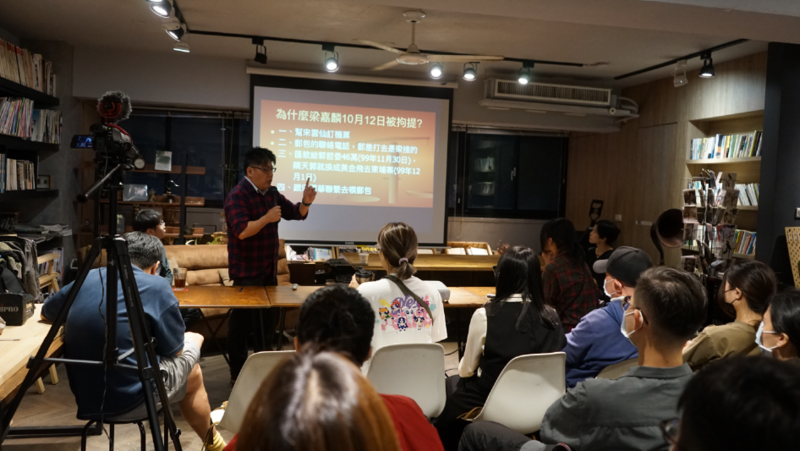
Photo / Attorney Chiu Hsien-chih shares the developments of the May 12 retrial investigation and explains the dubious injustices in the Hsiao Ming-yueh case.
Structural Issues in the Provisions of the Narcotics Hazard Prevention Act
Article 4 of Taiwan's Narcotics Hazard Prevention Act sets the severity of penalties based on the type of narcotics in its statutory design. However, distinguishing penalties solely by the type of narcotics is not necessarily appropriate. For example, those who manufacture, transport, or sell category-one narcotics face the death penalty or life imprisonment regardless of the severity of the involvement or the weight of the narcotics, creating severe problems of disproportionate culpability in many cases.
Article 17 of the same Act also stipulates that those who confess to the source of narcotics and thereby lead to the apprehension of other principal offenders or accomplices shall have their sentences reduced or remitted. This provision often becomes an important tool for police and prosecutors in handling cases, inducing suspects to confess to upstream sources of narcotics, which admittedly enhances investigative efficiency to a certain extent. However, the so-called sentence reduction has a massive impact in actual operation. Particularly concerning parole conditions, a life sentence requires serving 25 years before parole can be applied for, whereas a reduced life sentence becomes a fixed-term imprisonment of no more than 20 years and no less than 15 years, requiring only half of the sentence (7.5 years) to be served before applying for parole. This statutory design for sentence reduction creates a problem: defendants have a strong motivation and incentive to utilize this provision to frame innocent people in exchange for a reduced sentence. Moreover, because the statutory penalty design itself is excessively heavy and rigid, it further exacerbates the severity of this problem.
Regarding the direction of legislative amendments in our country, reference can be made to the approaches adopted by other countries in drug trafficking cases. For instance, the United Kingdom first categorizes cases into levels A, B, and C based on the degree of participation, and then simultaneously considers the type and quantity of the narcotics, multiplying the two to derive the degree of harm, which in turn generates 36 different sentencing levels ranging from fines to life imprisonment. In addition, while assistance to prosecutorial investigations can serve as a basis for sentence reduction, it should not be viewed through the concept of "collecting good-behavior stickers"; rather, it must depend on whether the contribution is of substantive importance and helpfulness to the investigation. The timing of pleading guilty or confessing to upstream sources should affect the extent of sentence reduction. The earlier one pleads guilty or confesses to upstream sources, the greater the assistance to the investigation, and the greater the extent of sentence reduction should be; conversely, if one waits until the truth is nearly brought to light before pleading guilty or confessing, the same extent of sentence reduction should not be granted, or sentence reduction should even be denied entirely.

Photo / Attorney Tsai Yi-cheng explains the legislative intent of Article 17, Paragraph 1 of the Narcotics Hazard Prevention Act, and why this provision became the crux of a wrongful conviction in the Hsiao Ming-yueh case.
Re-examining the Retrial System
According to Article 426 of Taiwan's Code of Criminal Procedure, applications for retrial fall under the jurisdiction of the original trial court that rendered the judgment. However, applying for a retrial with the exact same court makes judges prone to immense peer pressure when opening retrials, which may not be a suitable institutional design. Foreign practices could be referenced, where other courts of the same rank or an independent commission (such as the CCRC) accept and adjudicate retrial applications. The Ministry of Justice's establishment of the "Review Committee for Cases with Final Judgments of Guilt," composed of members from diverse backgrounds including attorneys and retired judicial officials, may serve as a referenceable direction for legal reform.
Discussion on Improper Interrogation
In this case, the prosecutor had a reasonable need to pursue upstream sources during the investigation, which in itself is beyond reproach. However, the strong incentive for sentence reduction is sufficient in its own right to become a motivational source for "seeking fortune and avoiding misfortune"; prosecutors continually reminding other defendants that "everyone else has confessed, and you must say the same to get your sentence reduced" had truly bordered on improper interrogation. Although in our country's legal practice, "informing someone of their legal rights" does not constitute coercion or inducement, it is no easy feat for judges to exclude such testimonies. Nevertheless, the definition of improper interrogation must ultimately return to Article 98 of the Code of Criminal Procedure: "Interrogation of a defendant shall be conducted with an earnest attitude and shall not resort to violence, threats, inducement, fraud, fatiguing interrogation, or other improper methods." This must be re-examined, especially in types of cases that heavily rely on accomplice testimonial evidence, where determinations must be made with utmost caution.
 Photo / Journalist Wang Li-jou, acting as the moderator, hosts the dialogue between the two attorneys and raises questions concerning the provision in Article 156 of the Code of Criminal Procedure that "the confession of an accomplice may not serve as the sole evidence."
This article is an AI-generated translation of the original Chinese text. In the event of any discrepancy, the Chinese version shall prevail.