
The 66th Anniversary of the 2025 Tibetan Uprising: Representation on the Island
Last edited: 2026-08-22
That day at Liberty Square, I heard the Tibetan language for the first time.
Its phonetics were extremely light, appearing as though they would easily scatter in the wind, yet the tone was steadfast, making one believe it could resolutely drift far away.
On March 10, the Association of Tibetans in Taiwan and the International Tibet Youth Congress - Taiwan Chapter held a candlelight vigil at Liberty Square, Chiang Kai-shek Memorial Hall, marking the 66th anniversary of the March 10 Tibetan Uprising. The annual theme was set as: "Tibet Has Never Been Part of China Since Ancient Times: False Peace Agreement, Real Invasion and Occupation." Following the grand parade the previous day, the vigil featured solidarity short speeches by various figures, the chanting of names of self-immolated Tibetans, a silent walk of three laps around Liberty Square, and incense-burning (sang) rituals. It was a protest conducted by Tibetans in the most dignified, solemn, and resolute manner.
When searching for "March" in an English dictionary, the primary occurrences are "demonstration and protest," followed by "march" (as in walking), and finally the month of March itself. March in the Western world seems to belong to protest; whereas in Taiwan, we also always choose to bloom vigorously in the warm and blossoming month of March, whether it was the Wild Lily student movement or later the Sunflower Student Movement.
For Tibetans, however, March is also a time of striving, yet one of profound sorrow.
In 1950, after negotiations between the Chinese People's Liberation Army and the Tibetan Kashag government broke down, the PLA launched a massive military invasion and occupied Tibet. The following year, a five-member Tibetan delegation headed by Ngabo Ngawang Jigme signed the Seventeen-Point Agreement with the Chinese Communist Party. The terms included: "The central authorities will not alter the existing political system in Tibet. The central authorities will also not alter the established status, functions and powers of the Dalai Lama. Officials of various ranks shall hold office as usual"; and "The policy of local administration in Tibet shall be carried out in accordance with the actual situation in Tibet and in accordance with the willingness of the Tibetan people, by means of consultation to resolve them." However, in 1954, the Chinese government promulgated a Constitution that abolished Tibet's special autonomous status, formally incorporated it under the jurisdiction of the People's Republic of China, and began implementing policies such as people's communes and land reform in Tibetan regions, gradually accumulating a wave of backlash from the Tibetan people.
On March 10, 1959, the 14th Dalai Lama Tenzin Gyatso was invited by a senior PLA officer to attend a song and dance performance. Due to lighting and stage setup difficulties, the venue had to be changed from the Dalai Lama's summer palace, Norbulingka, to the Tibet Military District Auditorium, and the Dalai Lama was denied permission to bring his bodyguards. The suspicious atmosphere, reminiscent of the "Hong Men Banquet," provoked widespread outrage among the Tibetan people and caused rumors such as "the CCP is kidnapping the Dalai Lama" and "the Han people are preparing to take the Dalai Lama away" to spread across the world. This ultimately sparked a massive popular protest in Lhasa. Seven days later, the Liberation Army began heavy shelling of Norbulingka, where the Tibetans had gathered. The Dalai Lama fled into exile in India, and 80,000 Tibetans followed in his footsteps, remaining displaced to this day.
Ever since, March 10 has become Tibetan Uprising Day, with scattered Tibetans around the world holding commemorative events everywhere. In Taiwan in 2025, these black-and-white historical events were transformed at Liberty Square into slogans, speeches, and questions. Carrying ideals and concerns, the experiences of Tibetans were represented from diverse perspectives across the other side of the ocean.
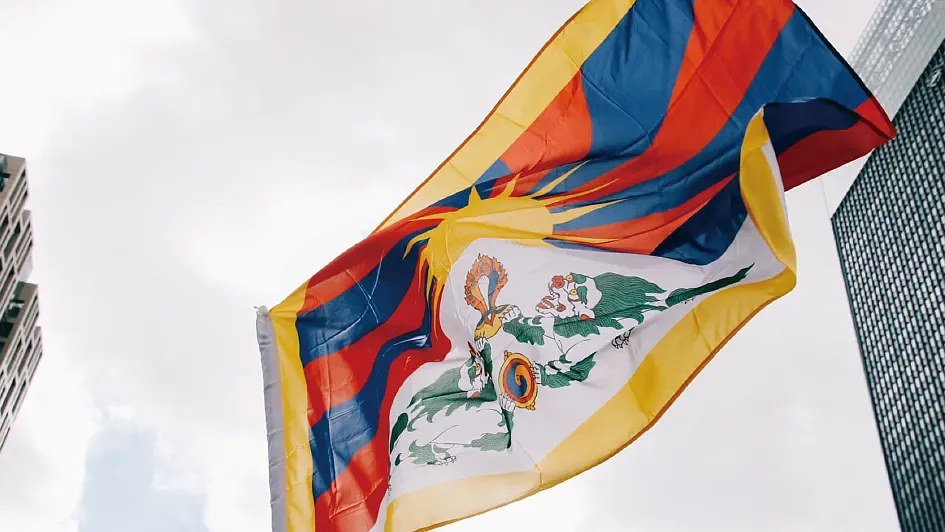
As an NGO intern without a fixed seat, I have the opportunity to sit at all sorts of desks, observing the personalities, preferences, and issues of concern of their owners. I remember sitting once at a desk covered with Tibetan dictionaries, history books related to Tibet, and a Snow Lion Flag hanging nearby. At the time, I wondered what on earth a Taiwanese person could see in the history of Tibet—was it vigilance, fear, or anger?
After all, as Taiwanese, it is indeed difficult for us to ignore the connection between the Tibetan issue and our own.
Ever since I was born, I have grown accustomed to the tension, anxiety, and restlessness surrounding political stalemates in my surroundings. When participating in related social movements in the past, I always expected to hear shouts and feel passion. As slogans broadcast through loudspeakers grew increasingly high-pitched, people's wildest vigilance and strongest resistance would be provoked.
Yet none of these things existed at the Tibetan vigil that day.
I remember during the opening remarks, Kelsang Gyaltsen, Chairperson of the Office of Tibet (Taiwan), read the Central Tibetan Administration's statement for March 10 Tibetan Uprising Day. The statement included twelve key elements, ranging from reviewing history, emphasizing the Dalai Lama's actions in India, and elucidating the ideal vision of Tibetans, to one specific point: "The Compassion and Peaceful Leadership of His Holiness the Dalai Lama."
"Under the visionary and steadfastly compassionate leadership of His Holiness the Dalai Lama, Tibetans harbor no hatred toward the CCP regime. The Dalai Lama advocates for promoting Tibetan autonomy through the 'Middle-Way Approach' and strives to resolve the Sino-Tibetan conflict through non-violent means. He emphasizes the importance of dialogue, mutual benefit, and long-term solutions. As the true masters of the Tibetan plateau, Tibetans possess irreplaceable religion and culture, as well as an unshakable national morale."
During the solidarity short speeches, I also heard two Taiwanese speakers independently mention the concept of "compassion." Rev. Huang Chun-sheng, Senior Pastor of the Jintan Presbyterian Church, stated: "True compassion is having the courage to face tyranny and totalitarianism." Lin Hsiu-hsing, Associate Professor in the Department of Humanities and Social Sciences at National Yang Ming Chiao Tung University, remarked: "Compassion is not weakness or ignorance of one's enemy, but a profound empathy." She also noted: "Taiwanese must learn to practice compassion in order to survive the historical examination questions posed to us; we should learn the wisdom of compassion from the Tibetan people."
At first, I deduced the meaning of these messages to be: "We should maintain compassion and empathy toward tyranny and totalitarianism." And I profoundly disagreed. I do not believe dialogue and communication are that magnificent, and I felt that compassion and empathy were overly grandiose, idealized terms. Amidst a complex situation, I simply could not achieve genuine absence of hatred and true compassion.
Yet after witnessing everything that followed, I realized I might have been mistaken.
That night, I felt a steady and powerful force. Accompanying the Tibetan monastic robes, the incense-burning stove, and the portraits of the Dalai Lama was a perceptible yet unspoken connection among the Tibetans—the peace and stability of loving and caring for one another, and the steadfastness of believing, even while chanting with eyes closed, that you are right by my side.
Perhaps the object of what Tibetans call compassion and empathy was never the regime, but rather themselves.
This article is an AI-generated translation of the original Chinese text. In the event of any discrepancy, the Chinese version shall prevail.