
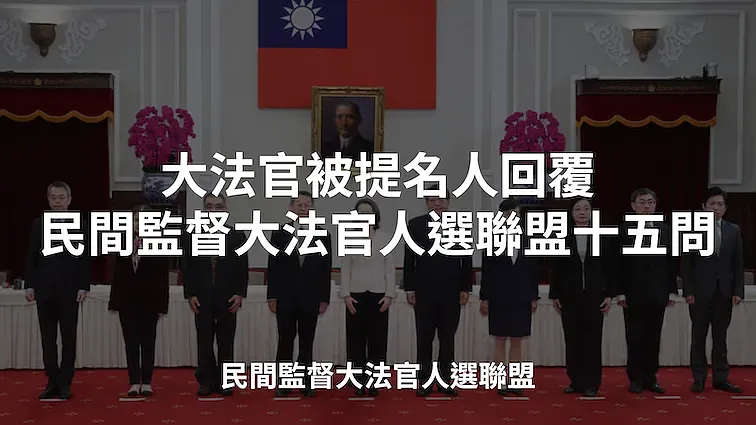
Grand Justice Nominees Respond to the Fifteen Questions from the Alliance for Citizen Monitoring of Grand Justice Nominees
Last edited: 2026-08-22
On March 21 of this year, President Lai Ching-te nominated Tsai Chiu-ming, Su Su-e, Hsiao Wen-sheng, Cheng Chun-hui, Lin Li-ying, Chen Tzu-yang, and Chan Chen-jung as Grand Justice nominees. Among them, Tsai Chiu-ming was also nominated as President of the Judicial Yuan, and Su Su-e as Vice President.
However, at a time when the Constitutional Court is already facing an operational crisis due to amendments to the Constitutional Court Procedure Act, the legislative majority led by the Kuomintang (KMT) and the Taiwan People's Party (TPP) has yet to actively review this crucial personnel appointment. This fact clearly demonstrates that the pan-blue alliance disregards the operational difficulties of constitutional organs and ignores the constitutional duty of institutional loyalty. To examine the suitability of the nominees and the process by which the Legislative Yuan exercises its consent power, 13 civil society organizations jointly formed the "Alliance for Citizen Monitoring of Judicial Yuan Grand Justices," calling upon the Legislative Yuan to conduct a rigorous review and posing questions to the nominees for the President and Vice President of the Judicial Yuan, as well as the Grand Justice nominees.
As of July 17, the Secretariat has received responses from all nominees. The content of each nominee's response is linked below for public review.
| Grand Justice Nominee | Response Status | Link |
|---|---|---|
| Tsai Chiu-ming (Also Nominated as President) | Responded | Web Reading | PDF Download|PDF 2 Download |
Su Su-e (Also Nominated as Vice President) |
Responded | Not yet updated | PDF Download|PDF 2 Download |
Lin Li-ying |
Responded | Not yet updated | PDF Download |
Chen Tzu-yang |
Responded | Not yet updated | PDF Download |
Chan Chen-jung |
Responded | Not yet updated | PDF Download |
Cheng Chun-hui |
Responded | Not yet updated | PDF Download |
Hsiao Wen-sheng |
Responded | Not yet updated | PDF Download |
I. Joint Questions for Grand Justice Nominees (15 Questions)
- March 28, 2025 - Fifteen Questions for Grand Justice Nominees by the Alliance for Citizen Monitoring of Judicial Yuan Grand Justices(Statement Link)
-
Focus on Human Rights and Constitutional Issues
- During your upcoming eight-year term, what do you consider to be the most indicative (or your most concerned) constitutional issue or fundamental human rights protection issue?
- What constitutional or human rights issues are there on which you hold a firm constitutional conviction, yet which diverge to a certain extent from current stable mainstream interpretations or legal order, or involve diverse and divergent opinions within society? How do you view the relationship between the judgments and adjudication activities of the Constitutional Court and social values? For you, what impact does practicing law in your current profession (including as a scholar, judge, prosecutor, etc.) versus serving as a Grand Justice have on your legal interpretations, and what additional contexts and factors must be considered (or does it have no impact)?
-
International Human Rights Covenants and Constitutional Review
- Paragraph 16 of the Concluding Observations of the 2022 International Review Committee on Human Rights Covenants states: "...In cases where existing or subsequently enacted laws and regulations conflict with the Two Covenants, the status of the Two Covenants must be further clarified. The Review Committee emphasizes that the Two Covenants, as the two most important human rights covenants of the United Nations, should be given priority." In your view, what is the hierarchy of international human rights covenants that have been domesticated within our legal system? If domestic law conflicts with international human rights covenants, what impact does this have on the constitutional review of such laws? What is the relationship between the list of rights in international human rights covenants and the categories and contents of fundamental rights in our nation?
- Article 10, Paragraph 7 of the Additional Articles of the Constitution stipulates that employment assistance, livelihood maintenance, and relief for persons with disabilities shall be guaranteed, and their self-reliance and development shall be fostered. Paragraph 3 of General Comment No. 6 on the Convention on the Rights of Persons with Disabilities, which has been domesticated, further points out: "...The denial of reasonable accommodation constitutes discrimination." In your view, does the content of this General Comment possess legal binding force? In constitutional review, what fundamental rights infringements do you believe are involved in laws or judgments that violate the "principle of reasonable accommodation"? What standard of review should be adopted?
-
Referendums and Constitutional Review
- Article 12 of the Additional Articles of the Constitution stipulates that amendments to our Constitution shall be subject to procedures of proposal by the Legislative Yuan and ratification by citizens. The 2022 constitutional amendment referendum on "Citizen Rights at Age 18" failed to pass as it did not reach the passage threshold. From the perspective of the current constitutional amendment procedures and the practice of the aforementioned referendum, do you consider the current constitutional amendment procedures and thresholds to be appropriate? How do you evaluate their impact on Taiwan's democratic operations? Does Article 12 of the Additional Articles of the Constitution raise any unconstitutionality concerns?
- Following the promulgation of Judicial Yuan Interpretation No. 748, certain groups opposed to same-sex marriage submitted a referendum proposal to the Central Election Commission (CEC) in January 2018 (concerning whether same-sex marriage should be defined and protected under the Civil Code), and a referendum was held on November 24 of the same year. Regarding the administrative disposition by the CEC announcing the establishment of the referendum proposal, certain persons identifying as Tongzhi (LGBTQ+), acting as interested parties and plaintiffs, filed a revocation lawsuit with the Taipei High Administrative Court prior to the vote and applied for a suspension of the execution of the referendum procedure. The case was finalized on May 29, 2020, when the Supreme Administrative Court dismissed the plaintiffs' appeal in Judgment No. 300 (2020), holding that the plaintiffs were not interested parties, lacked subjective public rights, lacked standing to sue, and that the protection-norm theory was not applicable. It additionally pointed out that even if a referendum proposal violated The Indigenous Peoples Basic Law, the CEC merely had the discretionary power not to approve its proposal establishment, and under the law, prosecutors possessed standing to sue, whereas indigenous peoples themselves did not. What is your view on the aforementioned perspective that even if an interested party's rights are directly infringed upon, they lack standing to sue? Regarding a referendum proposal with a high probability of unconstitutionality, how can and should the provisional disposition system prescribed in Article 43 of the Constitutional Court Procedure Act (CCPA) be utilized?
-
State Duty of Protection and Constitutional Review
- Currently, de facto spousal relationships between opposite-sex or same-sex cohabiting partners lack explicit legal protection. In your view, what fundamental rights are involved in the current status of our legal system failing to provide explicit protection for them? Is this unconstitutional?
- Laws related to social assistance prioritize the prevention of abuses and establish fictitious income and total household income calculation rules that do not reflect the economic reality of impoverished people, resulting in a severe underestimation of our country's impoverished population. Although exception clauses (Article 539) exist, many citizens still cannot apply for social assistance when facing livelihood difficulties. In your view, do the aforementioned problems concerning the social assistance system infringe upon people's right to survival and other fundamental rights? How should constitutional review be conducted?
- In legal issues involving climate and environmental change, infringements upon people's rights and interests often stem not from active state actions, but from state omissions or insufficient actions (such as carbon emission policies). In your view, does the state have a duty of protection toward vulnerable groups whose rights are about to occur or are being infringed upon under extreme climate scenarios? Do you consider such groups or interested parties to possess standing to sue, enabling them to demand that the state fulfill its duty of protection? If the system fails to provide appropriate remedies, does this infringe upon people's right to litigation?
-
Gender Identity and Protection of Fundamental Rights
- Judicial Yuan Interpretation No. 748 points out that differential treatment based on "sexual orientation" falls within the scope of the right to equality under Article 7 of the Constitution, and a stricter standard of review should apply. In your view, does our Constitution protect people's "gender identity"? What is the basis and extent of such protection? Regarding differential treatment based on "gender identity," what standard of review do you think should be adopted? Do you believe that the people's "right to sexual autonomy" protected by the Constitution includes the "right to gender self-determination"? What is your opinion on "legal gender recognition without surgery" (where applying for a change of gender registration does not require completing gender reassignment surgery)? If you support gender recognition without surgery, do you believe that changing gender registration still requires other conditions (such as a psychiatrist's diagnostic certificate), or do you support "free gender recognition"?
-
Land Expropriation and Protection of Fundamental Rights
- In recent years, land development for major national infrastructure projects has extensively adopted zone expropriation (e.g., the Taoyuan Aerotropolis, Taipei Shezidao development project, MRT development projects, and railways), causing infringements upon people's right to housing and property rights. In your view, is relying solely on "national economic development" sufficient to constitute the public interest objective for the state to initiate expropriation? Is the "zone expropriation" adopted in our legal system unconstitutional? When disputes involve the eviction of residents living on state-owned land, do you believe the state may purely stand in the position of a private individual to assert its ownership without needing to consider the infringement of public power on residents' fundamental rights such as the right to housing?
- In your opinion, how should the scope of land requiring free prior and informed consent by indigenous peoples or tribes, as stipulated in Article 21, Paragraph 1 of the The Indigenous Peoples Basic Law, be interpreted in accordance with Article 10, Paragraph 11 and the first half of Paragraph 12 of the Additional Articles of the Constitution, as well as our nation's successive interpretive intent and judgments concerning indigenous peoples' and indigenous rights? Is it unconstitutional to use the public or private nature of land as a distinguishing standard to exclude indigenous peoples or tribes from exercising their right to consultation and consent regarding the latter?
-
Protection of Prisoners' Human Rights
- What are your views on the current state where inmates in our country are unable to vote due to being factually incarcerated?
-
Judicial Review of National Security Issues and Construction of the Adjudication System
- Amid international wars and volatile geopolitical situations, there have recently been many discussions in our country regarding how the judicial system should respond and prepare during quasi-war/war situations. In the current political and social context, how would you define "(the risk of) endangering national security"? How should judicial review be conducted for various regulatory measures implemented on the grounds of "endangering national security"?
- The government recently announced that it will propose reform bills regarding the military trial system. Past precedents, including Interpretation No. 436, have all been important opportunities for transforming the military trial system. What are your views on the reform of the military trial system?
II. Joint Questions for Judicial Yuan President Nominee Prosecutor Tsai Chiu-ming and Vice President Nominee Judge Su Su-e (7 Questions)
- March 22, 2025 - JRF's Seven Questions for Judicial Yuan President and Vice President Nominees(Statement Link)
- In recent government public satisfaction surveys regarding administration, the item with the highest dissatisfaction is "judicial reform." What do you think are the reasons for the general public's low level of trust in the judiciary, and what concrete methods are there for improvement?
- There has always been a situation in the legal community where different organs and groups find it difficult to reach a consensus on specific controversial issues. How will you promote dialogue and communication among various organs and groups (e.g., the public, judges, civic groups, the Ministry of Justice)?
- Regarding the resources currently invested by the government in judicial adjudication, do you think they are sufficient? What are your views and concrete methods regarding the planning or increase of the judicial budget?
- When the current Judicial Yuan proposes reforms in the form of bills, it publishes drafts and legislative explanations, but does not simultaneously publish detailed policy impact assessments, making it difficult for various sectors of society to evaluate their impact. For example, in 2021, when the Judicial Yuan passed the draft regarding the "pyramid-shaped litigation system," it did not simultaneously detail how many people's rights might be affected by the restriction of the right of appeal, nor how relevant supporting measures would mitigate the impact. In your view, how should the Judicial Yuan communicate judicial policy reforms with the public? In the future, when proposing major amendments to bills, will you simultaneously submit "policy and human rights impact assessments"?
- Regarding the current problem of overwork in the judicial system, what do you think is the crux of the problem? Under the premise of maintaining the protection of people's rights, what approaches do you think should be adopted to reasonably alleviate the judicial burden? What concrete solutions do you have to rationalize case burdens while simultaneously fulfilling the goals of continuing education and training for judges? Furthermore, this Association's press release on December 23, 2024 affirmed a former nominee's proposal to use a "Judicial Reform Effectiveness Evaluation and Promotion Committee" to alleviate judge overwork, incorporating advocacy such as "policy and human rights impact assessments," "specialized committees," and "collaboration with frontline courts and grassroots judges." Do you commit to inheriting and implementing such policies?
- What are your views on the implementation of the "Citizen Judge System" up to the present? What are your thoughts on continuing to promote reforms to the criminal litigation system (such as the system of non-transfer of dossiers and evidence)?
- What are your views on the "reform of the military trial system"?
III. Questions for Nominee Tsai Chiu-ming (3 Questions)
- June 2, 2025 - Prosecutor Reform Experience, Legislative Amendment Stances, and Judicial Reform Vision: Three Major Issues Nominee Tsai Chiu-ming Must Clearly Address!(Statement Link)
- Learning from the past to shape the future, what are nominee Tsai Chiu-ming's participatory experiences and views regarding "prosecutorial reform"?
- How does nominee Tsai Chiu-ming view the differing opinions of the Judicial Yuan and the Ministry of Justice of the Executive Yuan regarding legislative amendments?
- Where should judicial reform head, according to nominee Tsai Chiu-ming?
This article is an AI-generated translation of the original Chinese text. In the event of any discrepancy, the Chinese version shall prevail.