
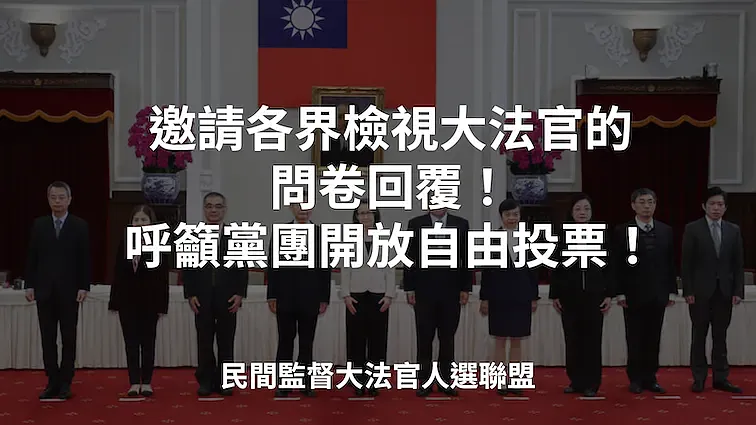
Statement by the Alliance for Citizen Monitoring of Grand Justice Nominees: Inviting All Sectors to Examine Nominees' Questionnaire Responses! Urging Party Caucuses to Allow Free Voting!
Last edited: 2026-08-22
On March 21 this year, the Office of the President announced the following seven Grand Justice nominees: Tsai Chiu-ming, Su Su-o, Chan Chen-jung, Lin Li-ying, Hsiao Wen-sheng, Chen Tzu-yang, and Cheng Chun-hui. Among them, Tsai Chiu-ming is also nominated as the President of the Judicial Yuan, and Su Su-o as the Vice President of the Judicial Yuan.
The nominees completed their interpellation procedures at the Legislative Yuan on July 9, 10, and 14, respectively. Meanwhile, all nominees also responded to this Alliance's questionnaire on the 16th, which this Alliance has made public. After careful review of the interpellation procedures and the nominees' questionnaire responses, this Alliance issues the following statement regarding the nominee for Judicial Yuan President:
1. Affirmation of all Grand Justice nominees for responding to this Alliance's questions
On March 22 this year, our Alliance member, the Judicial Reform Foundation, put forth "Seven Questions" for the nominees for the President and Vice President of the Judicial Yuan; regarding all Grand Justice nominees, this Alliance proposed "Fifteen Questions" on March 28; on June 2, the Judicial Reform Foundation further proposed "Three Major Issues That Must Be Clarified" to Presidential Nominee Tsai Chiu-ming.
Our Alliance has recently received responses from all nominees. To make the responses of all nominees known to the public, we are also publishing all questionnaires and their responses together. We hope that civil society organizations and the general public will discuss and examine the suitability of each nominee based on the content of the questionnaire responses. At the same time, we also call on the Kuomintang, Democratic Progressive Party, and Taiwan People's Party caucuses to promptly make public the nominees' responses to the party caucuses' questionnaires to facilitate examination.
This Alliance believes that only Grand Justices who are willing to engage in active dialogue with the public can understand the stances of different groups in society and confront the many contemporary, diverse, and novel legal issues. Therefore, this Alliance hereby affirms the attitude of all nominees in willing to respond to the aforementioned questions.
2. Tsai Chiu-ming's responses demonstrate sincerity in dialogue, but his understanding of Judicial Yuan operations still needs improvement
This Alliance has reviewed the responses of nominee Tsai Chiu-ming (honorifics omitted hereafter) to the questions raised by this Alliance, which contain many progressive arguments on specific issues.
For example:
- Regarding the "system of non-transfer of criminal case files and evidence," Tsai Chiu-ming demonstrated an open attitude toward institutional imagination; this advocacy is vastly different from the past attitudes of the Ministry of Justice and the prosecutorial system.
- When proposing major draft amendments to laws, Tsai Chiu-ming also promised that in the future, "policy and human rights impact assessments" will be conducted simultaneously on important issues.
- Regarding "reducing the judicial burden," Tsai Chiu-ming also believes that the reform of the appellate system must be achieved on the basis of a solid foundation of fact-finding.
On other questions, Tsai Chiu-ming also clearly and detailedly elaborated his opinions, which are well worth referencing; from their length and content, one can see the thoughtfulness put into the responses. Unfortunately, it can be found from Tsai Chiu-ming's self-description that his participation in prosecutorial reform was limited to attending relevant activities and meetings, or involved within the scope of his primary responsibilities; he seems to lack more proactive, active, and extra-institutional actions or investments.
During the review procedure on July 9, through the interpellation content, we saw that Tsai Chiu-ming's responses were less than ideal when committee members asked many questions about the current status of the judiciary. For example, regarding issues of performance evaluation under the Judges Act and the functions of the Judicial Yuan's Personnel Review Committee, background explanations still had to be provided by the inquiring legislators.
This Alliance believes that a candidate for the President of the Judicial Yuan does not necessarily need to know every single detail about the entire Judicial Yuan.
However, this Alliance believes that as a nominee for President, Tsai Chiu-ming's level of understanding regarding the relevant operations of the Judicial Yuan still needs to be strengthened.
3. Tsai Chiu-ming's responses to individual professional issues have both merits and flaws
Regarding the content of Tsai Chiu-ming's responses to individual issues, this Alliance believes that while human rights protection perspectives were overlooked on certain issues, his arguments on other issues have merits that should be affirmed.
Regarding the constitutional controversy over district land readjustment, Tsai Chiu-ming's response mainly opines that the district land readjustment system itself is not unconstitutional, but under actual operation, it may still lead to unconstitutional results in individual cases. However, what Tsai Chiu-ming overlooked is that our country's district land readjustment system has long led to extremely unreasonable results that are close to the expropriation for private interests. Permitting district land readjustment for non-public purposes allows land-demanding agencies to expand the acquisition of land beyond what is needed for public facilities and public interest undertakings, to be used as funds for raising development and construction expenses. This act itself lacks an "extremely important public interest purpose" and seriously violates the principle of proportionality. In addition, our country adopts the method of district land readjustment by way of substitute land, forcing a specific range of expropriated households to bear the cost of public construction that benefits an indefinite number of people, which has already violated the principle of fair burden.
Nevertheless, Tsai Chiu-ming's response still asserts that mere economic development cannot be used as a reason for district land readjustment, and that expanding the scope of expropriation will lead to expropriation behavior exceeding the scope necessary to achieve the public interest, which is also worthy of affirmation.
In response to Question 1 on "human rights issues of concern," Tsai Chiu-ming pointed out that the people's right to a healthy environment—namely the protection of the natural environment upon which humans and other living organisms depend for survival—is indeed closely related to human dignity. The destruction of Taiwan's ecology and the pollution of its terrestrial environment today, including air, land, surface water, and groundwater bodies, are especially severe in industrial areas and long-neglected remote townships, and should be given attention. In addition, Tsai Chiu-ming also positively affirmed that the state bears the obligation to protect vulnerable groups under climate change, that vulnerable groups have the litigation standing to petition the state to fulfill its protection obligations, and that if the people have no means of seeking relief under the current system, it constitutes a major infringement upon the right of access to court. In this regard, Tsai Chiu-ming's elaboration of his stance on the right to a environment and state responsibility for climate change can be described as complete, and this part should be affirmed.
As for the right to prior consultation and consent for indigenous peoples and tribes, Tsai Chiu-ming stated: "The Constitutional Court has repeatedly emphasized the autonomous rights of indigenous peoples in land, cultural, and social development, and considers that infringements upon their rights and interests should be subject to strict scrutiny."; "Indigenous peoples should have the right to participate in decision-making in policies involving their own land, and this right must be respected, regardless of whether the land is publicly or privately owned." He further pointed out: "The practice of excluding indigenous peoples or tribes from exercising the right to consultation and consent over private land may constitute an unconstitutional interpretation regarding the protection of indigenous rights under the Constitution, and may infringe upon the indigenous peoples' rights to self-governance, culture, and survival." This part should also be affirmed.
Regarding the protection of the rights of persons with disabilities, Tsai Chiu-ming's questionnaire response on the issue of "reasonable accommodation" for persons with disabilities not only tests an individual candidate's legal literacy, but also reflects the Grand Justice candidate's stance on human rights values. As one of the core concepts of the CRPD, reasonable accommodation aims to provide the concrete support and changes necessary for persons with disabilities to participate equally in society, work, education, and other fields, on the premise of not imposing a disproportionate burden on others. For a long time, the implementation of this concept in our country's judicial practice and policy formulation has still been insufficient, causing many persons with disabilities to remain in disadvantaged and excluded positions when facing public resources, legal procedures, or workplace environments. As guardians of the Constitution and protectors of human rights, if candidates can internalize the spirit of international human rights conventions into constitutional interpretation, it will not only respond to the long-standing expectations of vulnerable groups, but also propel a new milestone for human rights development in our country. This Alliance affirms Tsai Chiu-ming's response in this direction, and it also reminds us that the value of a Grand Justice is embodied not only in their understanding of the Constitution, but even more so in their care for human rights.
4. Whether Tsai Chiu-ming can uphold judicial independence remains a matter of widespread concern
During the Legislative Yuan interpellation process, Tsai Chiu-ming frankly mentioned that he self-recommended himself to the President after being consulted by Minister of Justice Cheng Cheng, Ming-Chien (who trained in the same cohort as Tsai Chiu-ming at the Judges and Prosecutors Training Institute). In response to concerns from all sectors regarding his background, Tsai Chiu-ming explicitly promised in the questionnaire that he would perform his duties neutrally and objectively, pointing out: "In practice, many prosecutors or lawyers who transition to judges are still able to competently practice independent adjudication and carry out the duty of pursuing justice, without being shaken in the spirit of judicial neutrality by role transitions."
Concerns from all sectors over whether Tsai Chiu-ming can remain free from the influence of the prosecutorial system and strictly uphold judicial independence can ultimately only be concretely evaluated after he assumes office as the President of the Judicial Yuan. In this regard, we sincerely call upon Tsai Chiu-ming, should he obtain the consent of the Legislative Yuan to serve as President of the Judicial Yuan, to strictly uphold loyalty to the Constitution and dispel the worries of all sectors through actions.
5. This Alliance calls on all party caucuses to allow legislators a free vote on this personnel consent case!
During the previous Grand Justice personnel consent case, party caucuses in the Legislative Yuan cast collective votes for individual candidates using a "bloc voting" approach, with all parties "voting solely based on political color and stance." The phenomenon of "party will superseding public interest" was jaw-dropping.
This Alliance has repeatedly called on all political parties to allow independent voting; regarding whether Grand Justice nominees are suitable or not, every legislator, entrusted by the citizens, should have their own independent criteria and values for judging suitability. Prioritizing party will and abandoning independent judgment naturally fails the mandate entrusted by voters.
In this regard, this Alliance earnestly calls upon: regarding the nomination and review of the Grand Justice personnel consent power, all party caucuses should allow legislators a free vote, and fully examine the nominees' moral integrity, constitutional and human rights philosophies, as well as scholarship and professionalism. We must not repeat past mistakes and allow the people's constitutional rights to continue being hijacked by party will.
Aside from Tsai Chiu-ming, this Alliance is also simultaneously releasing the questionnaire responses of the other 6 nominees—Su Su-o, Chan Chen-jung, Lin Li-ying, Hsiao Wen-sheng, Chen Tzu-yang, and Cheng Chun-hui—and cordially invites all sectors of society and civil organizations to jointly examine their responses and evaluate their suitability as Grand Justice nominees.
[Alliance for Citizen Monitoring of Grand Justice Nominees]
Human Rights Covenants Watch
Taiwan Disability Alliance
Citizen Congress Watch
Taipei Bar Association
Taiwan Association for Human Rights
Taiwan Labour Front
Taiwan Alliance to End the Death Penalty
Judicial Reform Foundation
Environmental Rights Foundation
Taiwan Forever Association
This article is an AI-generated translation of the original Chinese text. In the event of any discrepancy, the Chinese version shall prevail.