
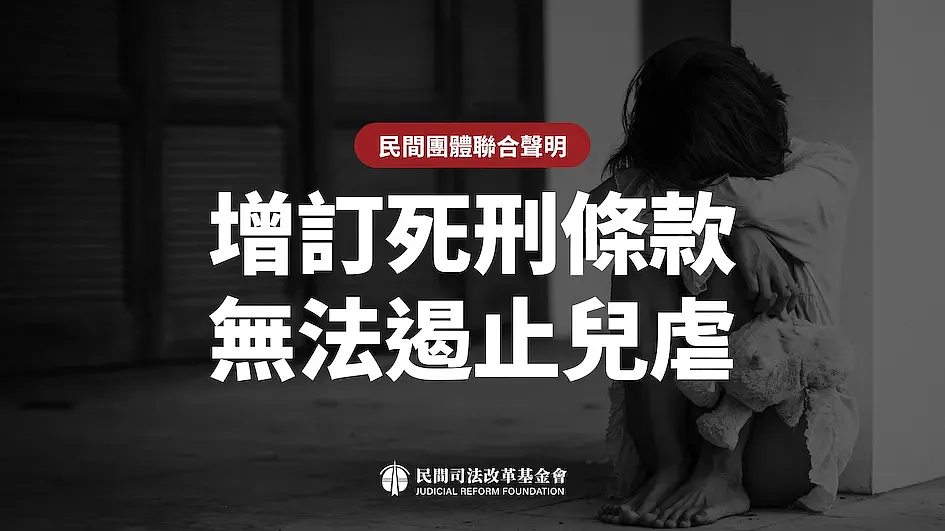
Joint Statement by Civil Society Organizations | Adding Death Penalty Provisions Fails to Deter Child Abuse
Last edited: 2026-08-22
Constitutional Court Judgment No. 8 of the 2023 (113) Judicial Yuan (hereinafter "113-Hsien-Pan-8") rendered a constitutionality interpretation on the death penalty, which, like opening Pandora's box, led the public to believe that since the death penalty is constitutional, excessive restrictions are unnecessary.
Following this came the relaxation of death penalty enforcement and the expansion of new provisions, including: the Ministry of Justice's worsening amendments to the Regulations for Executing the Death Penalty; and on July 18 of this year (2025), the Legislative Yuan's third reading and passage of the Criminal Code amendments regarding child abuse, which added death penalty provisions.
Regarding this legislative amendment, civil society organizations jointly issue the following statement:
Violating the ICCPR, Described as a Major Regression in the Abolition of the Death Penalty
Taiwan passed the Enforcement Act of The Two Covenants in 2009, requiring adherence to the text of the Two Covenants, and referencing the General Comments made by the Human Rights Committee as well as concluding observations proposed by international experts to review our nation's human rights standards.
Article 6 of the International Covenant on Civil and Political Rights (ICCPR) and paragraph 50 of General Comment No. 36 repeatedly emphasize that although Taiwan still retains the death penalty, it should not backslide. #This not only means that Taiwan cannot increase the execution of the death penalty, but it also should not expand the scope of application for the death penalty.
However, the Legislative Yuan's amendments this time openly violate the spirit of the ICCPR, not only causing Taiwan's policy on abolishing the death penalty to regress significantly, but also raising doubts about how the state will face the upcoming 4th international review of the Two Covenants in 2026.
Violating the Intent of Constitutional Court Judgment 113-Hsien-Pan-8, Legislators Abandon Their Own Professionalism and Dignity
Civil society organizations believe that "113-Hsien-Pan-8" contains numerous flaws and deficiencies, yet it still sets a minimum standard for the death penalty system. Among them, "113-Hsien-Pan-8" clearly states that although the death penalty remains constitutional in Taiwan, it should be strictly confined to categories of cases involving " #intentional homicide"; and even if the requirements of "intentional homicide" are met, it must still be examined whether the case constitutes a crime of the " #most serious nature", whether " #the strictest due process of law" was observed, and whether the individual case holds potential for reform and education, potential for reoffending, potential for resocialization, and so forth, before a decision on sentencing to death can finally be made.
However, the Legislative Yuan's recent additions and amendments to Articles 272-1 and 286 of the Criminal Code #allow for the possibility of a death sentence in cases of child abuse resulting in death that are non-intentional homicides and do not belong to the most serious crimes.
Such legislative amendments not only openly slap down the Constitutional Court's "113-Hsien-Pan-8" rendered just last year, but also ignore paragraph 35 of General Comment No. 36 of the ICCPR referenced by the Constitutional Court, which affirms that "the most serious crimes" should be strictly interpreted and limited only to extremely serious crimes involving intentional homicide. In other words, whether "negligent homicide" is recognized by the Grand Justices as the most serious crime category is open to debate; however, referring to the intent of paragraphs 35 and 50 of General Comment No. 36 of the ICCPR: #negligent homicide should be excluded from the category of the most serious crimes, #and therefore does not fall within the scope of application of the death penalty. This amendment to Article 286 of the Criminal Code not only carries suspected unconstitutionality, but also contravenes the intent of the ICCPR to protect the right to life. Such legislative quality can only be described as lawmakers showing contempt for the profession of legislative drafting and casting aside respect for the rule of law state, which is lamentable.
Draconian Laws and Harsh Punishments Risk Increasing the Dark Figure of Child Abuse
If we draw lessons from Japan and South Korea—whose culture, society, and public sentiment are similar to Taiwan's—we can also observe that when Japan and South Korea faced child abuse cases and chose the path of draconian laws and harsh punishments, the result was not the decrease in the number of child abuse cases or the effective intervention in child abuse cases hoped for by the general public. On the contrary, although child abuse-related legal provisions have been amended and made heavier multiple times, the number of child abuse cases each year continues to rise. There even arises a phenomenon where perpetrators, out of fear of government intervention, choose to keep children out of school and away from medical care, or avoid reporting systems, making it even harder for government or private units to discover and intervene in a timely manner.
Furthermore, #if heavy penalties are used to replace an understanding of the causes of child abuse and effective prior prevention, #it will be even more impossible to prevent child abuse cases from recurring in the future. Such a result surely cannot be what those of us concerned about child abuse issues wish to see; rather, how to establish a multi-layered, multi-perspective protection network so that children can grow up safely is what concerns us more.
Call to Action
Regarding the hastily passed child abuse amendments by the Legislative Yuan, civil society organizations call for:
(1) The Executive Yuan should request a reconsideration (veto) of the legal provisions that violate the ICCPR and "113-Hsien-Pan-8".
(2) Even if the child abuse amendments take effect, they still violate the ICCPR and the intent of "113-Hsien-Pan-8", raising concerns of unconstitutionality. In view of this, we call upon judges and prosecutors, based on their duty of loyalty to the Constitution, to refuse to apply provisions suspected of unconstitutionality or to petition for a constitutional interpretation.
Declaring Organizations
Taiwan Alliance to End the Death Penalty (TAEDP)
Taiwan Association for Human Rights (TAHR)
Human Rights Covenants Watch
Judicial Reform Foundation (JRF)
Amnesty International Taiwan
Human Rights Committee, Taipei Bar Association
This article is an AI-generated translation of the original Chinese text. In the event of any discrepancy, the Chinese version shall prevail.