
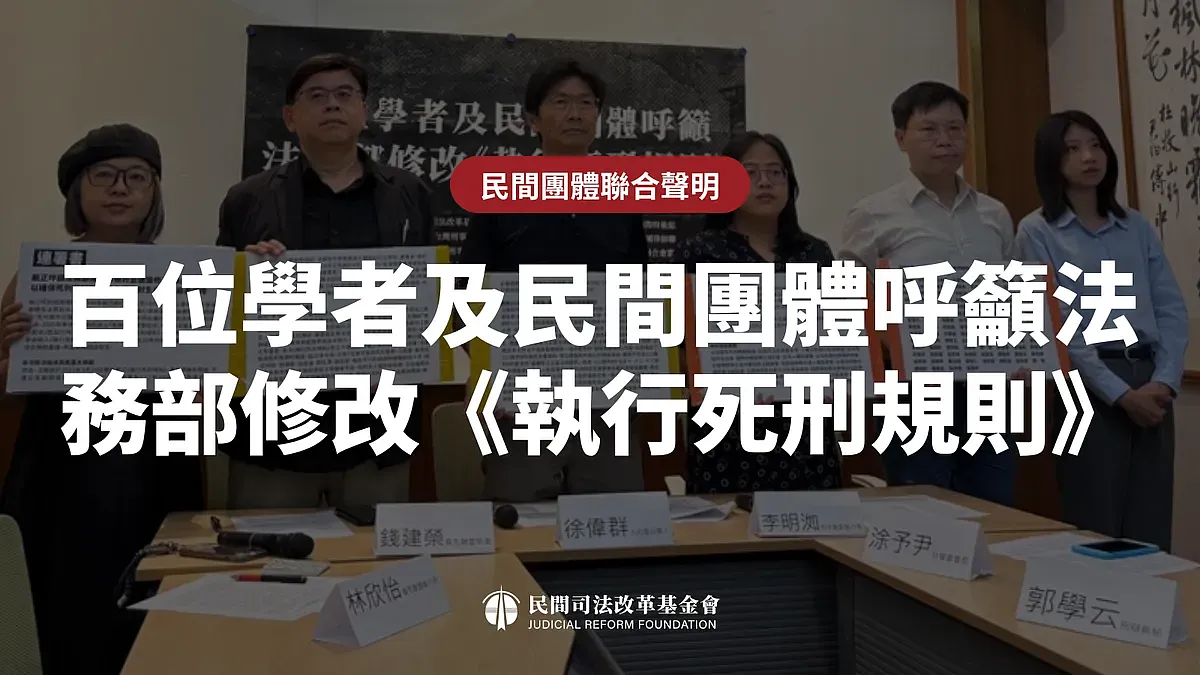
Joint Statement | Over 100 Scholars and Civil Society Organizations Call on the Ministry of Justice to Amend the Rules on the Regulations for Executing the Death Penalty
Last edited: 2026-08-22
109 scholars (with the list of signatories continuing to grow) from fields such as law, sociology, and crime prevention—including Huang Jung-Chien, Lee David C. , Mau-Sheng Lee, Hsu Wei-Chun, Hsieh Yu-wei, Wu Chih-kuang, Su Yen-tu, Chien Chien-jung, and Lo Ping-cheng—along with long-standing civil society organizations focused on the issue of capital punishment, such as the Taiwan Alliance to End the Death Penalty (TAEDP), the Taiwan Innocence Project, the Taiwan Criminal Defense Lawyers Association, the Judicial Reform Foundation, the Covenants Watch, and the Taiwan Association for Human Rights (TAHR), have jointly issued a signed statement.
Representatives of civil society organizations and scholars specifically held a press conference today. TAEDP Executive Director Lin Hsin-Yi, who moderated the event, stated that the joint statement had been submitted to the Ministry of Justice. The statement points out that the Regulations for Executing the Death Penalty, which were previewed by the Ministry of Justice on March 24, 2025, promulgated on April 16, and took effect on April 18, had a revision period of less than one month. Not only did this fail to respond to the due process and right to life protection requirements set forth in Constitutional Judgment No. 8 of 2024 by the Constitutional Court (hereinafter the 2024 Constitutional Judgment No. 8), but it also substantially renders the Regulations for Executing the Death Penalty more arbitrary, setting back nearly thirty years of efforts by all sectors in a single day. Therefore, everyone solemnly calls on the Ministry of Justice to: immediately conduct a comprehensive review and amend the Rules on the Regulations for Executing the Death Penalty in accordance with the intent of Constitutional Judgment No. 8; convene open and transparent consultative meetings to incorporate the opinions of experts, scholars, and civil society organizations; and, prior to any amendment, refrain from executing capital punishment pursuant to regulations that violate constitutional intent.
Hsu Wei-kuo, Convenor of Covenants Watch and one of the initiators of the petition, pointed out that in 2010, the Ministry of Justice issued a press release proclaiming its intention to "gradually abolish the death penalty," stating that "the abolition of the death penalty is a core area of human rights" and that "active measures should be taken" toward the gradual abolition of the death penalty "in order to conform with the international trend toward the abolition of capital punishment." However, in April of this year, the Ministry of Justice amended the Rules on the Regulations for Executing the Death Penalty to do the exact opposite: it lowered the existing barriers to the Regulations for Executing the Death Penalty and stripped those sentenced to death of their right to demand the fulfillment of the strictest procedures. Far from "actively and gradually abolishing the death penalty," this is instead an "active pursuit of the Regulations for Executing the Death Penalty" In the 2024 Constitutional Judgment No. 8, the Grand Justices spent ninety percent of their space trying every possible means to establish the strictest procedural conditions for the death penalty and its execution, in order to compensate for their inability to fully justify the constitutionality of capital punishment. Yet, the Ministry of Justice has used the name of the 2024 Constitutional Judgment No. 8 to significantly loosen the pass for executing the death penalty. The amendment decision made by the Ministry of Justice this time was not based on professional understanding, but on political demand. Furthermore, among these 36 petitioners of the 2024 Constitutional Judgment No. 8, wrongful convictions originally existed; this regulatory amendment clearly increases the likelihood of another "Chiang Kuo-ching case" recurring, a responsibility that this belief says no public official can afford to bear.
Chien Chien-jung, Executive Committee Member of the Taiwan Alliance to End the Death Penalty, bluntly stated that a sound democratic and rule-of-law state has no need for capital punishment whatsoever. The death penalty is a remnant tool used by authoritarian and feudal states to govern the people, and he believes that President Lai, who is most strongly opposed to authoritarianism, would not agree with this system. Regrettably, things have not been this way since President Lai took office. The Grand Justices lacked the courage to declare capital punishment unconstitutional, and the 2024 Constitutional Judgment No. 8 merely raised the threshold for sentencing and executing the death penalty through due process. There are currently as many as seven proven exonerated victims of wrongful death penalty cases. These wrongful cases occurred not only during the martial law era, but also under judicial procedures following the lifting of martial law, which shows that judicial procedures can never be perfect. Moreover, the so-called "execution in accordance with the law" is actually a specious argument. The separation of executive power and judicial power is meant to serve as a check and balance; the Rules on the Regulations for Executing the Death Penalty should inherently be an important regulation for the executive branch to restrain the judicial branch and protect the people's right to life. If the executive branch merely "recites" legislative restrictions without establishing stricter regulations from the perspective of respecting life and preventing miscarriages of justice, it is tantamount to abandoning the function assigned by the Constitution to protect the right to life. Past Rules on the Regulations for Executing the Death Penalty still conformed to constitutional requirements, but now, the more they are amended, the worse they become, turning instead into a manifestation of the infringement upon the right to life and the self-deprecation of executive power.
Li Ming-ju, Deputy Executive Director of the Judicial Reform Foundation, pointed out that 113 countries worldwide have completely abolished the death penalty, bringing the total to 145 countries that have abolished the death penalty in law or in practice. Countries such as China, North Korea, and Vietnam still widely use the death penalty; their leaders weaponize capital punishment, claiming it improves public safety, and even use it to instill fear among the public. At this moment, when facing the issue of capital punishment, the political will of the Democratic Progressive Party (DPP) government to rush trials and executions clearly runs counter to the majority of countries globally that support human rights, disregarding human rights values in exchange for political interests. She also questioned how the DPP government and the Ministry of Justice will face the international review of the Two Covenants next year, and how they can claim to be qualified as the competent authority for the Two Covenants affairs under the banner of "Taking Big Steps for Human Rights."
Tu Yu-yin, Chairperson of the Taiwan Association for Human Rights, believes that the Ministry of Justice has the obligation to amend the Rules on the Regulations for Executing the Death Penalty in accordance with the intent of the International Covenant on Civil and Political Rights (ICCPR, hereinafter the Covenant), and should re-examine and amend them pursuant to the Constitutional Court's judgment and the Administrative Procedure Act. In addition, the Rules on the Regulations for Executing the Death Penalty are a regulatory order enacted pursuant to the delegation of Paragraph 2, Article 145 of the Enforcement Rules of the Prison Act (or Prison Act), and the Ministry of Justice should amend them in accordance with Article 4 of the Enforcement Act of the Two Covenants and the ICCPR. However, the rules promulgated and amended by the Ministry of Justice this April narrow the scope of application for execution barriers, clearly weakening the relief rights of death row inmates, which runs counter to the intent of Paragraph 4, Article 6 of the ICCPR to guarantee complete relief rights for death row inmates. Although Constitutional Judgment No. 8 did not declare the death penalty unconstitutional, it determined that the Regulations for Executing the Death Penalty constitutes a deprivation of the right to life, and once a wrongful execution occurs it is irreversible; therefore, its constitutionality should be judged through strict review standards, and it emphasized that capital cases must adhere to the strictest due process of law. Consequently, regarding the Rules on the Regulations for Executing the Death Penalty that govern executions, the provisions on execution barriers should not be arbitrarily narrowed, and their formulation or amendment procedures must also conform to due process of law. Finally, considering the serious and ultimate impact of capital execution on the rights of the sentenced person, the Ministry of Justice should hold a public hearing pursuant to Subparagraph 2, Article 107 of the Administrative Procedure Act when amending the Rules on the Regulations for Executing the Death Penalty, so as to ensure that the amendment process is subject to public scrutiny and deliberation.
This article is an AI-generated translation of the original Chinese text. In the event of any discrepancy, the Chinese version shall prevail.