
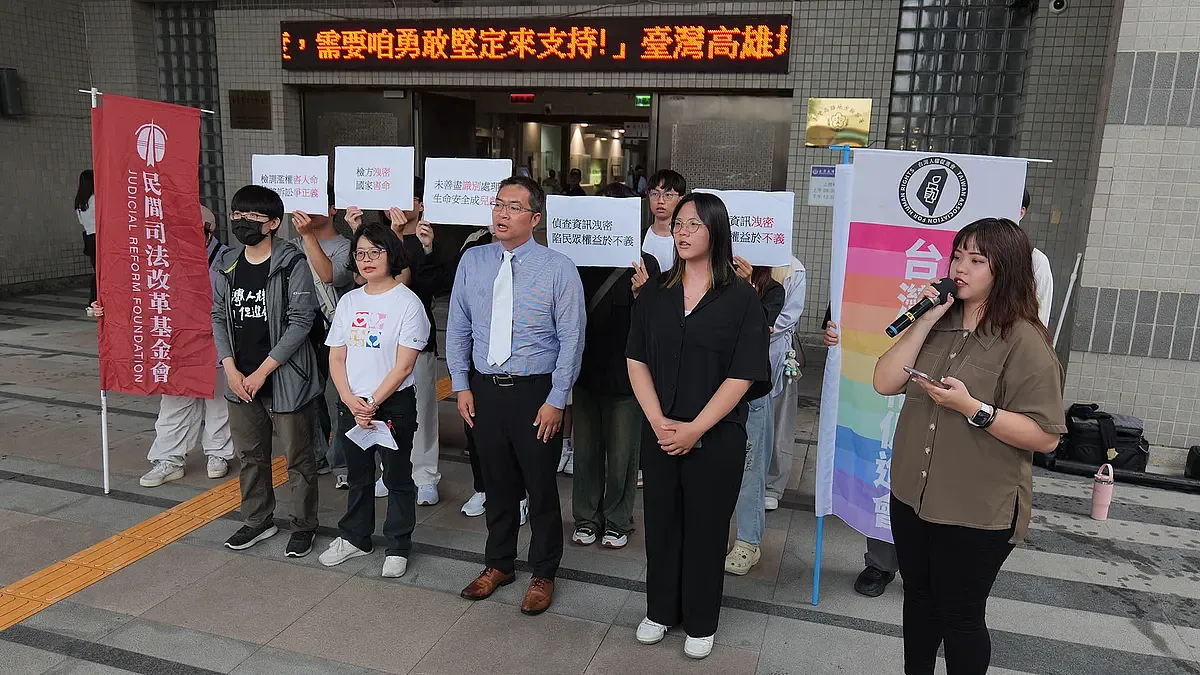
Joint Statement | Prosecutors' Leak an Accomplice to Abuse? Cambodian Scam Victim Plunges into Despair Again: Civil Society Groups on the First-Instance Judgment of the "Transnational Job-Seeking Scam State Compensation Case"
Last edited: 2026-08-22
On August 9, 2022, the Kaohsiung District Prosecutors Office cracked down on a transnational job-seeking scam and independently issued a press release entitled "Taiwanese Citizens Tricked into High-Paying Jobs in Dubai, Stripped of Freedom of Movement: Investigation Agencies Crack Down on Dubai Telecom Fraud and Human Trafficking Case, Two Taiwanese Masterminds Detained and Denied Visitation upon Request." The Kaohsiung District Prosecutors Office also provided related video footage to news media. However, the video provided by the Kaohsiung District Prosecutors Office was not footage of job-seekers in Dubai being beaten with electric shocks, but rather footage of the plaintiff in this case, Hsiao-P, being tortured by another scam syndicate in Cambodia.
After being rescued and brought back to Taiwan by civil society groups, Hsiao-P accused the Kaohsiung District Prosecutors Office that because the office failed to properly de-identify the footage, Hsiao-P's identity could be pinpointed from the exposed video, causing the scam syndicate to subject Hsiao-P to even more severe imprisonment and abuse. Hsiao-P even contracted Complex Post-Traumatic Stress Disorder (CPTSD) after returning to Taiwan. In response, the Kaohsiung District Prosecutors Office claimed that it could not be proven that the victim suffered more severe abuse because of the video, arguing that even if the Kaohsiung District Prosecutors Office failed to fulfill its duty of verification and mistakenly released the video, the suffering endured by Hsiao-P had no causal relationship with the Kaohsiung District Prosecutors Office, and therefore it bore no liability toward Hsiao-P.
Civil society groups argued that the Kaohsiung District Prosecutors Office not only violated the principle of non-disclosure of investigations, but also jeopardized Hsiao-P's personal safety, and thus filed a state compensation lawsuit against the Kaohsiung District Prosecutors Office. Subsequently, following trial proceedings across three court sessions, the Kaohsiung District Court Summary Court ruled against Hsiao-P today (July 28) (Judgment reference: 2024 Su-Kuo-Chien-Tzu No. 9 Judgment by the Kaohsiung District Court). In light of this, four organizations—the Judicial Reform Foundation, the Awakening Foundation (note: referring to Women's Rescue Foundation), the Taiwan Association for Human Rights, and the Covenants Watch—issued a joint statement regarding the first-instance judgment of the "Transnational Job-Seeking Scam State Compensation Case":
1. The Control Yuan's investigation report indicates that the Taiwan High Prosecutors Office (note: Kaohsiung Branch Prosecutor's Office) has violated the principle of non-disclosure of investigations, and the Kaohsiung District Prosecutors Office should bear compensation liability
2. The strict determination of causal relationship will lead to dead ends in seeking state compensation
1. The Control Yuan's Investigation Report Indicates that the Kaohsiung District Prosecutors Office Has Violated the Principle of Non-Disclosure of Investigations, and the Kaohsiung District Prosecutors Office Should Bear Compensation Liability
First, the Control Yuan's August 25, 2023 investigation report concluded that the Kaohsiung District Prosecutors Office violated the principle of non-disclosure of investigations. It pointed out that because the Kaohsiung District Prosecutors Office relied solely on the statements of the Investigation Bureau's Kaohsiung City Investigation Station without actively verifying the authenticity of the video or implementing de-identification procedures, it violated Paragraph 1 of Article 245 of the Code of Criminal Procedure and Article 2 of the Directions on the Non-Disclosure of Criminal Investigations. In addition, the Control Yuan's investigation report also pointed out that the press release issued by the Kaohsiung District Prosecutors Office not only mistakenly located the video's venue, but also ignored the fact that the victim in the video, Hsiao-P, was still detained and controlled by the scam syndicate in Cambodia, leading to Hsiao-P suffering aggravated imprisonment and abuse by the Chinese scam syndicate leader after the news was released.
It was not until September 25, 2022, that civil society groups successfully rescued Hsiao-P and brought them back to Taiwan. After police identification, Hsiao-P was recognized as a human trafficking victim, and a physician also diagnosed Hsiao-P with severe Post-Traumatic Stress Disorder (PTSD). To this day, Hsiao-P remains unable to maintain stable employment. The Control Yuan condemned the Kaohsiung District Prosecutors Office in its investigation report for failing to actively provide the victim with relevant counseling assistance and compensation measures, and for failing to hold the negligent personnel accountable, concluding that the Kaohsiung District Prosecutors Office was at fault.
Civil society groups believe that when investigating cases, prosecutorial authorities must strictly comply with the provisions of the Directions on the Non-Disclosure of Criminal Investigations. Cases categorized as strictly prohibited from disclosure must be rigorously reviewed and cannot be disclosed under any circumstances. However, regarding the situation where Hsiao-P was still being held hostage and had not yet escaped to safety, posing severe safety concerns, the Kaohsiung District Prosecutors Office absolutely should not have disclosed it. Yet, due to a failure to review, it disclosed the information, severely violating the provisions of the Directions on the Non-Disclosure of Criminal Investigations. Furthermore, although the Kaohsiung District Prosecutors Office applied mosaic blurring to the released video footage, the audio in the video was not altered, nor were other rooms in the video blurred (room furnishings, the abuser's voice), thereby enabling the identification of the victim Hsiao-P, leading to further abuse and causing secondary victimization.
Based on this, we believe that from the victim's statements and the Control Yuan's investigation report, it is evident that the Kaohsiung District Prosecutors Office clearly violated the non-disclosure of investigations. One of the core purposes of the non-disclosure of investigations system is to protect the constitutional rights and interests of involved parties; that is, if the identity of a key witness or victim is exposed, it is highly likely to pose a threat to their personal safety. This is precisely why the Directions on the Non-Disclosure of Criminal Investigations explicitly stipulate that cases where a victim is still being held hostage and has not yet escaped to safety with severe safety concerns are categorically prohibited from disclosure.
Therefore, given that the Kaohsiung District Prosecutors Office violated the principle of non-disclosure of investigations, resulting in infringement upon Hsiao-P's personal safety, the office should bear corresponding liability for this negligent act.
2. The Strict Determination of Causal Relationship Will Lead to Dead Ends in Seeking State Compensation
The trial process of this case disproportionately focused on the "causal relationship for the establishment of the victim's damages." The court failed to fully consider the Kaohsiung District Prosecutors Office's violation of the non-disclosure of investigations, nor did it take into account the geographical limitations of the transnational job-seeking scam case or the physical and mental trauma suffered by the victim at the time. In reality, it was impossible to gather relevant evidence at the location of the abuse, and most of the evidence of the abuse was concentrated in the hands of the scam syndicate, while investigation and law enforcement agencies failed to arrest the main members of the syndicate, resulting in difficulties in shouldering the burden of proof. Therefore, regarding the determination of causal relationship, civil society groups argue that the burden of proof should be shifted based on the equity principle of "manifest unfairness" under Article 277 of the Code of Civil Procedure. In other words, the court should weigh the specific circumstances of the case and require the Kaohsiung District Prosecutors Office to bear the burden of proof regarding whether the causal relationship for the establishment of damages is lacking.
Civil society groups also argue that under current academic interpretations of the State Compensation Act, the burden of proof for a civil servant's breach of official duties can generally be fulfilled through the victim's inference of the civil servant's attributable breach of duties. For instance, the illegal act of the Kaohsiung District Prosecutors Office in violating the non-disclosure of investigations empirically constitutes a breach of the mandatory duty of care. Therefore, when a civil servant breaches their official duties and subsequently causes damage to a victim, it can typically be presumed that a causal relationship exists between the breach of official duties and the resultant damage, unless the defendant further puts forward a "defense of lawful alternative conduct" to overturn the causal relationship for the establishment of damages.
However, civil society groups observed during the trial proceedings in the Kaohsiung District Court Summary Court that the judge not only ignored the plaintiff Hsiao-P's applications for evidence investigation, but also frequently interrogated the appointed lawyer for the case, asking questions such as: "How can the plaintiff prove that they were abused at the time?", "Please have the plaintiff prove which news report the people in Cambodia saw before committing the violence?", and "How can the plaintiff prove that they were beaten more severely because of the relevant news?" In other words, the court failed to consider the geographical and spatial limitations of this case, remained blind to the reality that the fraud call-center personnel have not yet been brought to justice, demanded that Hsiao-P—whose life was in constant danger—conduct exhaustive evidence collection against the scam syndicate, and summarily dismissed the party's applications for favorable evidence investigation. Furthermore, it failed to shift the burden of proof between the plaintiff and the defendant in accordance with the legal principle of manifest unfairness, instead forcing the party to bear the procedural disadvantage, resulting in an overly strict determination of state compensation liability and plunging the victims into a dead end where help is unavailable.
In summary, we call upon the judicial system to view the particularities of victims' cases more fairly, to establish a reasonable arrangement to a certain degree for the proof of causal relationship and the allocation of the burden of proof, and to weigh the fact that the Kaohsiung District Prosecutors Office failed to review the case in accordance with the Directions on the Non-Disclosure of Criminal Investigations, severely violating non-disclosure rules and causing infringements upon major legal interests such as the victim's life, body, or health. Regarding the outcome of the first-instance judgment, civil society groups will continue to assist the client in filing an appeal to strive for a favorable judgment. At the same time, we also urge all sectors to continue paying attention to this case and demand that the Kaohsiung District Prosecutors Office bear corresponding liability for this negligent act.

Press Conference Time
Monday, July 28, 2025, 09:40
Press Conference Location
Kaohsiung District Court (No. 188, Hedong Rd., Ch'ien-chin Dist., Kaohsiung City)
Attendees
- Hong-Cheng Shih | Standing Executive Member, Judicial Reform Foundation
- Ying-Chiu Tu | Executive Director, Women's Rescue Foundation
- Tzu-Ting Yang | Director, Southern Office, Taiwan Association for Human Rights
- Wei-Chun Hsu | Chairperson, Covenants Watch
Co-issuing Groups
Judicial Reform Foundation
Women's Rescue Foundation
Covenants Watch
Taiwan Association for Human Rights
Press Contacts
Cheng-Ching Lin, Assistant Research Fellow, Legal Policy Department, Judicial Reform Foundation (JRF)
Telephone: 02-2523-1178 #14
Email: kacan@jrf.org.tw
Kuan-Chen Chen, Legal Affairs Specialist, Case Action Department, Judicial Reform Foundation (JRF) Foundation
Telephone: 02-2523-1178 #21
Email: olivia@jrf.org.tw
This article is an AI-generated translation of the original Chinese text. In the event of any discrepancy, the Chinese version shall prevail.