
Op-Ed | A Global "Rule of Law Recession"? Attending the 2025 World Justice Forum and Confronting Taiwan's Crisis Alarm
Last edited: 2026-08-22
In 2018, the administration of Philippine President Rodrigo Duterte cracked down on the independent media outlet Rappler by revoking its corporate registration and filing tax and libel lawsuits; in May 2022, the President of Kiribati unilaterally suspended multiple High Court judges; and in July 2023, the Central African Republic passed a referendum abolishing presidential term limits. This simultaneous global phenomenon of declining democratic fluidity and the weakening of mechanisms to check government power is known as the "Rule of Law Recession."
Against this backdrop, the World Justice Forum 2025 was held in Warsaw, Poland. Co-hosted by the non-governmental organization World Justice Project (WJP) and the Polish Ministry of Justice under the theme "Standing up for the Rule of Law," the forum invited government officials, representatives of international and non-governmental organizations, and human rights advocates from across the globe to discuss how to uphold fundamental rights and democratic order at a time of escalating rule-of-law decline.
The four-day forum allowed participants, activists, and advocates concerned with the rule of law, democracy, and human rights to exchange experiences, forge shared objectives, and jointly formulate strategies to reverse the global trend of rule-of-law decline. Notably, following its receipt of the World Justice Challenge Award last year (2024), the Judicial Reform Foundation from Taiwan was invited to attend this year as the sole representative organization from Taiwan, bringing an invaluable local perspective to the global dialogue on the rule of law.
Revealing the Fractures in Democratic Defenses: The WJP Rule of Law Index
The best-known publication of the WJP, the WJP Rule of Law Index, collects raw data from countries and regions every year, establishing a systematic quantitative evaluation through 8 factors and 44 sub-factors to provide regions worldwide with a shared foundation for understanding the current state of the rule of law.
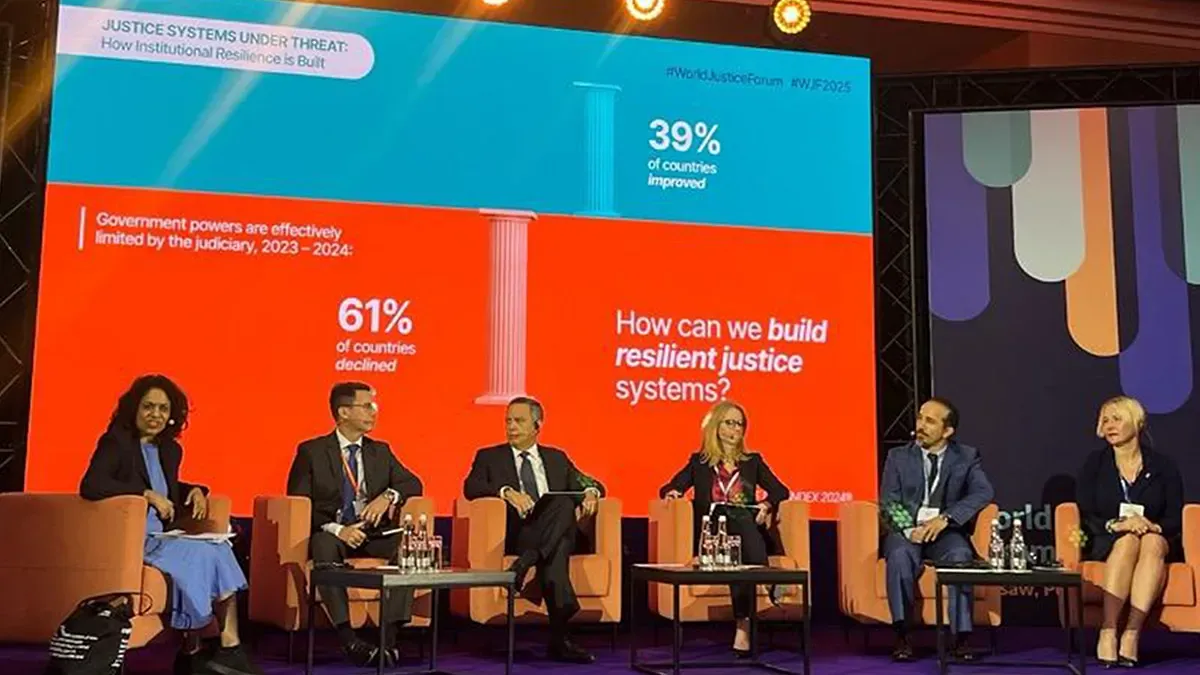
The 2025 World Justice Forum was built precisely upon this latest global assessment, which revealed that most countries are facing predicaments such as the expansion of executive power, the erosion of human rights protections, and judicial systems failing to meet the needs of the people. The latest assessment results indicate that as many as 57% of countries have regressed in their performance regarding "Constraints on Government Powers," and globally, 61% of countries have seen a decline in the independence of judicial organs and their capacity to check the government.
Looking across a broader timeline from 2016 to 2024, this proportion reaches as high as 66%. The data demonstrates that judicial independence and checks and balances are being eroded on a global scale, deserving the utmost attention and vigilance from all sectors.
The Judicial Battleground: Three Pathways to Rebuild Global Rule of Law Resilience
Independent judicial organs can not only effectively check government power but also safeguard citizens' rights and ensure the fair implementation of the law.
Internal judicial functional agencies within the government (including prosecutors general and judicial departments) likewise play an indispensable role in ensuring that administrative decision-making complies with the principles of the rule of law.
However, a major trend in the global rule of law regression is that the judicial system has become the primary target of attacks and weakening. Whether through personal attacks against individual judges, the questioning of public trust in the judiciary as a whole, or the undermining of court functions through institutional design, these seemingly fragmentary measures may be underpinned by the planned mobilization of political departments or specific political parties. Their objective is to erode the core standing of the judiciary as a checking organ, allowing power to be concentrated in individual will and free from external oversight and review.
Once judicial review mechanisms are compromised, the principles of separation of powers, transparent operations, and political accountability upon which the rule of law system relies will likewise begin to fray. So, what are the solutions to reverse this regression and rebuild rule of law resilience? There is no one-size-fits-all formula for this question, but through exchanges and dialogues at the forum, experiences from various countries have synthesized three key directions:
1. External Assistance: Intervention and Checks by International Organizations
When a country encounters a crisis of rule of law regression, global intergovernmental international organizations such as the United Nations and regional organizations such as the European Union can serve as external support that exerts external oversight and checks.
Taking Poland as an example, during the tenure of the Law and Justice (PiS) party from 2015 to 2023, it promoted a series of judicial reforms. While ostensibly aimed at de-communization and improving efficiency, these reforms actually resulted in the high degree of politicization of judicial power. This included the unconstitutional appointment of Constitutional Tribunal judges, the refusal to publish court judgments, the strengthening of the Minister of Justice's control over the prosecutorial system and the appointment of judges, and amendments allowing parliament to dominate the selection of members of the National Council of the Judiciary, thereby undermining the checking function of the judicial system.
Consequently, the European Commission for Democracy through Law (Venice Commission) repeatedly pointed out that Poland's reform measures posed a substantive threat to the rule of law. The European Commission also froze COVID-19 recovery funds originally allocated to Poland and even filed a lawsuit with the Court of Justice of the European Union, imposing a hefty fine of 1 million euros (approximately NT$34.9 million) per day for defying its rulings.
Today, Poland's new government has pledged to promote judicial reforms, including restoring the independence of the National Council of the Judiciary, abolishing the politicized disciplinary chamber, and readjusting personnel arrangements in the Constitutional Tribunal.
2. Internal Resilience: Self-Defense of Judicial and Electoral Systems
A country's electoral system and judicial system are the vital conditions that enable it to maintain self-defense, self-protection, and self-repair. The vitality and stability of the judicial system rely on the participation and voice of every legal practitioner.
Dorota Zabłudowska of The Judges' Association of Poland (Themis) emphasized, "Our goal and responsibility, as judges and lawyers, is to ensure that every Jane and Joe in our countries understands that every court is their court. It is not the politicians’ court — it is theirs."
3. Organizations and Actors in Civil Society
A World Bank forum representative pointed out, "We need to understand that justice is not the only responsibility of ministries of Justice and the judiciary. There are many organizations and many actors in society who are responsible and have a calling to actually produce justice in society, fairness and rural freedom."
Precisely for this reason, sustaining an open and vibrant civil society that allows diverse individuals to gradually construct mutually understood and empathetic value frameworks through communication and dialogue is an indispensable foundational condition for maintaining the cohesive operation of a democratic community.
Looking Back at Taiwan's Rule of Law from an International Perspective
Throughout the four-day forum—whether in closed-door sessions or hallway conversations—representatives from various parties expressed curiosity and goodwill toward Taiwan and the JRF, voiced concern over Taiwan's vulnerability to geopolitical conflicts, and even praised Taiwan for maintaining an open atmosphere of democracy and freedom amidst such power struggles and struggles.
When the assembly played the JRF's award-winning video, the three-minute short film condensed how the JRF, during the Sunflower Movement over the past decade, called upon lawyers to provide pro bono legal assistance, supported protesters facing court proceedings, and promoted the Supreme Court's explicit recognition of the right of resistance and civil disobedience as institutional guarantees for freedom of assembly and procession. In that moment, the thunderous applause served as the world's affirmation of Taiwan's democracy and rule of law.
However, since 2024, Taiwan's judicial system has been facing unprecedented challenges: from the Constitutional Court being deadlocked since October 2024, to trial judges in individual cases being subjected to public hate speech attacks, demonstrating that Taiwan's judiciary is similarly bearing the impact of rule-of-law regression amidst the increasingly acute antagonism between the legislative and judicial branches and sharpening political conflicts between the ruling and opposition parties.
Given that Taiwan struggles to formally acquire statehood internationally, making it difficult to apply for membership in most international organizations—let alone expect assistance from external forces such as the European Union—its predicament is clear.
Fortunately, however, Taiwanese society still maintains an open democratic atmosphere and has established substantive connections with like-minded international allies. Vibrant social movements and freedom of the press also provide internal support for the system. Therefore, even amidst an era of value conflicts, polarization of stances, and communication fractures, as long as citizens retain the agency to stand up and speak out and the system continues to permit collective action, this society has not lost hope.
Finally, returning to the forum venue in Warsaw, Poland, as International IDEA Secretary-General Kevin Casas-Zamora stated, "The most basic test that a liberal democracy should pass is being able to defend itself."
This article hopes that by bringing the observations and reflections from the 2025 World Justice Forum back to Taiwan to share with colleagues and partners, we can continue to contemplate: as a legal practitioner, a member of a judicial human rights organization, or even a citizen of Taiwanese society—what more can we do for ourselves?
※ This article was published on August 13, 2025, by Crossing
This article is an AI-generated translation of the original Chinese text. In the event of any discrepancy, the Chinese version shall prevail.