
JRF Newsletter
July Newsletter | Fleeing to the Last Room: How is Freedom Possible?
Last edited: 2026-08-23
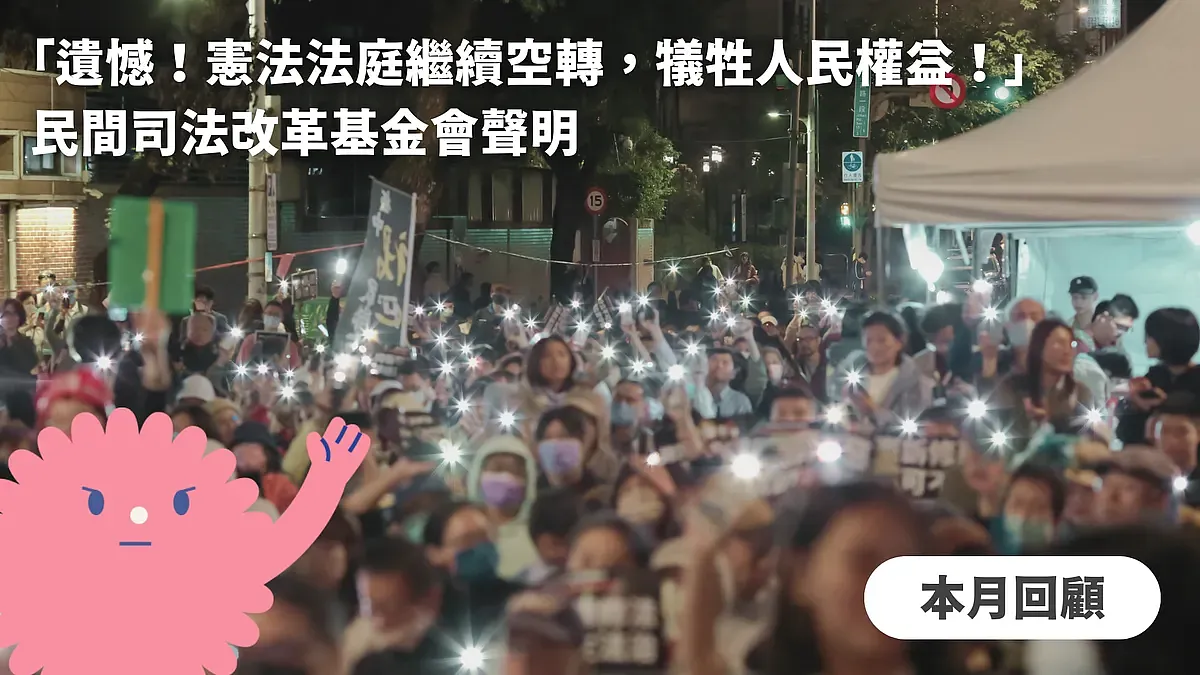
On July 25, the Legislative Yuan held a vote on the consent appointments for Grand Justices. All 7 nominees—Tsai Chiu-ming (nominated as President of the Judicial Yuan), Su Su-e (nominated as Vice President of the Judicial Yuan), Chan Chen-jung, Lin Li-ying, Hsiao Wen-sheng, Chen Tzu-yang, and Cheng Chun-hui—failed to secure the approval of a majority of all legislators. In response, our Foundation issues the following statement:
▌I. The Constitutional Court Remains Paralyzed, Unable to Protect People's Rights and Interests
On January 25 of this year (2025), the amended provisions of the Constitutional Court Procedure Act officially came into effect, requiring the Constitutional Court to have 10 Grand Justices in order to conduct substantive deliberations. However, since October 31 of last year (2024), 7 Grand Justices have completed their terms. To this day, their successors have not been approved and appointed by the Legislative Yuan. This has left the Constitutional Court unable to conduct substantive adjudications in accordance with the revised Constitutional Court Procedure Act, effectively paralyzing it for 179 days.
The ongoing inability of the Constitutional Court to conduct substantive adjudications has undermined citizens' rights to petition the court for constitutional interpretation when laws are suspected of being unconstitutional. Taking Case No. 384 of the 2023 Judicial Yuan Constitutional Court jurisprudence as an example, the petitioner was a victim of sexual violence during their minority. Because the statute of limitations for prosecution had expired, preventing any further prosecution, the petitioner filed a petition for constitutional interpretation regarding the question: "Is the statute of limitations for sexual offenses against minor victims too short?" Yet, since the Constitutional Court accepted the case last year, it has remained stalled to this day. How much longer must one wait before a case is scheduled for review?
▌II. The People Need a President of the Judicial Yuan Capable of Leading Judicial Reform and a Constitution Court That Operates Efficiently
The grim reality that not a single Grand Justice nominee passed this time has already become an established fact. Looking to the future, however, for judicial reform groups, we need a President of the Judicial Yuan who can lead judicial reform and a Constitutional Court that can operate efficiently. We must still solemnly urge that the next round of presidential nominations, as well as the Legislative Yuan's review and voting processes, must be approached from the perspective of the people.
Our Foundation calls upon the authorities: while the prompt and smooth operation of the Constitutional Court is deeply anticipated by the public, it does not mean that merely rushing to fill the vacant Grand Justice positions so the court can function is enough. More importantly, the President's third round of nominees must resonate with the public's expectations for judicial reform. Legislators from both the ruling and opposition parties should also use "whether the nominees are fit for the position" as the sole standard when exercising their consent power in the future, in order to garner the greatest level of social support.
Finally, the public's expectations for judicial reform transcend partisan politics. When the judicial branch cannot function normally, all citizens become victims. We sincerely hope that judicial reform can be fully realized, and we hereby appeal that political infighting among political parties should not obstruct the protection of citizens' litigation rights and the advancement of judicial reform.

This year marks the 30th anniversary of the founding of the Judicial Reform Foundation (JRF). To look back at past human rights transformations and look forward to future judicial reforms, we specially organized the exhibition "Becoming an Ordinary Person: The 30th Anniversary Special Exhibition of the Judicial Reform Foundation" at the February 28 National Memorial Hall. The exhibition area introduces thirty years of Taiwan's judicial reform history, including the evolution of the rule of law through the Legal Aid Act, the Code of Criminal Procedure, the Constitutional Court Procedure Act, and the Judges Act. Through vintage photographs, old archives, past judicial reform magazines, and interviews with judicial reform pioneers, the exhibition reviews Taiwan's historical milestones—such as rescuing victims of major wrongful death penalty cases, tracking down corrupt prosecutors, and monitoring Grand Justice nominees—while also incorporating judicial reform issues of recent concern.
"I hope one day the judiciary can become our promise—promising a fair trial." — "Song of Judicial Reform," Lyrics by Sue Wang, Composition by Summer Lei
On the day of the opening press conference, we invited partners from various fields who have cared about and promoted judicial reform over the years to join the celebration, share their journeys and heartfelt thoughts, and we were also honored to have Professor Lei Kuang-hsia, who composed the Song of Judicial Reform back then, perform live, once again bringing us the emotional resonance of that promise.
JRF Chairperson, Attorney Huang Hsu-tien, stated: "Sustaining thirty years is no easy feat. For the judiciary to move forward and progress, every citizen before the law needs to be able to safely be an ordinary person, without having to struggle just to be considered ordinary."
The exhibition venue, the February 28 National Memorial Hall, formerly served as the United States Information Service (USIS) building and carries profound historical significance. Lan Shih-bo, Executive Director of the 228 Memorial Foundation, pointed out: "We hope our next generation can share our historical memory and remember these efforts and achievements, which may seem taken for granted today, but were anything but ordinary."
Thirty years ago, the Taiwan Bar Association promoted the establishment of an independent, citizen-led judicial reform organization. Thirty years later, Attorney Hsu Chien-hung, Convenor of the Supervisory Committee of the Taiwan Bar Association, also attended and delivered remarks on behalf of the association: "The JRF has brought together many idealistic lawyers to fight together for institutional reform. In the future, the Taiwan Bar Association will continue to support judicial reform and walk alongside the JRF."
Former Legislator and former President of the Taiwan Bar Association, Attorney Yu Mei-nu, also came to show her support. She said: "Every era has different challenges. From monitoring unfit judicial officers, to proposing drafts to alleviate the burden on judicial officers, to establishing a dedicated gender judicial reform group and focusing on gender equality in the judiciary, the JRF has played different roles across various eras, constantly striving to ensure that everyone can become an ordinary person."
Attorney Lin Yung-sung, Standing Director of the JRF, expressed emotionally: "Over the past thirty years, judicial officers' attitudes, the cross-examination system, and legal aid have all improved; yet, there are still many uncompleted reforms. Thank you to all the partners who have supported us along this journey, and I hope Taiwan's judiciary continues to transform."
Over the course of 30 years, the JRF has mobilized the collective power of the people from the bottom up, turning an abnormal judicial landscape of the past into today's normal reality, while monitoring whether the rights that the majority now take for granted are also universally protected for vulnerable groups.
Though tasks remain unfinished, our steps never cease. We continue to make our promise and walk toward the future.


Author: Chang I-hung / Volunteer at JRF Taichung Office
Step into the 30th-anniversary exhibition space of the JRF, and you will see a corded telephone sitting quietly in a corner. Picking up the receiver, you can listen to a compilation of slogans from numerous recent press conferences; you can also hear the Song of Judicial Reform telling tales of an era prior to judicial reform—an era of torture and unequal status between prosecutors and defense attorneys. Today, if you visit the attorney-client meeting room in a correctional facility, you will see a corded telephone placed in front of a transparent partition just like that, but now, when defendants and lawyers discuss their cases, they are no longer wiretapped. A single telephone handset carries multiple layers of meaning.
Beginning in March of this year, I started serving as an exhibition tour guide volunteer at the JRF Taichung Office, and I also participated in three reading groups held in April focusing on old judicial reform magazines. In the process of engaging with these past stories of judicial reform, what left the deepest impression on me was the historical trajectory of Taiwan transitioning from an authoritarian judiciary to a human rights judiciary—through the amendment of the Code of Criminal Procedure, down to constitutional interpretations establishing the protection of defendants' litigation rights, step by step building up defendants' human rights.
The exhibition area for major judicial reform milestones is placed directly in front of the telephone. Below are some of the key milestones in the history of judicial reform that I believe are most worth understanding:
▌I. The 2003 Amendment to the Code of Criminal Procedure
Prior to 2003, Taiwan's criminal procedure adopted an "inquisitorial system." During the investigative stage, prosecutors were not bound by statements made by the parties; defendants struggled to provide testimony favorable to themselves and lacked an equal footing with the prosecution. During court trials, judges were authorized to proactively investigate evidence. Amid a blurring of responsibilities between adjudication and prosecution, it was common to see judges and prosecutors teaming up to attack the defendant. Furthermore, as judges functioned as part of the prosecutorial machinery, the impartiality of their rulings was subject to severe doubt.
Following the amendments, criminal procedure shifted toward an "adversarial system." During the investigation phase, the prosecution and defense each gathered evidence favorable to their respective sides, and in court, they led the trial process through "cross-examination." Since then, defendants and prosecutors have finally stood on equal ground. As a rule, judges no longer participate in investigating evidence, doing so exceptionally only when necessitated by considerations of fairness, justice, and the discovery of the truth.
In addition, the amendments established "rules of evidence." Since then, testimonial evidence provided by the prosecution has been scrutinized more rigorously, and evidence gathered in violation of procedural rules has been excluded—for instance, testimonies extracted through coercion are no longer admissible after the amendment. In hindsight, the quality of evidence in cases adjudicated after the establishment of rules of evidence has indeed improved significantly.
However, the 2003 amendments also left unfinished business: namely, they failed to reform toward Japan's principle of "single-copy indictment", retaining instead the system of dossier and evidence transmittal. Dossier and evidence transmittal refers to the practice where prosecutors submit the case files (records) and physical evidence to the court all at once upon the conclusion of investigation. This weakens the prosecutor's responsibility to debate with the defense in a timely manner upon submitting evidence. At the same time, because judges review the files beforehand prior to the court session, they are prone to preconceived notions, making impartial adjudication exceedingly difficult.
An even worse scenario arises when dealing with an inattentive judge who fails to review the case files to understand the facts before the hearing: the trial is reduced to mere formality, the case contents fail to receive substantive review, and ultimately, when writing the judgment, the judge often has to heavily rely on the prosecutor's written indictment.
▌II. Judicial Yuan Interpretation No. 582 of 2004: Confessions Can No Longer Serve as the Sole Evidence
In several wrongful death penalty cases in Taiwan, judges' verdicts were frequently observed to place excessive weight on confessions. However, some confessions were extracted through torture, and in the case of Hsu Tzu-chiang, the critical evidence was not even a confession by the defendant himself.
In 1995, Huang Chun-chi, a defendant in the murder of Huang Chun-shu, falsely claimed that Hsu Tzu-chiang was an accomplice in order to delay his own execution. Subsequently, based on testimonies from a "co-defendant" obtained entirely through torture without any supporting evidence, Hsuch was successively sentenced to death by courts 8 times, alongside two life sentences.
In 2004, the Council of Grand Justices promulgated Interpretation No. 582. One of its key focal points was: "Statements made by a co-defendant that are unfavorable to themselves may not be adopted as evidence of another co-defendant's crime (factual determination)." The Grand Justices reasoned that even in the case of a co-defendant, criminal facts remain independent, and statements made by co-defendants should still be treated as witness testimony, subjected to the statutory verification of oral evidence, with the defense holding the litigation right to cross-examine the witness. Taking the Hsu Tzu-chiang case as an example, the co-defendant committed perjury to delay his execution; his testimony was never verified, yet it was granted the same status as a defendant's confession—constituting one of the major flaws in that case.
The second key point: "A defendant's confession may not be used as the sole evidence for a guilty verdict." In the book Decoding 'False Confessions' by Japanese psychologist Sumio Hamada, it describes how Mr. Toshikazu Sugaya, a party involved in the "Ashikaga Case", confessed to a crime out of despair despite the prosecution employing no coercion or inducement during investigation, simply because the emergence of crucial DNA evidence made his confession appear to satisfy the requirement of voluntariness. This demonstrates that when there is no other primary evidence to prove the offense or establish the truth of a confession, excessively lenient determinations of guilt indeed lead to miscarriages of justice.
Even cases devoid of harsh torture carry the potential for false testimony, let alone statements manufactured through physical abuse. Fortunately, Hsu Tzu-chiang was acquitted with a final judgment in 2015, ending 21 years of protracted litigation. To this day, no further wrongful death penalty cases have occurred in Taiwan.
▌III. Judicial Yuan Interpretation No. 654 of 2009: Litigation Rights Bid Farewell to the Shadow of Wiretapping
Prior to democratization, freedoms guaranteed by the Constitution were not institutionally protected. Although society gradually opened up following democratization, the judiciary had not yet fully broken free from authoritarianism, and defendants' rights of defense remained incomplete.
In fact, as early as 2007, the Grand Justices had already issued an interpretation on the issue of wiretapping. Interpretation No. 631 declared that "prosecutors issuing telecommunication monitoring warrants" was unconstitutional. Prosecutors are responsible for criminal investigation; if they are simultaneously endowed with the power to approve wiretaps, it creates a conflict of interest akin to a player acting as the referee. However, acknowledging that wiretaps remain necessary in investigative practice, the authorization for wiretapping was entrusted to judges who exercise their powers independently.
Yet inside detention centers at that time, conversations between defendants and their lawyers were still being wiretapped. This not only infringed upon the defendant's freedom of secret communications, but also exerted a knock-on effect on their litigation rights. At the time, Attorney Yu Po-hsiang happened to be handling a case defending Mai An-huai, former director of the Taipei County Magistrate's office. Attorney Yu encountered the wiretapping issue during an attorney-client meeting, which inspired him to apply for a constitutional interpretation, paving the way for the subsequent Interpretation No. 654.
The interpretation text stated that Article 23, Paragraph 3 of the Detention Act, which justified monitoring for the purpose of "achieving the objectives of detention" or "maintaining detention center order," violated the principle of proportionality and should be abolished. Furthermore, Article 28 of the Detention Act, which stipulated that wiretapped contents of conversations between defendants and lawyers could be used as criminal evidence in court, obstructed the exercise of the defendant's right of defense and should likewise be abolished. Since then, defendants have finally been able to discuss their cases with their attorneys with peace of mind, and litigation rights officially bid farewell to the shadow of state-apparatus wiretapping.
▌Conclusion
The historical depth of the past 30 years tells us that judicial reform cannot be achieved overnight, and setbacks do occur. However, we have indeed slowly built a human rights-based judicial system out of the authoritarian judiciary of the martial law era. Looking back at this historical context, today's judiciary is more trustworthy than it was in the past, but we all know that the path in pursuit of human rights has no end.
🔎 References:
JRF Magazine Issue 20: On the Adoption of the Adversarial System in Criminal Procedure
JRF Magazine Issue 21: What is "Non-Transmittal of Indictments and Dossiers"?
This article is an AI-generated translation of the original Chinese text. In the event of any discrepancy, the Chinese version shall prevail.
